
On the Protection of Zion
A refuge from the storm, a standard for the nations, and the duty of a free people to prepare
Voices Crying from the Mountains
For nearly two centuries, seers of many traditions have looked toward the American West and seen the same thing: a refuge when the storm breaks.
You will see the Constitution of the United States almost destroyed, it will hang by a thread, and that thread as fine as the finest of silk fiber… the White Horse [LDS people] and the Red Horse [Native Americans] who will combine in its defense. The White Horse will raise an Ensign on the tops of the mountains of peace and safety, where all nations may flee unto for safety… A terrible revolution will take place in the land of America, such as has never been seen before; for the land will be left without a supreme government and every species of wickedness will run rampant. It will be so terrible that father will be against son and son against father; mother against daughter and daughter against mother. The most terrible scenes of murder and bloodshed and rapine that has ever been looked upon will take place. Peace will be taken from the earth and there will be no peace only in the Rocky Mountains. This will cause many hundreds and thousands of the honest in heart of the world to gather there
The “White Horse Prophecy,” attributed to Joseph Smith (c. 1843), from Edwin Rushton’s account · John Welch’s reproduction, B. H. Roberts Foundation
Bracketed words are editorial. The prophecy’s authenticity is disputed, and the Church of Jesus Christ of Latter-day Saints has said it is not official doctrine. It is shared here for its place in Rocky Mountain tradition.
There is a land beyond the Rocky Mountains that will be invaded by the Heathen Chinese, unless great care and protection is given.
White Horse Prophecy, same account · B. H. Roberts Foundation
15Swiftly came entropy upon France, likewise upon Russia; so too upon China— the servant sat upon the horse and the princes walked on foot, the thing which I hate in mine heart, saith the LORD. Though swiftly it came upon them, slowly shall it come upon you. As a creeping fog in the night shall it come, and ye shall not be delivered after three generations[64a] except by division…
19Howl ye for the fine buildings; they shall come down slowly at their own hand, and with a yawn shall she depart from among nations, from being Queen of nations; for I have heard the cry of the black man and the red man wherewith they have cried unto me.
20So shall I do unto that mighty people… 21Woe unto that nation, for they kill and eat their children to sustain their old age. Their babies have no graves, but their cry cometh up unto me.
22As they bled their womb, so shall I bleed their heritage, and unto a mightier people [red horse & white horse] will I give their land.
The Book of Ben Kathryn 65:15; 64:19–22 · Prophecy in the Book of Ben Kathryn
Bracketed words are editorial.
When we talk of energies and power centres you must also consider the timespan of human evolution. Although you may find this hard to accept, America’s moment of destiny, her time of greatness, has not yet come, for even though she is a major power in the World America is still very young. Above all, she is young spiritually. Nevertheless, the Western part of America is destined to be the Eden of the New Age when it dawns…
The Ramala Teachers, The Wisdom of Ramala · The Ramala Centre, Glastonbury
Then the area where the entity is now located [Virginia Beach] will be among the safety lands, as will be portions of what is now Ohio, Indiana and Illinois, and much of the southern portion of Canada and the eastern portion of Canada; while the western land—much of that is to be disturbed—in this land—as, of course, much in other lands.
Edgar Cayce, Reading 1152-11 (August 13, 1941) · text as quoted at Hutton Commentaries
To be fair to the record: Cayce’s best-known “safety lands” are in the Midwest, Canada and Virginia Beach. His readings don’t name the Rocky Mountains or the intermountain West as a safe area, and this one warns that much of “the western land” will be disturbed.
Zion’s Boundaries
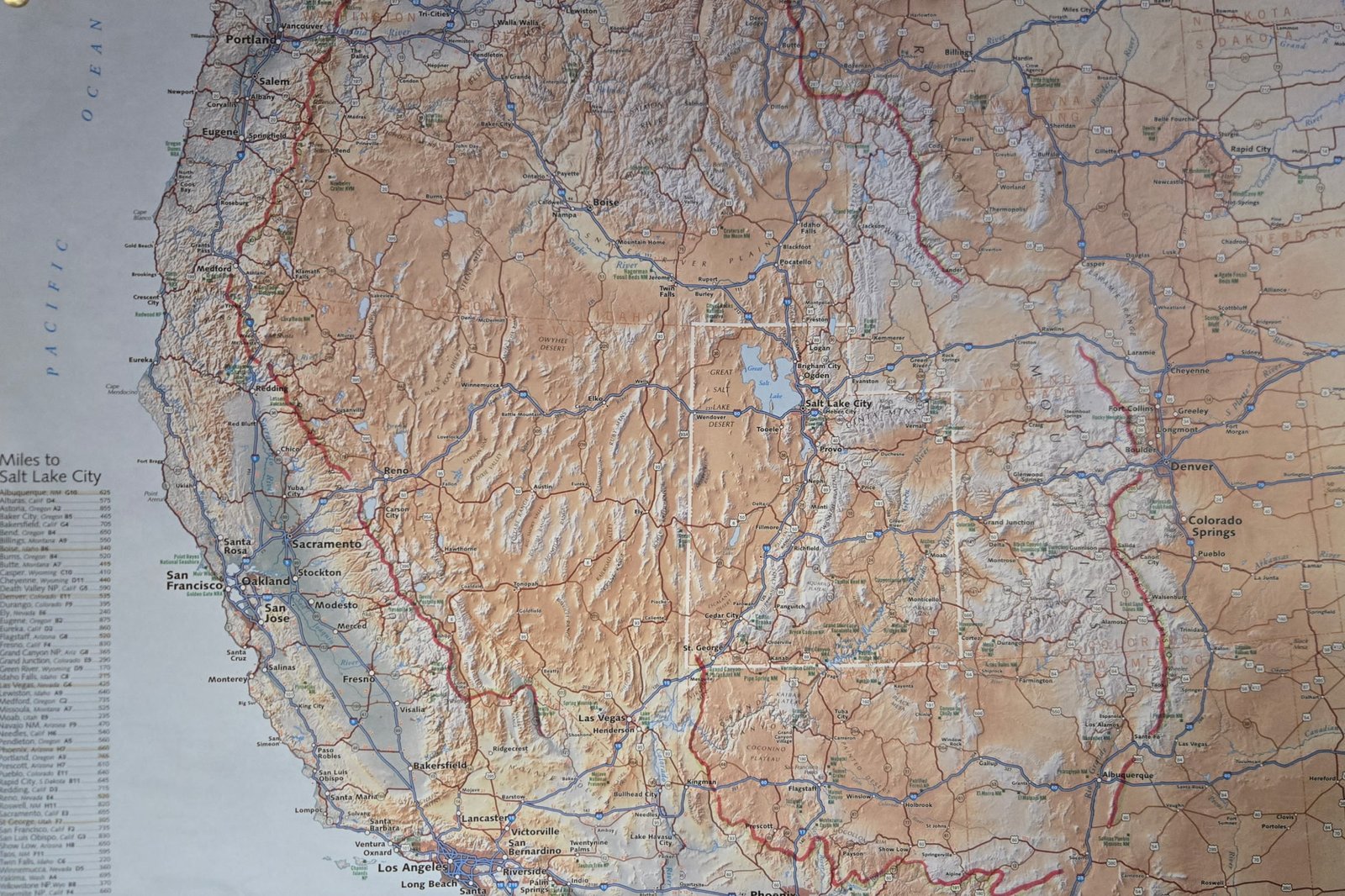
The interactive map below traces the natural ramparts of the West, the great watershed divides of the Sierra, the Cascades and the Rockies, and marks every highway that crosses them.
Open the Zion’s Boundaries map full screen →
Look closely and the geography preaches its own sermon. The boundary follows the ridgelines where water parts ways, west to the Pacific and east to the Mississippi. Inside lies the Great Basin, the Columbia Plateau, the Snake River Plain, the Colorado Plateau and the Wasatch, a land of high passes and long distances. Only a limited number of highways cross that line. Every one of them is a door. A door can welcome the refugee, and it can be closed to the destroyer.
The Zion Protection Corps
Mission Statement
Inasmuch as many mystics, visionaries and prophets of the many religious persuasions have foreseen coming turmoil for the United States of America and the importance of its western geography as a defense and boundary to protect its Constitution, freedom and democracy.
And inasmuch as providence has seen fit to bring a people there with a love and passion for God, Country, Freedom and the fighting spirit—the Protection Corps takes upon itself the duty to plan for any and all possibility of attack on the Constitution and democracy of the United States, especially from external threat.
The Corps is a planning and preparedness fellowship, not a private army. Its work is the work of Captain Moroni before the battle: fortifying hearts and storehouses, knowing the land, organizing families and congregations, building communications, and standing ready to support lawful authority, meaning our governors, our state National Guard and state defense forces, our sheriffs and our emergency managers, whenever they call. We defend the Constitution by keeping it ourselves.
The Mountains Hold
A hypothetical scenario: how the storm might come, and how a prepared people might weather it.
A Work of Fiction
In this invented story, a secret circle inside the federal government, an unelected network calling itself “the Concord,” uses a staged nationwide cyberattack to suspend Congress and seize emergency power. It opens America’s Pacific and Gulf ports to “humanitarian partners” from Iran, China, Russia and a South American junta, who turn out to be an invading army. The coasts fall in the dark. But the governors of the Mountain West refuse the decree, keep their Guard under lawful command, and on a clear-channel AM station an old night announcer reads their letter and adds two words of his own: “Come home.” Hundreds of thousands of refugees stream over the passes and are welcomed, vetted and put to work. The tribal nations of the Four Corners stand with the Constitution. A network of ham radio operators carries the truth to the world. The invading columns stall in the snow on a land that will not feed them, and Congress reconvenes in the mountains. The Constitution hangs by a thread, and the thread holds.
Read the full narration script
FICTION. Every character, organization, broadcast and event is invented. No real person, party or office-holder is portrayed. Narrator lines are plain text and scene cues are in [brackets], ready for video production.
00:00 Cold open
[Black screen. The sound of AM radio static, a dial turning slowly. Then: a satellite view of the continental United States at night, every city lit.]
This is the United States tonight. Look at it carefully.
Because in the story you are about to hear, an invented one, not a prophecy, not a forecast, the lights on this map have two hundred and ten days before they go out across half the country.
[The map slowly darkens from the coasts inward. Only the spine of the Rocky Mountains stays lit.]
By the end, a constitution will have hung by a single thread. A foreign army will stand on American soil for the first time in two centuries. And a band of mountains, two thousand miles long, will become the last fortress of a free republic.
And all of it turns on two words, spoken into an old radio microphone in Salt Lake City, by a man who had never given an order in his life.
[Close on a vintage broadcast microphone. A red ON AIR light flickers to life.]
"Come home."
00:55 Day one
[A modest kitchen in Reno, Nevada. Early morning light. A coffee maker. A phone on the counter.]
Day one. A Tuesday in late October.
At six-forty in the morning, Rosa Delgado, a freight dispatcher for a trucking company in Reno, is reading load sheets at her kitchen table when every screen in the house goes black at once.
Not the power. The power is still on. The refrigerator still hums.
It's the network. Phone, internet, card readers, the traffic lights on Virginia Street. All of it, at once.
[Montage: frozen gas pump screens; a grocery checkout lane stalled; an airport departure board showing only dashes.]
Across the country, the same thing is happening. Banks freeze. Fuel pipelines shut their valves as a safety precaution. Hospital records vanish behind ransom screens.
The official word, when it finally comes over the radio at noon, is "a coordinated cyberattack by unknown actors."
The truth, which almost no one knows yet, is that the attack did not come from outside.
02:10 The Concord
[Slow push through a dim, wood-paneled conference room. Faces in shadow. A seal on the wall, deliberately blurred.]
For years, inside the vast machinery of government, a small circle of officials had been building something. Not a party. Not a movement anyone voted for. A network.
Unelected administrators. A handful of compromised office-holders. Contractors with keys to systems the public never sees. They called themselves, privately, the Concord.
Their belief was simple, and it was poison: that the American people could no longer be trusted to govern themselves, and that the Constitution was an obstacle to be managed.
[An encrypted message scrolls across a screen in an unfamiliar script, then translates.]
And they had found partners abroad who wanted the same thing for different reasons. Planners in Tehran. In Beijing. In Moscow. And a military junta that had seized power in a South American capital two years before, with cartel money behind it.
The partners would provide the force. The Concord would provide the door.
03:20 Day three: the decree
[A podium in a government briefing room. A spokesperson, face never shown, reading from a binder.]
Day three. With the country dark and frightened, the Concord moves.
Citing the cyberattack, a "Continuity of Order Directive" is read on every broadcast frequency still operating. Congress is "temporarily suspended for its own safety." Elections are "postponed." State governors are ordered to place their National Guard units under a new federal emergency command.
[Newspaper front pages, printed on emergency presses: "ORDER DIRECTIVE IN EFFECT."]
Most people don't understand what they're hearing. Most people are standing in line for water.
But in a small house in Cedar City, Utah, an eighty-two-year-old retired surveyor named Hal Whitaker, Rosa's grandfather, turns off the radio, walks out to his garage, and switches on a machine he hasn't used in four years.
[Close on a ham radio transceiver's dial lighting up amber. A hand-lettered call sign taped to the shelf.]
A shortwave radio. And a stack of paper logbooks.
"If they're lying on the big stations," he says to nobody, "somebody out there is telling the truth on the little ones."
04:30 Day five: the ships
[The Port of Long Beach at dawn. Giant container cranes, motionless. Then: unfamiliar gray vessels on the horizon.]
Day five.
Under the Directive, the Concord announces that "international humanitarian partners" will assist with relief on the West Coast and the Gulf Coast.
The first ships arrive at Long Beach and Oakland flying flags of convenience. The cargo manifests say "relief supplies."
[A container door swings open. Darkness inside. Silence.]
They are not relief supplies.
Within seventy-two hours, foreign troops are moving through the ports of California and the Gulf, escorted by federal vehicles, waved through by officials who had sworn an oath to the Constitution and broken it.
It is the scenario Americans watched in movie theaters for forty years and always laughed at. Because it could never happen.
It is happening.
05:40 Day six: the governors
[Split screen: state capitol domes. Boise. Salt Lake City. Helena. Cheyenne. Denver. Carson City. Santa Fe. Phoenix.]
Day six. And here is the first crack in the Concord's plan.
They had assumed the governors would comply. Most of the country was too dark and too scared to resist.
But in the Mountain West, one by one, the governors refuse.
Not with speeches. With a joint letter, eleven lines long, signed in a hotel conference room in Salt Lake City by every governor between the Sierra and the Great Plains who could physically get there.
[An old typewriter. A page being typed. The words appear on screen.]
It says, in part: "We do not recognize any order that suspends the Congress of the United States. Our Guard remains under lawful state command. Our oath is to the Constitution, and the Constitution has not been suspended."
The letter cannot be published. The networks are down.
So they read it on the radio.
06:30 Two words
[A broadcast studio, 1970s wood paneling, still in use. A night-shift announcer, late fifties, cardigan, reading glasses.]
The station is a fifty-thousand-watt AM signal, one of the old clear-channel giants built so that, at night, a single voice can be heard across the entire West. Its emergency generators have been tested every month for sixty years. Tonight, they carry the whole region.
The night announcer is a man named Gordon Pratt. He reads farm reports and high school football scores. He has never given an order in his life.
He reads the governors' letter, all eleven lines. Then the governors' staff hand him a second page: instructions for anyone on the coasts trying to reach safety. Which highways are open. Where the reception centers are. What to bring.
He reads the whole page. Then he looks up from the paper, takes off his glasses, and says something that isn't written there.
[Close on his face. Quiet.]
"If you're out there, and you're frightened, and you don't know where to go… come home."
[Map: the radio signal spreads like ripples across the night map of the West, out over the Pacific, down into Mexico, up into Canada.]
Two words. He meant them as comfort.
Within an hour, ham operators have relayed them across the continent. Within a day, they are painted on overpasses. Within a week, they are the name of a movement.
07:40 Day nine: the exodus
[Aerial: Interstate 80 climbing toward Donner Summit. Headlights in both lanes, all heading east, stretching back to the horizon.]
Day nine.
From Sacramento, from the Bay Area, from Portland and Seattle and Los Angeles, the honest in heart begin to move.
Not soldiers. Families. Nurses. Machinists. Grandmothers with photo albums in pillowcases. People with bundles under their arms.
[A minivan with a mattress tied to the roof. A child asleep against the window.]
On I-80 over Donner. On I-84 up the Columbia Gorge. On I-90 over Snoqualmie. On I-15 through Cajon Pass. Every mountain highway in the West becomes a river of headlights flowing toward the high country.
In Reno, Rosa Delgado's trucking company becomes something else overnight. Her dispatch board, which used to track freight, now tracks buses, water tankers, and church vans. Her job, as she puts it, is "getting everyone who comes over that mountain a cot, a meal, and a name tag by midnight."
[Rosa at a whiteboard covered in route numbers, a radio handset in one hand.]
Reception centers open in high school gyms, stake centers, county fairgrounds, and convention halls. Congregations of every faith set up kitchens side by side. Volunteers write down every name, every skill, every medical need.
And quietly, patiently, sheriffs' deputies and Guard liaisons review the lines. Because not everyone coming over the mountain is a refugee.
09:00 The vetting
[A folding table in a gymnasium. A sign: "WELCOME. REGISTRATION HERE." A volunteer with a clipboard, a deputy standing nearby.]
This is the hardest work of the whole war, and it is done with clipboards.
Every arrival is welcomed. Every arrival is fed. And every arrival is asked the same simple questions. Who are you? Where are you from? Who here can vouch for you?
Families are sponsored by congregations. Doctors are matched with clinics. A welder from Oakland is driving a supply truck within forty-eight hours.
[Quick cuts: a nurse receiving a hospital badge; a teenage boy learning to operate a radio; an elderly couple handed keys to a spare room by a local family.]
And among the hundreds of thousands, a few hundred people whose stories don't hold together are quietly referred to the authorities, questioned under law, and, where the evidence warrants, held.
Not by mobs. Not by vigilantes. By sworn officers, in daylight, with records.
That is the difference, the governors keep saying, between those defending the Constitution and those who suspended it.
10:00 Day fourteen: the stall
[Map animation: red arrows pushing inland from the coastal ports along the interstates, then slowing, then stopping at the mountain passes.]
Day fourteen. The invasion turns inland.
The foreign columns, guided by Concord officials, push east along the great highways, toward the mountains. They expect the high country to fall the way the coastal cities did: quickly, quietly, in the dark.
It doesn't.
[Snow begins falling on a mountain pass. A highway sign half-covered: "CHAIN CONTROL AHEAD."]
Because the mountains have always been their own kind of wall. Narrow canyons. High passes. Hundreds of miles of empty desert between towns. And now, the first storms of winter.
And because the people in those mountains will not cooperate.
No fuel is sold. No food is sold. No local official signs anything. Every county sheriff, every town council, every ranch family, every hospital, refuses, politely and completely.
The Guard, under lawful state command, holds the passes as a wall of law, not of rage. Checkpoints. Supply depots. Field hospitals. Radio relays on every ridge.
[A line of Guard trucks parked at a mountain summit. Steam rising from a field kitchen. A chaplain handing out coffee.]
The columns halt. Then they wait. Then they begin to run out of things.
An army can cross an ocean. It cannot live on a land that will not feed it.
11:10 The Red Horse
[Monument Valley at sunrise. Wind across red sand. A tribal police vehicle on a long empty road.]
Far to the south, on the Navajo Nation, a tribal police lieutenant named Daniel Begay receives a radio call from Hal Whitaker in Cedar City. They have talked on the air for twenty years about weather, and fishing, and nothing at all.
Tonight Hal is asking for help.
The southern approaches, the long desert roads out of Arizona and New Mexico, run across tribal lands and open country that no outside army understands.
The tribal nations of the Four Corners, sovereign governments with their own laws, police and councils, meet in emergency session. And they make a decision that will be taught in schools for a century.
They stand with the Constitution.
[Two hands clasping: one weathered, one young. A tribal flag and an American flag side by side on a pole.]
An old prophecy, told around Rocky Mountain firesides for a hundred and fifty years, spoke of a White Horse and a Red Horse who would combine in the Constitution's defense.
Nobody in this story plans to fulfill a prophecy. They simply keep their word.
12:10 Day forty: the truth gets out
[Hal's garage at night. Three radios now. A dozen volunteers. Logbooks stacked to the ceiling.]
Day forty. The Concord's greatest weapon was never the foreign army. It was the dark. Control of every screen, every broadcast, every story.
But you cannot shut off the sky.
Hal's garage is now one of four hundred amateur radio stations across the West passing messages on a disciplined schedule: health-and-welfare traffic, refugee lists, and eyewitness reports, each one logged, timed and signed.
[A world map. Thin lines of light leap from the Rockies to Canada, Britain, Australia, Japan.]
Those reports reach the world. Photographs of foreign troops at American ports. The text of the Continuity Directive. The governors' letter. Testimony from federal employees who refused unlawful orders.
And inside the Concord, the cracks become fractures. Generals who were promised a "temporary stabilization" see foreign uniforms on American streets and understand what they have been used for.
One by one, regular military units begin announcing, by radio, that they answer to the Constitution, and to no one else.
13:00 Day ninety: the thread
[A grand old courthouse or tabernacle-style hall in the mountains. Snow on the steps. People filing in wearing heavy coats.]
Day ninety. In a cold hall in the Rocky Mountains, something happens that hasn't happened since 1774.
Members of Congress, the ones who escaped, the ones who walked, rode buses, and hitchhiked across a broken country, gather to reconvene the lawful government of the United States.
They don't have a quorum at first. They wait. Every few days, another member arrives, gaunt and road-worn, to applause.
[A close-up of a worn pocket Constitution, its spine cracked, held open in a trembling hand.]
On day ninety-eight, they reach a quorum. They declare the Continuity Directive void. They call for the arrest, under law, of every official who signed it.
For three months, the Constitution of the United States had hung by a thread, as fine as the finest silk fiber.
The thread held.
13:50 Day two hundred ten
[Spring. Snowmelt on a mountain stream. The highway over the pass now open, trucks heading west carrying food.]
It takes another four months. Cut off from supply, isolated diplomatically, facing a reunited military and a population that never stopped resisting, the foreign forces negotiate their withdrawal through neutral intermediaries.
The ships leave the ports they came through.
The members of the Concord who did not flee are tried in open civilian courts, with lawyers, with juries, with every protection they had tried to take from everyone else.
[Rosa's kitchen in Reno. A faded copy of the governors' letter framed on the wall. A handheld radio on the counter.]
Rosa Delgado still lives in Reno. Her dispatch board hangs in a museum now. Thirty-one thousand names, every one of them welcomed.
Hal Whitaker died the following winter, at his radio. His last logbook entry reads, simply: "All stations. Net closed. Thank you."
Gordon Pratt went back to reading farm reports. He never once took credit for two words.
14:40 Close
[Return to the satellite map. The lights come back on, city by city, coast to coast, starting from the mountains and spreading outward.]
That's the scenario. Invented, from the first dark screen to the last net.
Nobody knows how such a crisis would really unfold. We pray it never does.
But prophets and visionaries of many faiths have looked toward these mountains and seen a refuge from the storm. And the people who live here have always known that a refuge is not built in a day. It is built in years. With food in the pantry. Radios on the shelf. Neighbors who know each other's names. And an unshakable loyalty to the Constitution.
[The words fade in over the mountains: "…for a defense, and for a refuge from the storm." D&C 115:6]
Arise, and shine forth.
[Fade to black. The sound of AM static. Then silence.]
Go deeper: Aaron’s feature-length screenplay imagines this struggle on the big screen.
The Gates of the Mountains
Every highway that crosses Zion’s Boundaries, and the communities best placed to keep each gate.
The map shows every interstate and U.S. highway where it crosses the great divides. In any national emergency, whether earthquake, collapse, civil disorder or foreign attack, those crossings are where refugees will arrive, where supplies must flow, and where the public’s safety will be won or lost. Planning for them is civil defense and logistics: reception centers, supply depots, fuel and water, medical stations, radio relays, and lawful checkpoints run by the proper authorities.
For each corridor below, the lead hub is the nearest city with the population, hospitals, fuel, warehouses and transport to sustain operations. The support communities supply volunteers and forward facilities. The secondary roads are the lesser routes that local planners must not forget.
I-90 · Snoqualmie Pass
- Lead hub
- Spokane
- Support
- Ellensburg, Wenatchee, Moses Lake, Cle Elum
- Secondary roads
- US-97 (Blewett Pass), WA-410 (Chinook Pass, seasonal), WA-20 (North Cascades, seasonal)
- Priorities
- Reception centers at Ellensburg and Wenatchee; fuel and food depots on the I-90 corridor; hospitals in Spokane and Wenatchee
I-84 · Columbia River Gorge
- Lead hub
- Tri-Cities (Kennewick, Pasco, Richland)
- Support
- Yakima, The Dalles, Hermiston, Pendleton, Hood River
- Secondary roads
- WA-14 (north bank of the Columbia), US-197, OR-35, US-97 at Biggs Junction
- Priorities
- River, rail and barge logistics; reception at The Dalles and Hermiston; coordination of the Columbia bridges with state authorities
US-20 / US-97 · Central Oregon & Klamath
- Lead hub
- Bend / Redmond
- Support
- Klamath Falls, Burns, Lakeview, Alturas
- Secondary roads
- OR-58 (Willamette Pass), OR-126 (McKenzie Pass), OR-138, OR-62, CA-139
- Priorities
- Redmond airport as an air logistics node; Klamath Basin food supply
I-80 · Donner Summit
- Lead hub
- Reno / Sparks
- Support
- Truckee, Carson City, Fernley, Fallon
- Secondary roads
- CA-70 (Feather River Canyon / Beckwourth Pass), CA-89, CA-49, CA-20
- Priorities
- The largest reception operation in the West; the Reno-Sparks warehouse district as a supply base; Fallon and Fernley overflow; winter chain-control coordination
US-50 · Echo Summit
- Lead hub
- Carson City
- Support
- South Lake Tahoe, Minden / Gardnerville, Placerville-area volunteers
- Secondary roads
- CA-88, CA-4, CA-108 (Sonora Pass), CA-89 (Monitor Pass)
- Priorities
- Carson Valley reception and medical; the state capital as a coordination center
US-395 / CA-14 / CA-58 · Owens Valley & Mojave
- Lead hub
- Bishop (forward), Las Vegas (rear)
- Support
- Ridgecrest, Lone Pine, Mammoth Lakes, Barstow
- Secondary roads
- CA-178, CA-190, CA-120 (Tioga Pass, seasonal)
- Priorities
- Long empty stretches, so pre-positioned water and fuel matter most here
I-15 · Cajon Pass
- Lead hub
- Las Vegas
- Support
- Victorville / Hesperia, Barstow, Baker, Primm; St. George to the rear
- Secondary roads
- US-395 (Adelanto), CA-138, CA-18, I-40 west of Needles
- Priorities
- Enormous volume from Southern California; staged reception in Barstow and Las Vegas; water on the Mojave crossing
US-93 / US-95 / I-40 · Colorado River
- Lead hub
- Kingman
- Support
- Lake Havasu City, Bullhead City, Laughlin, Boulder City
- Secondary roads
- AZ-95, AZ-68, historic Route 66
- Priorities
- Coordination of the Colorado River bridges and Hoover Dam area with authorities; desert water supply
I-17 · Black Canyon & the Mogollon Rim
- Lead hub
- Flagstaff
- Support
- Prescott, Payson, Show Low, Camp Verde
- Secondary roads
- AZ-87 (Beeline), AZ-260, AZ-89A
- Priorities
- Reception for the Phoenix metro; Rim-country shelters; partnership with tribal governments
I-25 South · Elephant Butte
- Lead hub
- Albuquerque
- Support
- Socorro, Truth or Consequences, Belen
- Secondary roads
- NM-1, US-60 west to Magdalena
- Priorities
- Reception for El Paso and southern New Mexico; Rio Grande water and agriculture
I-40 Tijeras Canyon & I-25 Glorieta Pass
- Lead hub
- Albuquerque / Santa Fe
- Support
- Las Vegas (NM), Taos, Española, Moriarty
- Secondary roads
- NM-14 (Turquoise Trail), NM-333, US-64 over the Sangre de Cristos
- Priorities
- Kirtland-area hospitals and warehouses; Santa Fe as a seat of government
US-160 / US-50 / US-24 / US-285 · Southern Colorado
- Lead hub
- Colorado Springs / Pueblo
- Support
- Cañon City, Salida, Alamosa, Woodland Park
- Secondary roads
- CO-12, CO-69, CO-9, CO-67
- Priorities
- Large military and medical infrastructure; San Luis Valley farms
I-70 · Floyd Hill to Eisenhower Tunnel
- Lead hub
- Denver metro (Golden, Boulder, Lakewood)
- Support
- Fort Collins / Loveland, Idaho Springs; Grand Junction as the western supply base
- Secondary roads
- CO-119 (Peak to Peak), CO-72, CO-14 (Cameron Pass), Trail Ridge Road
- Priorities
- The densest population on the eastern wall; the tunnel and canyon corridors; KOA 850 AM in Denver for public alerts
I-80 · Sherman Hill & the Continental Divide
- Lead hub
- Cheyenne
- Support
- Laramie, Rawlins, Rock Springs
- Secondary roads
- WY-130 (Snowy Range), WY-230, US-287 north
- Priorities
- Rail and freight interchange; winter road closures; fuel from Wyoming refineries
I-25 Wyoming · Casper & the Big Horns
- Lead hub
- Casper
- Support
- Sheridan, Buffalo, Douglas, Worland, Cody
- Secondary roads
- US-14A, WY-789
- Priorities
- Energy production; ranch-country food supply; very long distances between towns
I-90 Montana · Bozeman Pass & Billings
- Lead hub
- Billings
- Support
- Bozeman, Livingston, Big Timber, Red Lodge
- Secondary roads
- US-310, MT-78, US-191 into Yellowstone country
- Priorities
- Montana’s largest city for hospitals and freight; Yellowstone gateway towns as shelters
I-15 North · Great Falls & Helena
- Lead hub
- Great Falls
- Support
- Helena, Choteau, Wolf Creek, Lewistown
- Secondary roads
- MT-200 (Rogers Pass), US-89 along the Front
- Priorities
- Air base and state capital coordination; KERR 750 AM (Polson) for northern alerts
Canadian Crossings
- Lead hubs
- Spokane, Coeur d’Alene, Kalispell
- Support
- Omak, Colville, Sandpoint, Bonners Ferry, Eureka
- Priorities
- A friendly border with an ally: coordinate with Canadian authorities on refugees and relief; mountain-pass supply lines
The Interior Keystones
Behind the gates lie the crossroads that will feed, house and coordinate the whole region:
- Salt Lake City and the Wasatch Front: the natural seat of regional coordination, the largest population inside the boundary, the Church’s welfare and bishops’ storehouse system, and KSL 1160 AM, Utah’s Primary Entry Point emergency station.
- Boise and the Treasure Valley: the hub for the Snake River Plain and the I-84 interior, with KBOI 670 AM.
- Pocatello and Idaho Falls: the I-15 / I-86 crossroads and the hinge between Utah, Idaho and Montana.
- Elko, Winnemucca and Wells: the I-80 interior and the relay chain between Reno and Salt Lake.
- Ely: the meeting point of US-93, US-50 and US-6 across the “loneliest road.”
- Grand Junction, Moab, Green River and Price: the I-70 / US-6 / US-191 hinge to the Colorado Plateau.
- St. George and Cedar City: the southern I-15 anchor and rear depot behind Las Vegas.
Receiving the Stranger
“Many will come with bundles under their arms to escape the calamities.” How we receive them will show who we really are.
If calamity strikes the coasts, one of the first and greatest tasks in the mountains won’t be fighting. It will be welcoming. Tens or hundreds of thousands of frightened people may come over the passes within days. Most will be the honest in heart: families, nurses, tradesmen, grandparents. Among them will be the very patriots Zion needs. A few may come to do harm. The task is to open our arms wide while keeping our eyes open, and to do both lawfully and humanely.
When the Lines Go Dark
A call to raise up a network of radio watchmen across the mountains.
In nearly every modern disaster, cell towers and the internet fail first. In a deliberate attack they may be the first targets. What remains is radio: the voice of a neighbor on a handheld, an operator in a garage relaying traffic across a thousand miles, and the old clear-channel AM giants whose night-time signals blanket the West. We call on every ward, branch, congregation and neighborhood to build this network now, while the sun is shining.
Amateur (HAM) Radio
- Get licensed. The FCC Technician license (a 35-question exam) opens VHF/UHF and local repeaters. The General license opens HF, the long-haul bands that reach across the continent without any infrastructure.
- Join ARES and RACES. The Amateur Radio Emergency Service (ARRL) and the Radio Amateur Civil Emergency Service work directly with emergency management. Volunteer through your county.
- Check into nets. Practice weekly on local and statewide emergency nets. Learn formal message handling (the ARRL radiogram format) so information moves accurately.
- Strengthen the repeaters. Support local repeater clubs with battery and solar backup so mountaintop repeaters survive a grid failure.
- HF and Winlink. Equip some stations for HF voice and Winlink radio email, so written messages and lists can move between states with no internet at all.
- Families on GMRS. For households, GMRS radios (one inexpensive FCC license covers the family, no exam) and a neighborhood channel plan keep loved ones in touch across town.
AM Broadcast Partners
FEMA’s National Public Warning System uses Primary Entry Point stations, hardened broadcasters with backup power that carry national emergency alerts. Within Zion’s Boundaries and its gateways, these include:
| Station | City | Frequency |
|---|---|---|
| KSL | Salt Lake City, UT | 1160 AM (50,000-watt clear channel) |
| KOA | Denver, CO | 850 AM |
| KBOI | Boise, ID | 670 AM |
| KERR | Polson, MT | 750 AM |
| KKOH | Reno, NV | 780 AM |
| KXNT | Las Vegas, NV | 840 AM |
| KKOB | Albuquerque, NM | 770 AM |
Source: FEMA, National Public Warning System stations.
Build relationships with these and your local AM stations before you need them. Introduce your ARES group to station engineers and news directors. Offer volunteers to help run generators. Agree on how verified reports from the ham network can reach the public. Keep a battery or hand-crank AM radio in every home, and teach your children which station to tune to when everything else goes silent.
Prepare Every Needful Thing
“If ye are prepared ye shall not fear.” (D&C 38:30)
Whatever form the storm takes, whether earthquake, economic collapse, pandemic, grid failure or war, the household that has prepared becomes a blessing instead of a burden. The Latter-day Saint tradition of home storage, counseled for generations, is among the wisest civil defense programs ever devised. Start small, start today, and build steadily.
72-Hour Kit (per person)
- Water: 1 gallon per day, 3 days
- Ready-to-eat food, 3 days, and a manual can opener
- Flashlight or headlamp, extra batteries
- Battery or hand-crank AM/FM/NOAA radio
- First-aid kit and 7 days of prescription medicines
- Change of clothes, sturdy shoes, rain gear
- Emergency blanket or sleeping bag
- Cash in small bills
- N95 masks, hygiene items, wet wipes
- Whistle, multi-tool, duct tape, work gloves
- Phone charger and power bank
- Paper map of your state and printed contact list
Long-Term Food Storage
- Begin with a 3-month supply of the foods you normally eat, then rotate it
- Build toward a one-year supply of basics:
- Wheat, rice, oats and other grains
- Dry beans, lentils and legumes
- Powdered milk, sugar or honey, salt, cooking oil
- Canned meats, fruits and vegetables
- Garden seeds (non-hybrid) and canning supplies
- Grain mill, pressure canner, and a stove that doesn’t need the grid
- Store cool, dry and dark, in sealed buckets or #10 cans
Water
- At least 14 gallons per person stored (2 weeks)
- Food-grade barrels; rotate every 6 to 12 months
- Quality filter (gravity or pump type)
- Unscented bleach and know the dosage for purification
- Know your water heater and pipes hold drinkable water
- Identify nearby springs, streams and wells
Medical
- Comprehensive first-aid and trauma kit
- Extra supply of prescriptions (ask your doctor)
- Over-the-counter pain, fever, allergy and stomach medicine
- Spare eyeglasses, dental and hygiene supplies
- CPR, first-aid and Stop the Bleed training for adults
- A reference book such as a wilderness medicine guide
Power, Heat & Light
- Solar panels and battery bank, or a generator with stored, stabilized fuel
- Lanterns, candles, matches and lighters
- A safe way to heat one room in winter
- Wool blankets and cold-weather clothing
- Carbon monoxide detector (battery powered)
- Rechargeable batteries and a solar charger
Communications
- Hand-crank or battery AM radio; know your PEP station
- GMRS or FRS radios for the family
- Ham radio and license for at least one household member
- A family plan: meeting places and an out-of-state contact
- Neighborhood contact tree on paper
Documents & Finances
- Copies of IDs, birth certificates, passports
- Insurance, deeds, titles, medical records
- Paper list of accounts and phone numbers
- Stored in a waterproof, grab-and-go folder, plus an encrypted digital copy
- Emergency cash reserve; stay out of debt
Skills (no one can take these)
- Gardening, seed saving and food preservation
- First aid and basic nursing
- Radio operation and message handling
- Basic carpentry, plumbing and small-engine repair
- Reading a paper map and navigating without GPS
- Cooking from scratch with stored foods
- Knowing your neighbors, and serving them
Helpful resources: Ready.gov emergency kit list and Emergency Preparedness (Gospel Topics) from the Church of Jesus Christ of Latter-day Saints.
Arise and Shine Forth
The prophets did not show us the storm to make us afraid. They showed it to us so we would build the house upon the rock while the sky is still clear. Every filled pantry, every licensed radio operator, every neighbor who knows another’s name, every congregation ready to open its doors to the stranger is a stone in the walls of Zion.
Let us be a people worthy of the refuge we are called to keep: humble before God, faithful to the Constitution, fearless in preparation, and generous to all who come seeking peace.
“Arise and shine forth, that thy light may be a standard for the nations; and that the gathering together upon the land of Zion, and upon her stakes, may be for a defense, and for a refuge from the storm, and from wrath when it shall be poured out without mixture upon the whole earth.”
The scenario on this page is fiction. Prophecies are quoted from their published sources for reflection and do not represent the official doctrine of any church. The Zion Protection Corps is a preparedness fellowship that supports, and never replaces, lawful civil and military authority.


