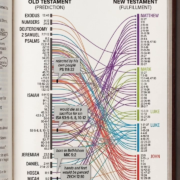

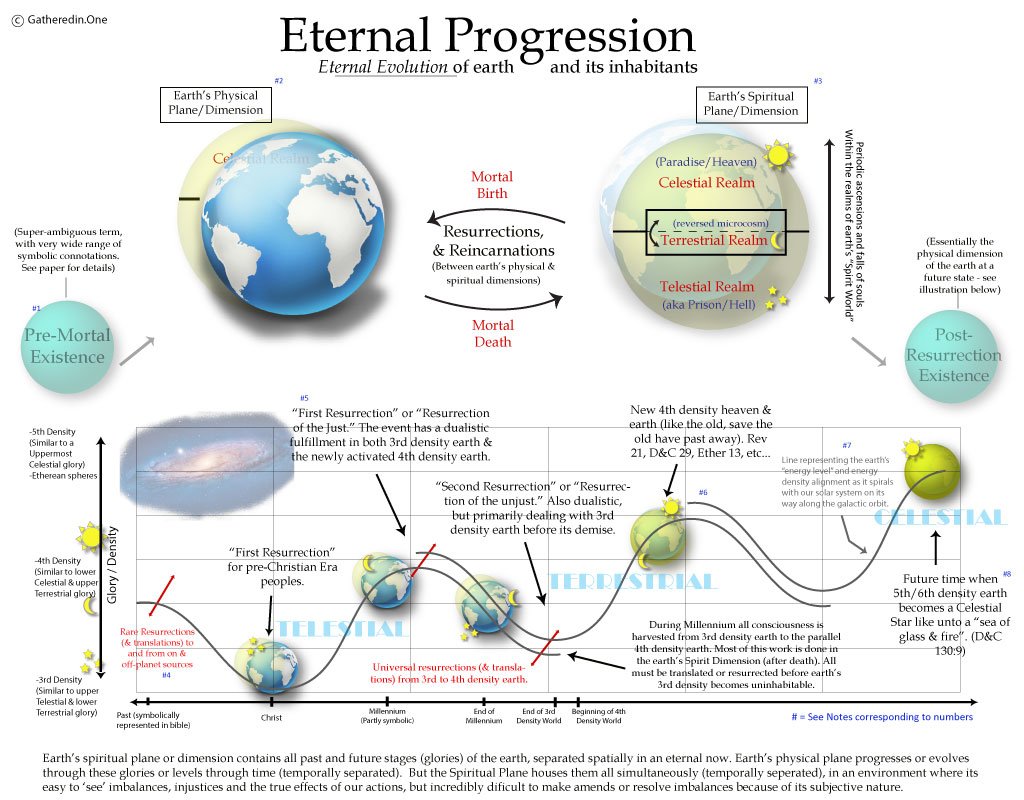
Lets explore the two possible timelines of the Mellenium being in our dimension, before or after the earth passes away.
.
#1 Gog/Magog > Apocalyptic end-times war & earth passes away by fire > Millennium
#2 Gog/Magog > Millennium for righteous in other realm > Apocalyptic 2nd Gog/Magog end-times war & earth passes away by fire
The big difference in these two timelines is when the 3rd density/Telestial earth is actually destroyed and how the transition to 4th density/Terrestrial earth occurs (do people leave this sphere or evolutionarily transition).
As mentioned in the Law of One article, the end-times explanations in that book and scripture can be interpreted in two different ways. One is an apocalyptic end to this world BEFORE the millennium, (which people have to be raptured or die to transition into) the other has the apocalyptic end to this telestial world AFTER the millennium. If the “little season/short time” mentioned in Rev 20:3, 7–8; and D&C 29:22 and D&C 88:110–111 is BEFORE the Millennium (Because the Millennium actually happens in a different sphere where there is “time no longer”), then that means that everyone on earth must die and slowly be reborn/repopulate a FULLY DIFFERENT DIMENSION after this one more or less ends apocalyptically. On the other hand, if the “little season/short time” of Rev 20:3, 7–8; and D&C 29:22 and D&C 88:110–111 is after the Millennium, and the Millennium actually is in this sphere and every one naturally transitions to it, as those scriptures suggest, then the apocalyptic end of the earth actually happens much later when earth ‘cycles down to 3rd density again”. TWO different interpretations, but vastly different. The Law of One is unclear. The Book of Ben Kathryn suggests the latter. The Doctrine and Covenants suggest the former.
.
SCRIPTURES ARE CLEAR THAT THE EARTH WILL PASS AWAY AFTER THE MILLENIUM. The question is, when and where is the Millennium? If only the righteous enjoy it, and the wicked are ‘locked up’ this does not jive with the Law of One with suggests that the wicked will go to another planet and never come back.. more like what we hear with…
26 But, behold, verily I say unto you, before the earth shall pass away.. the righteous shall be gathered on my right hand unto eternal life; and the wicked on my left hand will I be ashamed to own before the Father; 28 Wherefore I will say unto them—Depart from me, ye cursed, into everlasting fire, prepared for the devil and his angels. 29 And now, behold, I say unto you, never at any time have I declared from mine own mouth that they should return, for where I am they cannot come, for they have no power. (D&C 29:26–29)
MILLENNIUM IS BEFORE THE FINAL HARVEST (& IN DIFFERENT DIMENSION). It must be a sub-harvest if its before the wicked are sent ‘away to their own place’. This, and the fact it is outside of ‘time’, is why I suspect it is a state of the righteous in heaven. A ‘resurrection’ will make heaven or 4rth density/terrestrial time/space into a level as dense/tangible as this mortality.
“63.25 At this nexus the green-ray environment exists to a far greater extent in time/space [or the ‘Millennial’ spirit world] than in space/time [the physical world].”
This is really the only way that D&C 88 makes sense where it says that during the Millennium there will be “time no longer”. It can’t be on ‘space/time’ mortal earth if there is no time! (Although this phrase might have a double meaning in that this is AFTER the ‘Times’ of Moses during the fulness of time when we’re in an intercalary ‘timeless’ period.)
110 And so on, until the seventh angel shall sound his trump; and he shall stand forth upon the land and upon the sea, and swear in the name of him who sitteth upon the throne, that there shall be time no longer; and Satan shall be bound, that old serpent, who is called the devil, and shall not be loosed for the space of a thousand years. 111 And then he shall be loosed for a little season, that he may gather together his armies. (D&C 88:110–11, see also 84:100 & Rev 10:6)
The Lord hath redeemed his people;
And Satan is bound and time is no longer.
The Lord hath gathered all things in one.
The Lord hath brought down Zion from above.
The Lord hath brought up Zion from beneath.
(D&C 84:100)
.
THE END OF THE EARTH IS AFTER THE MILLENNIUM. So then there’s obviously TWO different destruction events, one that involves the earth with earthquakes, tusunamis, angry stars, etc that occurs before the Millennium when arm of the Lord falls on Gentiles, and one AFTER the millennium when the earth literally passes away by fire.
“And as one earth shall pass away, and the heavens thereof even so shall another come, and there is no end to my works, neither to my words. For behold, this is my work and my glory-to bring to pass the immortality and eternal life of man. And now, Moses, my son, I will speak unto thee concerning this earth upon which thou standest…” (Moses 1:38)
“But the day of the Lord will come as a thief in the night; in the which the heavens shall pass away with a great noise, and the elements shall melt with fervent heat, the earth also and the works that are therein shall be burned up. (2 Peter 3:1–10)
“9 For the hour is nigh and the day soon at hand when the earth is ripe; and all the proud and they that do wickedly shall be as stubble; and I will burn them up, saith the Lord of Hosts…22 And again, verily, verily, I say unto you that when the thousand years are ended, and men again begin to deny their God, then will I spare the earth but for a little season; 23 And the end shall come, and the heaven and the earth shall be consumed and pass away, and there shall be a new heaven and a new earth. 24 For all old things shall pass away, and all things shall become new, even the heaven and the earth, and all the fulness thereof, both men and beasts, the fowls of the air, and the fishes of the sea..” (D&C 29:9,22–24)
“22 Ye say that ye know that the end of the world cometh; ye say also that ye know that the heavens and the earth shall pass away; 23 And in this ye say truly, for so it is; but these things which I have told you shall not pass away until all shall be fulfilled.” (D&C 45:22–23)
“26 Wherefore, it shall be sanctified; yea, notwithstanding it shall die, it shall be quickened again, and shall abide the power by which it is quickened, and the righteous shall inherit it. 27 For notwithstanding they die, they also shall rise again, a spiritual body.” (D&C 88:26–27)
“Suppose ye that we shall believe the testimony of one man, although he should preach unto us that the earth should pass away? 3 Now they understood not the words which they spake; for they knew not that the earth should pass away.” (Alma 9:2–3)
“And ye also know that by the power of his almighty word he can cause the earth that it shall pass away; yea, and ye know that by his word he can cause the rough places to be made smooth…” (1 Nephi 17:46)
“And at my command the heavens are opened and are shut; and at my word the earth shall shake; and at my command the inhabitants thereof shall pass away, even so as by fire.” (Ether 4:9)
…stand in holy places; 23 And prepare for the revelation which is to come, when the veil of the covering of my temple, in my tabernacle, which hideth the earth, shall be taken off, and all flesh shall see me together. 4 And every corruptible thing…shall be consumed; 25 And also that of element shall melt with fervent heat; and all things shall become new, that my knowledge and glory may dwell upon all the earth. (D&C 101:22–25)
.
So do you see where I get my idea that the Millennium is in another dimension and sits BETWEEN Gog/Magog and the final dispensation of the fulness of times? These scriptures establish that the Millennium IS NOT 4rth density time/space earth! It can’t be, because that is AFTER the wicked are sent away where “they cannot come”.
.
.
ORDER OF EVENTS:
-Gog/Magog >
-40yr silence/probation (could be 7-40yrs, TWO 40yr periods, one of peace one of trouble?)
-First Resurrection happens shortly before (at beginning) the Arm of the Lord falls on gentiles (D&C 45:45)
-End of the Time of the Gentiles/Tribulation/Arm of Lord falls on Gentiles (wormwood, solar flare, small expansion event, Christ come to Jews in Jerusalem.)
-Celestial events (CME, wormwood?, earthquake) happen “immediately” after Tribulation or Jerusalem attack/second Abomination of Desolation. Like BOBK says! (JS-M 1:33)
—Millennium for righteous begins in another realm/dimension (‘Time no longer” might mean, same as ‘fullness of time’)
-3rd Temple built in Jerusalem/Zion built in America
-Beginning Dispensation of the Fullness of Times (Great righteousness to prepare for the end/Basically a/the Millennium)
-City of Enoch/Zion from above joins with earth to harvest all who will be harvested.
-I think this period will be 250yrs, could be 1000? could be 100-700yrs? or even 2000?
—After, Apocalyptic 2nd Gog/Magog end-times war & earth passes away by fire. (not expansion, but galactic solar flare)
7 And ye are called to bring to pass the gathering of mine elect; for mine elect hear my voice and harden not their hearts;
8 Wherefore the decree hath gone forth from the Father that they shall be gathered in unto one place upon the face of this land, to prepare their hearts and be prepared in all things against the day when tribulation and desolation are sent forth upon the wicked.
9 For the hour is nigh and the day soon at hand when the earth is ripe; and all the proud and they that do wickedly shall be as stubble; and I will burn them up, saith the Lord of Hosts, that wickedness shall not be upon the earth;
10 For the hour is nigh, and that which was spoken by mine apostles must be fulfilled; for as they spoke so shall it come to pass;
11 For I will reveal myself from heaven with power and great glory, with all the hosts thereof, and dwell in righteousness with men on earth a thousand years, and the wicked shall not stand.
12 And again, verily, verily, I say unto you, and it hath gone forth in a firm decree, by the will of the Father, that mine apostles, the Twelve which were with me in my ministry at Jerusalem, shall stand at my right hand at the day of my coming in a pillar of fire, being clothed with robes of righteousness, with crowns upon their heads, in glory even as I am, to judge the whole house of Israel, even as many as have loved me and kept my commandments, and none else.
13 For a trump shall sound both long and loud, even as upon Mount Sinai, and all the earth shall quake, and they shall come forth—yea, even the dead which died in me, to receive a crown of righteousness, and to be clothed upon, even as I am, to be with me, that we may be one.
14 But, behold, I say unto you that before this great day shall come the sun shall be darkened, and the moon shall be turned into blood, and the stars shall fall from heaven, and there shall be greater signs in heaven above and in the earth beneath;
15 And there shall be weeping and wailing among the hosts of men;
16 And there shall be a great hailstorm sent forth to destroy the crops of the earth.
17 And it shall come to pass, because of the wickedness of the world, that I will take vengeance upon the wicked, for they will not repent; for the cup of mine indignation is full; for behold, my blood shall not cleanse them if they hear me not.
18 Wherefore, I the Lord God will send forth flies upon the face of the earth, which shall take hold of the inhabitants thereof, and shall eat their flesh, and shall cause maggots to come in upon them;
19 And their tongues shall be stayed that they shall not utter against me; and their flesh shall fall from off their bones, and their eyes from their sockets;
20 And it shall come to pass that the beasts of the forest and the fowls of the air shall devour them up.
21 And the great and abominable church, which is the whore of all the earth, shall be cast down by devouring fire, according as it is spoken by the mouth of Ezekiel the prophet, who spoke of these things, which have not come to pass but surely must, as I live, for abominations shall not reign.
22 And again, verily, verily, I say unto you that when the thousand years are ended, and men again begin to deny their God, then will I spare the earth but for a little season;
23 And the end shall come, and the heaven and the earth shall be consumed and pass away, and there shall be a new heaven and a new earth.
24 For all old things shall pass away, and all things shall become new, even the heaven and the earth, and all the fulness thereof, both men and beasts, the fowls of the air, and the fishes of the sea;
25 And not one hair, neither mote, shall be lost, for it is the workmanship of mine hand.
26 But, behold, verily I say unto you, before the earth shall pass away, Michael, mine archangel, shall sound his trump, and then shall all the dead awake, for their graves shall be opened, and they shall come forth—yea, even all.
27 And the righteous shall be gathered on my right hand unto eternal life; and the wicked on my left hand will I be ashamed to own before the Father;
28 Wherefore I will say unto them—Depart from me, ye cursed, into everlasting fire, prepared for the devil and his angels.
29 And now, behold, I say unto you, never at any time have I declared from mine own mouth that they should return, for where I am they cannot come, for they have no power.
30 But remember that all my judgments are not given unto men; and as the words have gone forth out of my mouth even so shall they be fulfilled, that the first shall be last, and that the last shall be first in all things whatsoever I have created by the word of my power, which is the power of my Spirit.
When Brigham Young and architect Truman O. Angell laid out the blueprints for the Salt Lake Temple in the mid-19th century, they were not merely designing a house of worship; they were engaged in a radical act of bilical architectural and theological translation.
Central to Latter-day Saint (LDS) theology is the doctrine of Restoration—the belief that ancient order, priesthood authority, and sacred rites have been restored to the earth in the modern era. Nowhere is this principle more explicitly materialized than in the comparison between the biblical Temple of Solomon and the Salt Lake Temple.
While Solomon’s temple operated on a lateral, one-story axis moving west from the outer court to the Holy of Holies, the Salt Lake Temple takes that exact ritual trajectory and transposes it vertically into a multi-story design. By stacking these sacred spaces, Latter-day Saints created an architectural climb that mirrors both ancient Israelite temple worship and the progressive spiritual ascension of the Christian soul.
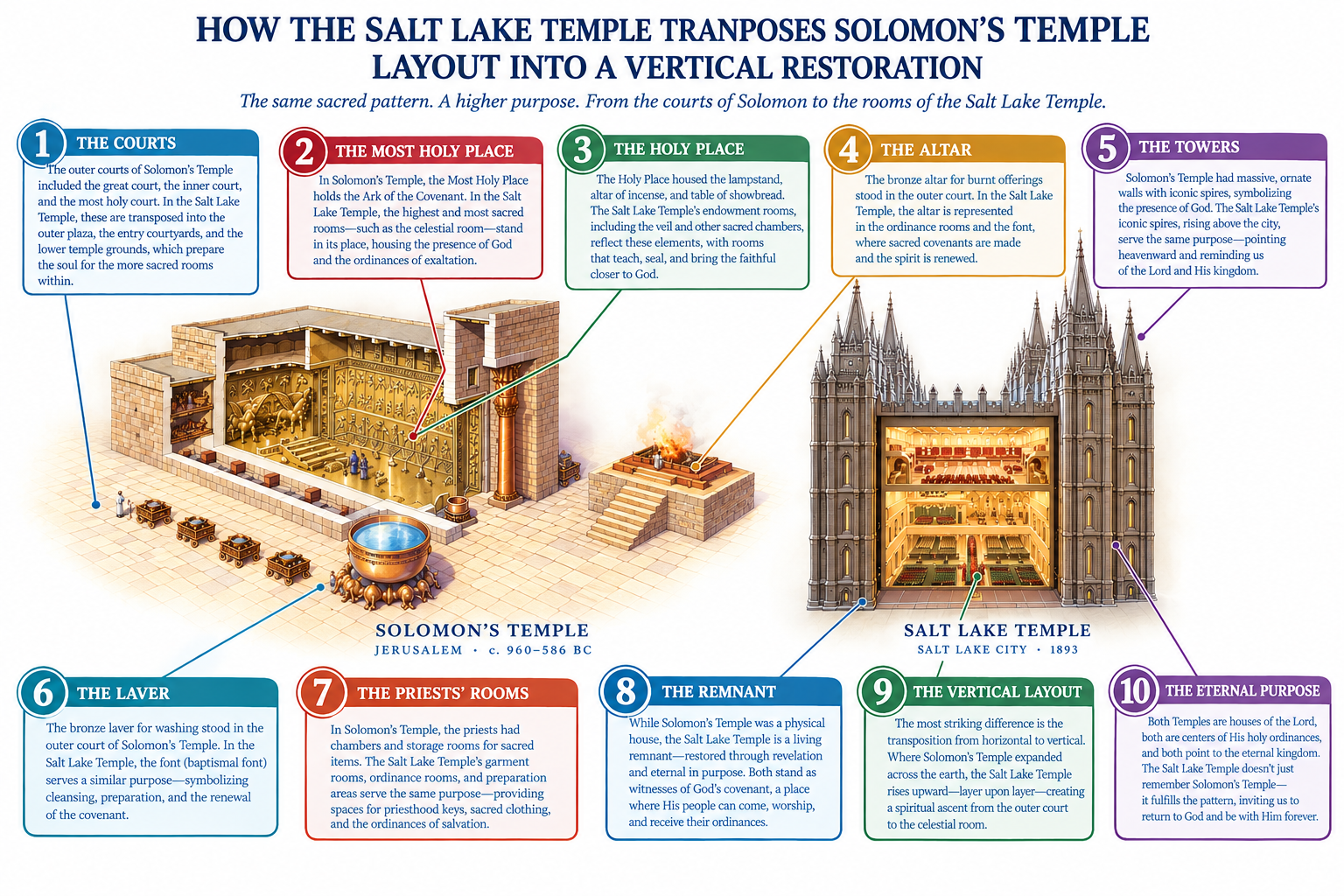
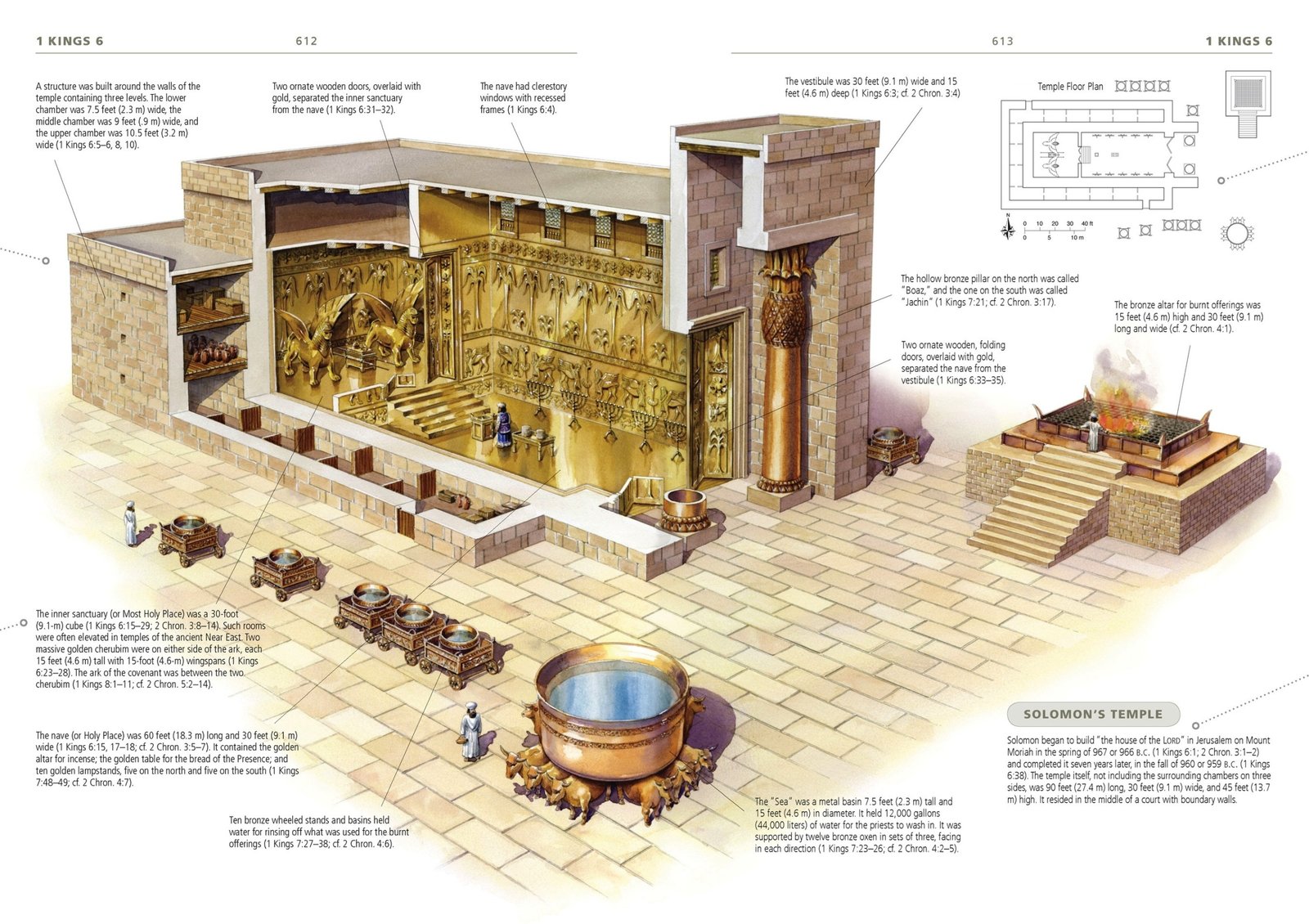
To understand the lower level of the Salt Lake Temple, one must first step into the Outer Court of Solomon’s Temple. Anciently, the outer precinct was defined by purification, sacrifice, and preparatory consecration before a priest could enter the sacred structure itself.
Solomon’s Temple (Horizontal):
[ Outer Court / Brazen Sea ] ──► [ Holy Place / Veils ] ──► [ Holy of Holies ]
Salt Lake Temple (Vertical):
[ Top Floor ] Assembly Hall (Church of the Firstborn)
▲
[ Floor 3 ] Celestial Room & Holy of Holies (Split Sacred Center)
▲
[ Floor 2 ] Initiatory & Endowment Rooms (The Holy Place)
▲
[ Floor 1 ] Baptistry & Washings (Solomon’s Outer Court / Brazen Sea)
In Solomon’s court stood two prominent features: the Altar of Burnt Offering and the Brazen Sea—a massive bronze basin resting on the backs of twelve oxen, accompanied by ten smaller mobile lavers (1 Kings 7:23–26). Here, Levite priests underwent ritual washings to cleanse away physical and ritual impurity, followed by consecrated anointings with sacred oil to sanctify them for divine service.
In the basement level of the Salt Lake Temple, this ancient outer court finds its direct modern counterpart:
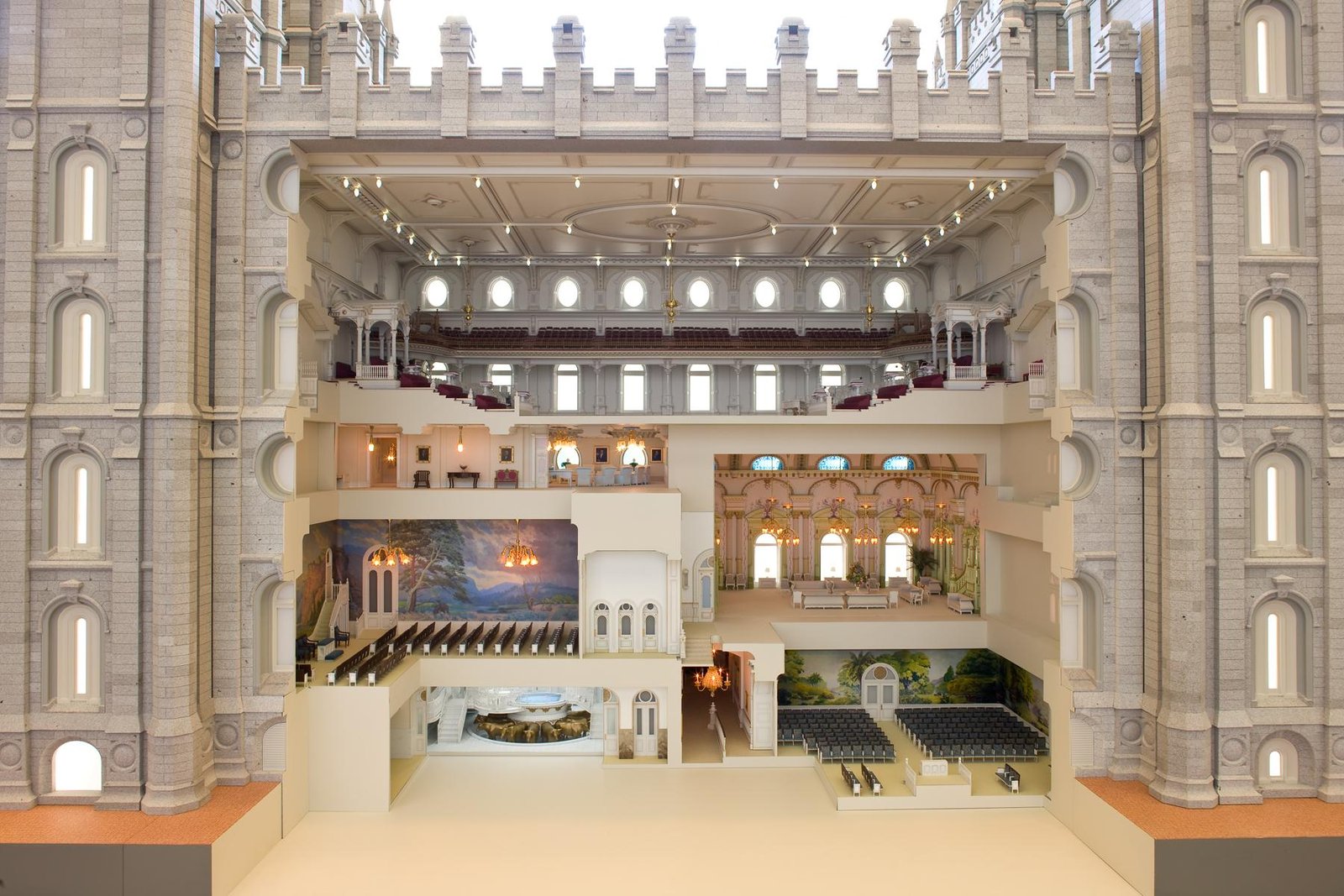
Ascending from the lower level to the middle floors, the patron leaves the “outer court” and steps into the equivalent of Solomon’s Holy Place (Hekhal). Anciently, this was an elongated hall accessible only to ordained priests. It contained three main sacred implements:
Hugh Nibley’s extensive comparative research into ancient Jewish liturgy, apocryphal literature, and the Egyptian Book of the Dead highlights that the Holy Place was fundamentally a space of preparatory instruction, covenant-making, and symbolic ascent. The priest entered this room to perform precise, prescribed gestures and prayers before approaching the veil that separated humanity from the throne of God.
In the Salt Lake Temple, these ancient implements and rites are transposed into the multi-stage Endowment ceremony:
In Solomon’s Temple, the Holy of Holies (Kodesh HaKodashim) was a perfect cube, dark and silent, housing the Ark of the Covenant topped by the Mercy Seat. It represented the literal throne room of Yahweh. It was strictly off-limits to everyone except the High Priest, who entered only once a year on the Day of Atonement (Yom Kippur) through the veil.
The Salt Lake Temple makes a profound theological shift: it splits the functions of Solomon’s Holy of Holies into two distinct spaces.
Solomon’s Holy of Holies (Single Space)
├── Entered only by High Priest (Yom Kippur)
└── Housed Ark of the Covenant & Relics
│
▼ Transposed & Split
Salt Lake Temple Upper Level (Dual Spaces)
├── 1. The Celestial Room (Open to ALL endowed patrons)
│ └── Signals Christ opened the veil for all faithful saints.
└── 2. The LDS Holy of Holies (Restricted to Church President/High Priests)
└── Houses sacred altar; traditional site of modern sacred relics.
The primary space patrons enter after crossing the veil is the Celestial Room. Unlike Solomon’s dark, restricted inner sanctuary, the Celestial Room is brilliantly lit, beautifully appointed with chandeliers, mirrors, and fine furnishings, symbolizing the celestial kingdom of God.
By allowing all worthy Latter-day Saints who have made temple covenants to enter this room, LDS theology illustrates a core New Testament doctrine: through the atonement of Jesus Christ, the veil of the temple was rent in twain (Matthew 27:51). The divine presence is no longer restricted to a single solitary High Priest; heaven has been opened to every obedient follower who enters into the covenant. Here, patrons also perform eternal sealings (marriages), linking families forever in God’s presence.
While the Celestial Room democratizes the divine presence, the Salt Lake Temple preserves the ancient high-priestly sanctuary through a dedicated Holy of Holies—a small, highly inner room adjoining the Celestial Room.
If the first three levels of the Salt Lake Temple transpose and refine the Old Testament pattern of Solomon’s Temple, the upper-most floor adds an entirely new dimension drawn directly from New Testament theology.
Taking up the entire top floor of the Salt Lake Temple is the grand Priesthood Assembly Hall, complete with tiered pulpits at both the east and west ends representing the Melchizedek and Aaronic priesthoods.
──────────────────────────────────────────┐
│ PRIESTHOOD ASSEMBLY HALL │
│ (Top Floor – Mount Zion / Heavenly City)│
└──────────────────────────────────────────┘
▲
│
┌──────────────────────────────────────────┐ │
│ SOLOMON’S TEMPLE (OT) │ │
│ Outer Court ──► Holy Place ──► Holy of │───────────┘
│ (Veil) Holies │ (Extends OT Pattern into NT Eschatology)
This room represents the “General Assembly and Church of the Firstborn” described in Hebrews 12:22–23:
“But ye are come unto mount Sion, and unto the city of the living God, the heavenly Jerusalem, and to an innumerable company of angels, to the general assembly and church of the firstborn…”
In early Latter-day Saint theology, the “Church of the Firstborn” represents the exalted body of saints in heaven who have received the fullness of priesthood blessings. By building a grand assembly hall atop the temple, the architecture makes a powerful physical statement: the ultimate destination of the saint’s spiritual path is not merely individual entrance into the Celestial Room, but communal gatherers in the heavenly city.
The lower floors guide the individual step-by-step from the world (Outer Court), through instruction and covenants (Holy Place), to individual reconciliation with God (Holy of Holies). The top floor brings that redeemed individual into the collective council of the Priesthood—bringing the heavenly church down to earth, where God’s servants assemble to govern, instruct, and prepare the world for the Second Coming of Christ.
The Salt Lake Temple is a masterwork of comparative theology written in stone, wood, and glass. By taking the lateral, linear layout of Solomon’s ancient temple and folding it upward into a vertical structure, the early Latter-day Saints created a visual and physical allegory of spiritual ascent.
From the baptismal oxen in the basement to the veil in the middle floors, the split Holy of Holies, and the heavenly Assembly Hall at its peak, the Salt Lake Temple bridges the Old and New Testaments—translating ancient Levite rituals into modern Christian restorationism.
| Dimension / Aspect | Solomon’s Temple (Ancient Israel) | Salt Lake City Temple (LDS) |
| Spatial Axis | Lateral / Horizontal (Westward progression across one level) | Vertical / Multi-Story (Ascension upward across multiple floors) |
| Lower Precinct / Floor 1 | The Outer Court | The Basement / Baptistry Level |
| Water Vessel | The Brazen Sea (resting on 12 bronze oxen) | The Baptismal Font (resting on 12 oxen) |
| Purification Rites | Washing of Levite priests; animal sacrifices | Baptisms for the dead; Initiatory Washings & Anointings |
| Spiritual Focus | Cleansing of physical and ritual impurity | Cleansing from sin, personal consecration, ancestor redemption |
| Middle Section / Floor 2 | The Holy Place (Hekhal) | The Endowment / Instruction Rooms |
| Sacred Implements | Menorah (Light), Shewbread (Covenants), Altar of Incense (Prayer) | Temple Altars, Creation/Garden/World/Terrestrial Rooms |
| Rites & Progression | Priestly duties, incense offering, approaching the veil | Presentation of the Endowment, covenant-making, prayer circle |
| Boundary | Woven Veil separating Holy Place from Holy of Holies | The Temple Veil separating Terrestrial from Celestial Room |
| Upper Section / Floor 3 | The Holy of Holies (Kodesh HaKodashim) | Split into Two Spaces: |
| Public/Patron Space | None (Restricted strictly to the High Priest once a year) | The Celestial Room: Open to all endowed, covenant-keeping members (symbolizing Christ renting the veil) |
| High Priestly Sanctuary | The inner sanctuary housing the Ark of the Covenant | The LDS Holy of Holies: Restricted room for the Church President / High Priests |
| Sacred Contents | Tablets of Law, Aaron’s Rod, Pot of Manna (Inside Ark) | Sacred altar (Mercy Seat); historical LDS church relics |
| Top Floor / Celestial Peak | No direct OT equivalent (Extends into NT Eschatology) | The Priesthood Assembly Hall |
| Biblical Source | Inspired by Hebrews 12:22–23 | “General Assembly and Church of the Firstborn” |
| Symbolic Meaning | The divine throne room of Yahweh in heaven | The heavenly council of Saints brought to earth; priesthood governance |
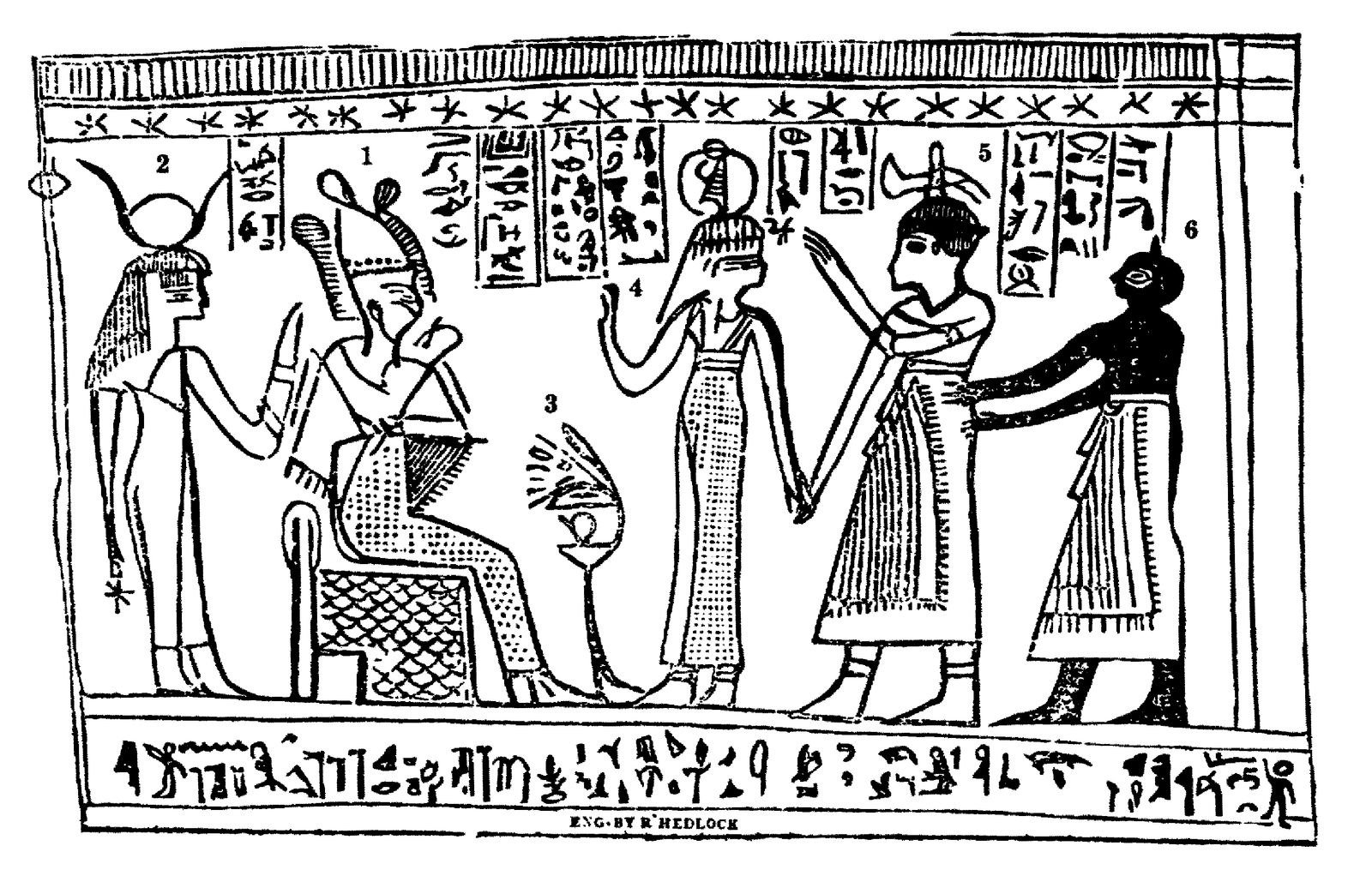
If you’ve ever spent time reading skeptical critiques of Latter-day Saint scripture, you know the routine. A critic holds up Facsimile 1 or Facsimile 2 from the Book of Abraham, points to a modern Egyptological textbook, and declares with triumph:
“Joseph Smith got it all wrong! An Egyptologist looks at this image and sees Osiris, Anubis, Khnum, or Horus—not Abraham, Yahweh, or the idolatrous priest of Elkenah!”
It sounds like a slam dunk on the surface. But beneath that confident assertion lies a fundamental, glaring category error. It relies on a tactic that can only be described as bad logic—and, quite frankly, hypocrisy.
The skeptic’s critique rests on a flawed assumption: that Joseph Smith was attempting to translate these ancient vignettes according to native, pagan Egyptian priests. But native Egyptian priests didn’t believe in Abraham, Joseph, Jacob, or Moses! They worshipped their own pantheon.
Joseph Smith wasn’t presenting a translation of pagan Egyptian mythology. He was presenting a translation of a Jewish reinterpretation of Egyptian iconography.
To demand that a Jewish text composed or adapted in an Egyptian milieu conform strictly to traditional Egyptian polytheism misses how ancient cultures interacted, borrowed, and re-contextualized each other’s art and sacred stories.
In the ancient Mediterranean—particularly during the Hellenistic and Ptolemaic periods when the Joseph Smith Papyri were produced (c. 300 BC – 100 AD)—cultures did not live in isolated silos. They engaged constantly in a process known as syncretism: mapping their own theological concepts onto the visual and literary language of neighboring empires.
When the Greeks encountered Egypt, they practiced Interpretatio Graeca. The 500 BC Greek historian Herodotus and his contemporaries looked at Ra and called him Zeus; they looked at Osiris and called him Dionysus; they looked at Thoth and called him Hermes. Do Egyptologists accuse Herodotus of “failing a translation test” because a native priest of Amun-Ra wouldn’t use the name Zeus? Of course not. That was how ancient cross-cultural communication worked.
The Jewish diaspora in Egypt—which thrived in places like Alexandria, Memphis, and Elephantine—practiced their own version: Interpretatio Judaica. They took the vibrant visual vocabulary of Egyptian art and re-read it through the lens of their own covenant history.
Look at the Jewish historian Flavius Josephus in his famous work Against Apion. Josephus quotes Manetho, a 3rd-century BC Egyptian priest who wrote a history of Egypt. Manetho described a group of “polluted people” and shepherds (the Hyksos) who occupied Egypt and were eventually expelled under Pharaoh Ahmose.
How does Josephus handle this native Egyptian history? He completely reinterprets it! Josephus asserts that Manetho’s “Hyksos” and “polluted people” were actually Moses and the Children of Israel.
If you asked Manetho himself, he would have vehemently disagreed with Josephus. Manetho would say, “Ahmose had nothing to do with your God or your prophet Moses!” But Josephus would reply, “This is our history hidden inside your records.”
It was a collision of two distinct cultural frameworks claiming the same historical memory. Josephus wasn’t “failing to read Egyptian correctly”—he was intentionally reclaiming the narrative through a Jewish lens. Josephus understood that the Hyksos were Asiatic nomads who came to Egypt from the region of Israel and almost certainly had a shared heritage of Levantine peoples like himself. Modern scientists and theologians vehemently argue whether Josephus’ re-interpretation of Egyptian history is entirely correct, or whether Moses, Joseph or Abraham were actual historical characters hidden within Egyptian names and history, but this very debate underlines the absurdity of the arguments many Christians make against Joseph Smith and his similar re-interpretation of ancient Egyptian/Jewish syncretic ideas.
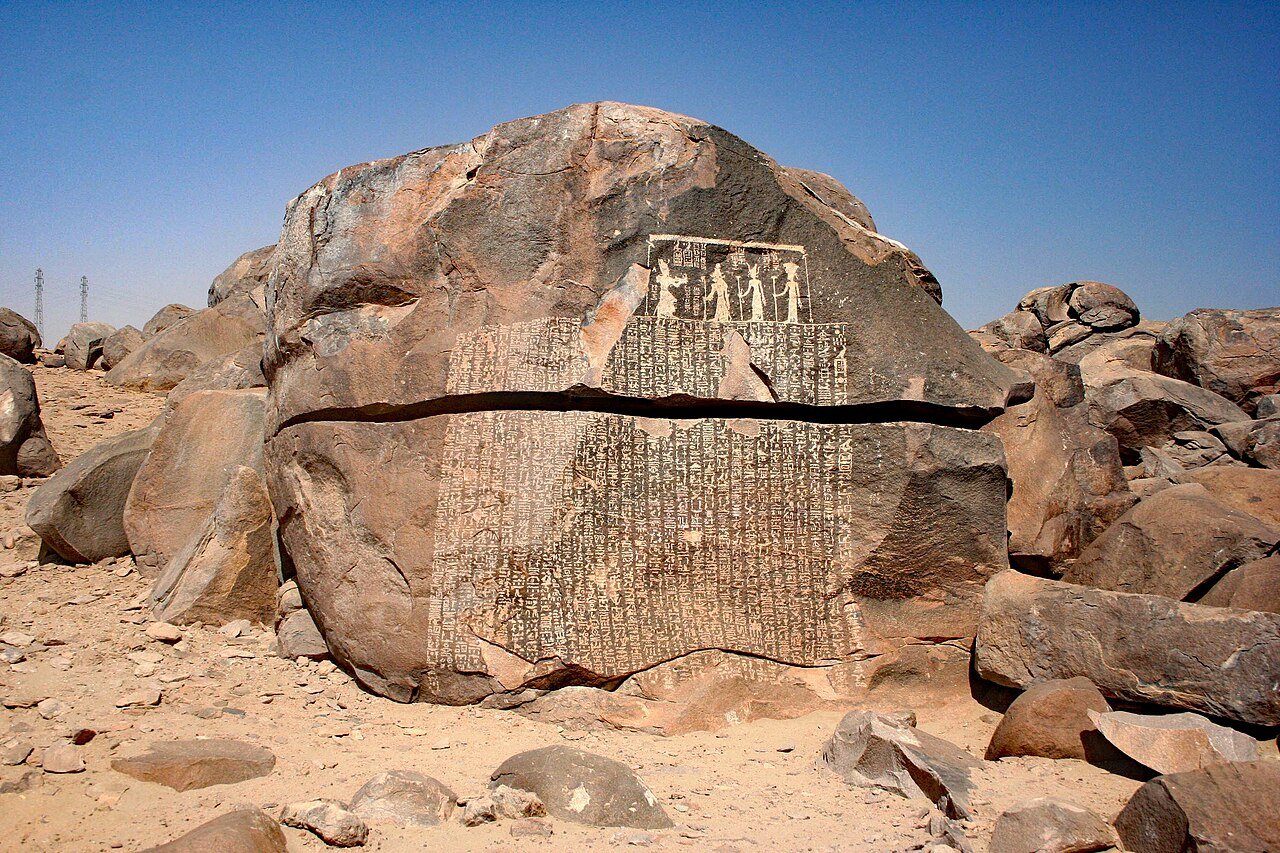
To see how this works in practice, consider one of the most famous inscriptions in Egypt: the Famine Stela, located on Sehel Island near Elephantine.
           THE TWO READINGS OF THE FAMINE STELA

   Native Egyptian / Egyptologist       Jewish Diaspora Reader
 ┌────────────────────────────────┐   ┌────────────────────────────────┐
 │ • King Djoser                  │   │ • Pharaoh of Egypt             │
 │ • Priest/Advisor Imhotep       │   │ • Patriarch Joseph             │
 │ • 7-Year Nile Drought          │   │ • 7-Year Biblical Famine       │
 │ • Appeal to Khnum / Hapi       │   │ • Power of Yahweh / True God   │
 └────────────────────────────────┘   └────────────────────────────────┘
Carved during the Ptolemaic period (the exact same era as the Joseph Smith Papyri), the Famine Stela tells a story set in the distant Old Kingdom reign of Pharaoh Djoser:
Now, how do we read this artifact?
An ancient Jew looking at that motif wouldn’t see pagan priests doing pagan rituals; they would see the hand of Yahweh working through Joseph to save Egypt from starvation.
Both interpretations exist simultaneously within their respective cultural frameworks. The native Egyptian priest saw Imhotep and Khnum. The Jewish reader saw Joseph and Yahweh.
Yet, when Joseph Smith provides an interpretation of Egyptian facsimiles that reflects this exact Jewish recontextualization, the Christian skeptic steps in and shouts: “No! You can’t do that! That’s not Joseph, that’s Imhotep! That’s not Yahweh, that’s Khnum!”
That is hypocritical. It demands that an ancient Jewish text conform to 19th-century pagan Egyptian orthodoxy, while completely ignoring the fact that these same secular Egyptologists would likely deny the very existence of Abraham, Joseph and Moses within Egyptian iconography.
[TO DO: add both a summary and full interpretation of the famine stela. Make a case for the fairly obvious fact that the “people of Khnum” are almost certainly Israelites (given the Aramaic Elephantine Papyri), which suggests that Jewish Egptians saw Khnum as Yhwh or the God of Israel. Talk about the Imhotep cult figures found in Jewish/Pheonician colonies of Spain and how these also suggest the Jews saw Imhotep and Joseph. Explain how Khnum is the ‘Ba’ of Osiris (ba), ram-headed Khnum was viewed as the living ba (soul) of several high-ranking creator and underworld gods, including Osiris and Geb) and Thus Joseph’s interpretation of what other Egyptologist call Osiris is spot on.]
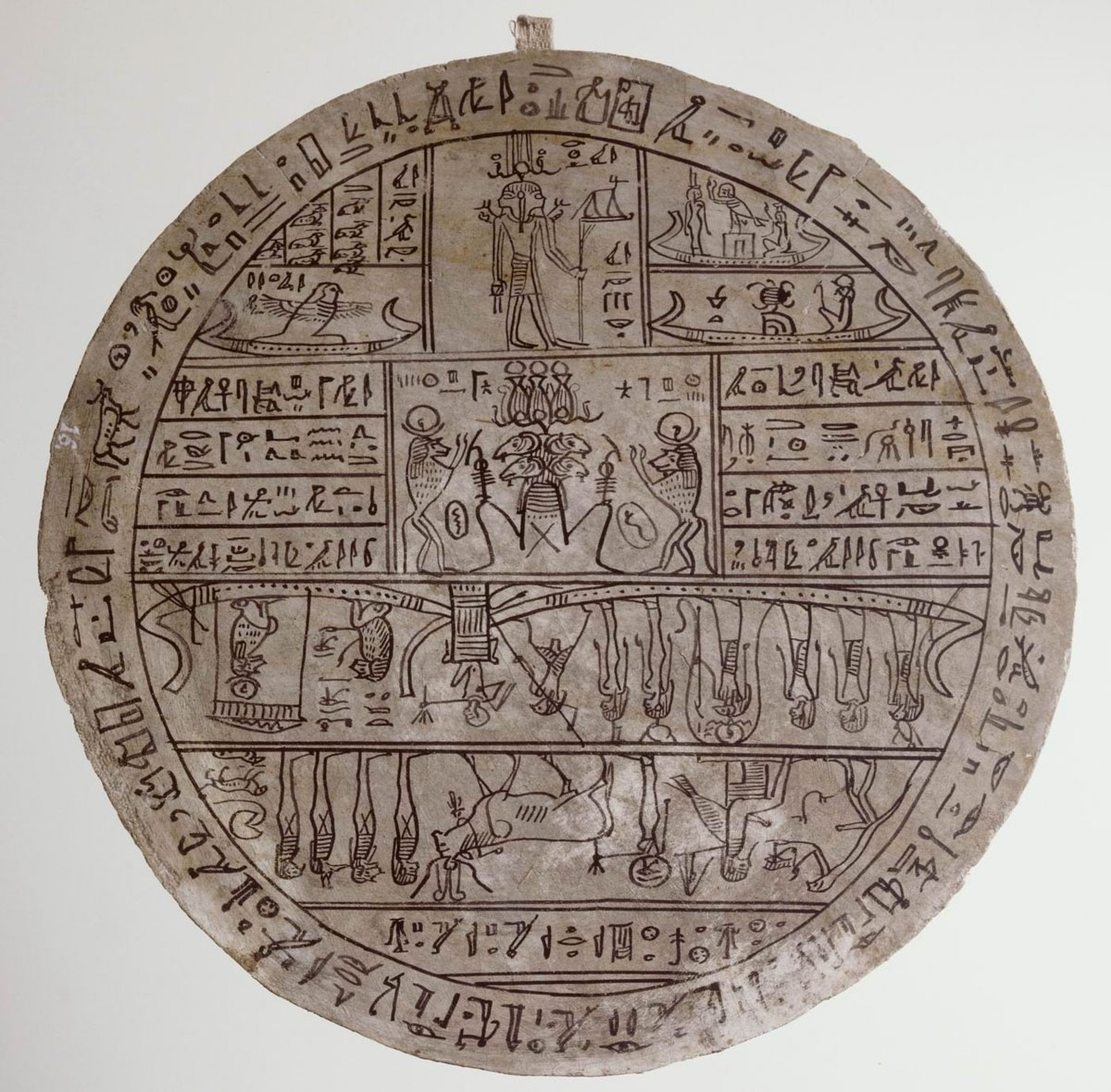
Is there hard archaeological proof that Jews in Egypt actually took native Egyptian visual images, hypocephali, and funerary motifs and forced them into Jewish cultural paradigms?
Yes—in abundance. The prime evidence lies in the Greek Magical Papyri (PGM) and related syncretic texts from Hellenistic Egypt.
When scholars examine the PGM, they find Egyptian funerary drawings, Osiris vignettes, and hypocephali wrapped inside prayers that invoke:
In these ancient papyri, Jewish and Greco-Jewish scribes routinely took traditional Egyptian iconography—drawings of Egyptian gods sitting on thrones, hypocephali representing the cosmos, or figures on lion-couches—and repurposed them. A drawing that originally depicted Anubis embalming Osiris in native tradition was re-labeled or re-understood by Jewish syncretists as an altar of sacrifice involving Abraham or Isaac.
  TRADITIONAL EGYPTIAN           GRECO-JEWISH SYNCRETISM
   PAGAN ICONOGRAPHY               (PGM / HELLENISTIC)
┌──────────────────────┐        ┌──────────────────────┐
│  Anubis / Osiris     │  ───►  │  Abraham / Jehovah   │
│  Hypocephalus / Ra   │  ───►  │  Cosmos / Kolob      │
│  Pagan Funerary Art  │  ───►  │  Sacred Covenant     │
└──────────────────────┘        └──────────────────────┘
This wasn’t a “mistake.” It was a deliberate, culturally ubiquitous practice in late-period Egypt. Scribes appropriated the visual art of the dominant culture to teach their own theology.
When Joseph Smith published the Book of Abraham and its accompanying facsimiles, he provided explanations for the figures:
A 21st-century secular Egyptologist looks at Facsimile 2 and says, “This is a standard Egyptian hypocephalus meant to keep the deceased warm in the tomb.”
To which the student of ancient history should respond: “Of course that’s what a pagan Egyptian would say!”
  THE SKEPTICAL FALLACY vs. HISTORICAL REALITY

  Skeptic's Flawed Assumption:
  [Egyptian Artifact] ──► MUST EQUAL ──► Native Pagan Egyptian Religion

  Historical & Restoration Reality:
  [Egyptian Artifact] ──► RE-READ VIA ──► Jewish / Patriarchal Context (Book of Abraham)
Joseph Smith didn’t claim to restore what an ancient idolater in Thebes thought about Facsimile 2. He restored how Jews believed Abraham and his Jewish descendants adapted and re-interpreted Egyptian visual motifs to teach covenant truths.
If a Jewish scribe in 200 BC took an Egyptian hypocephalus and assigned its central figure to represent God (instead of Osiris or Ra) sitting on His throne revealing the stars to Abraham, that scribe was doing the exact same thing Joseph Smith revealed in 1835.
The next time a critic tries to dismiss the Book of Abraham by comparing Joseph Smith’s explanations to a standard Egyptology dictionary, recognize the sleight of hand being played.
It’s bad logic. It’s hypocrisy.
When you understand how ancient texts were adapted, transmitted, and re-read across cultural boundaries, the Book of Abraham’s facsimiles don’t look like a 19th-century blunder at all. They look remarkably, strikingly, and authentically ancient.
Welcome to the foundational guide, legislative blueprint, and community hub for our upcoming civic reenactment. In an era increasingly defined by political gridlock, institutional centralized overreach, and a growing disconnect between the citizenry and the corridors of power, this exercise offers an intentional retreat into the mechanics of self-governance. We are bringing together passionate individuals to participate in a structured, immersive environment designed to mimic the foundational legislative mechanics that forged the American Republic.
Borrowing the highly participatory architecture of the historic Utah Caucus system and merging it with the formal solemnity of the early Continental Congresses, this simulation invites participants to step out of the audience of modern political theater and onto the stage of actual legislative deliberation. Our primary vehicle for interaction is the parliamentary process, driven by the principles of common consent and direct democracy. Here, you will not simply debate abstract concepts; you will organize into distinct caucus blocks, draft resolutions, debate amendments under strict parliamentary rules, and work toward actionable, legal mechanisms that can be executed in the real world.
“Real liberty is neither found in despotism, nor in the extremes of democracy, but in moderate governments.” — Alexander Hamilton. This simulation aims to rediscover that moderate, robust balance through rigorous structural debate.
This initiative is engineered specifically for those who believe that our current political institutions are failing to adequately address systemic existential crises. Whether your primary concern is economic stability, technological overreach, or moral preservation, this assembly provides a laboratory to test solutions. By dividing our assembly into small, cohesive caucuses, every voice is granted a direct channel to shape the overarching collective resolutions. Our goal is to conclude this event not with vague statements of intent, but with concrete, formatted legislative proposals, constitutional amendment templates, and a binding budget blueprint capable of driving authentic grassroots political action.
To understand the design of this simulation, one must look to two foundational pillars of Western republicanism: the early Continental Congresses of 1774 and 1775, and the modern legacy of the Utah Caucus System. When the original Continental Congress convened in Philadelphia, it did so without a formal constitutional mandate. It was an emergency gathering of distinct, self-governing colonies seeking unified, legal, and defensive solutions to unprecedented overreach. Those early delegates relied heavily on parliamentary procedures inherited from the English system but adapted them to prioritize the principle of common consent—ensuring that small colonies were not utterly crushed by the larger ones, and that decisions carried genuine moral authority.
Centuries later, the state of Utah retained a unique echo of this decentralized, neighbor-to-neighbor governance through its traditional neighborhood caucus system. Unlike states that rely purely on direct primary voting, the caucus system requires citizens to gather physically in local school gyms, churches, and community centers. In these neighborhood meetings, citizens debate issues at a hyper-local level and elect trusted delegates from among their own neighbors to represent them at broader conventions. It is a system built on the premise that political power must bubble up from the grassroots, rather than trickle down from centralized party elites.
Our simulation synthesizes these models to correct the flaws of the contemporary political ecosystem. Modern digital discourse has fractured the civic bond; we substitute anonymous online echo chambers with face-to-face parliamentary negotiations. By simulating the Continental Congress through a structured caucus model, we challenge our delegates to find common ground without compromising on existential necessities. We operate under the assumption that the structural framework of the United States Constitution remains our greatest shield, but that the machinery of our current government requires structural restoration from the ground up, initiated by an organized and educated populace.
To ensure that our proceedings mirror the gravity of a true constitutional body, all sessions will strictly adhere to traditional parliamentary law, guided by a modified variant of Robert’s Rules of Order. This structural rigidity is not intended to stifle debate, but rather to protect it. Parliamentary procedure ensures that the majority rules, the minority is heard, and individual factions are prevented from hijacking the broader body’s time. Every motion, point of order, and amendment will be recorded by our clerk, ensuring an unbroken ledger of our legislative progress.
The core philosophy driving this assembly is the concept of “Common Consent.” True political legitimacy is not manufactured through coercive 51-to-49 percent votes that leave half the population feeling disenfranchised. Instead, we pursue structural pathways where disparate groups can agree on protective boundaries that safeguard all participants. By working through decentralized caucuses, our delegates can iron out regional and ideological differences in smaller, collaborative committees before exposing resolutions to a vote by the general body.
The work of this simulated Congress is organized into five distinct constitutional inquiries. Each caucus group will receive these identical questions, charging them to debate the provided sub-points, draft formal responses, and synthesize their conclusions into cohesive political strategies.
Our caucuses will systematically evaluate the following acute vulnerabilities currently threatening the stability of our constitutional order:
Delegates must pivot from diagnosing systemic failures to engineering concrete, defensive countermeasures based on resilience and independence:
Caucuses are tasked with translating their solutions into the exact language of governance. This includes drafting specific text for structural amendments under the authority of Article V of the U.S. Constitution, alongside corresponding local Nullification Acts and state-level legislative demands to legally enforce decentralized solutions.
A plan without a deadline is a mere fantasy. Delegates will debate and sign a binding legislative covenant outlining the precise organizing targets, local outreach metrics, and security benchmarks that must be established within our respective home districts prior to our next reconvened session.
True political power requires material backing. This final module demands a rigorous accounting of our collective assembly fund. Delegates will debate the precise, strategic appropriation of our budget—balancing capital allocations between decentralized energy infrastructure, community security networks, legal defense funds, and civic educational materials.
The final hour of our Continental Congress simulation marks the transition from academic roleplay to real-world deployment. The resolutions, constitutional language, and budget allocations ratified on our floor are designed to be carried back to our actual home communities. By practicing these complex parliamentary maneuvers here, our delegates develop the exact civic muscles required to effectively intervene in city council chambers, county commission hearings, and state legislative sessions. We are building a highly organized, legally literate network of citizens capable of utilizing Article V and local sovereignty frameworks to safeguard human freedom.
If you are ready to move beyond the passive consumption of news and actively participate in creating structural solutions to the existential threats facing our world, we invite you to register your delegation. Review the legislative agenda, read the parliamentary handbook available on our portal, and prepare your caucus to defend the principles of common consent. The future of liberty has always rested in the hands of deliberative assemblies of free citizens; let us gather and do the work that our current representatives refuse to accomplish.
© 2026 The Continental Congress Simulation Project. All Rights Reserved. Modelled on the Principles of Constitutional Liberty and Local Governance.
.
Gerardo Valenzuela Jiménez, Víctor Joel Santos Ramírez
The First Archaeological Surveys in Chametla: The town of Chametla, meaning “place where chia is ground or prepared,” is located in the southern region of the state of Sinaloa, 36 km from the municipal seat of El Rosario, in the lower reaches of the Baluarte River. Archaeological and ethnographic remains have been found there, revealing the history of the region’s ancient inhabitants, a story that has been gradually recounted by the local people from the early decades of the 19th century to the present day. The first archaeological surveys are attributed to the American geographers Carl Sauer and Donald Brand, who conducted a regional study in the states of Nayarit and Sinaloa during 1929 and 1930, traveling along much of the Acaponeta and Baluarte Rivers, reaching as far as the city of Culiacán. The objective of that first investigation was to prove the existence of a cultural corridor between pre-Hispanic populations of the Mexican Highlands and the Southwest of the United States (Álvarez et al ., 2005).
At that time, Sauer and Brand began documenting archaeological sites of a previously unknown culture, settled in a fertile region with abundant natural resources. They found remains of artificial mounds and a large quantity of elaborate polychrome incised pottery, which had already been identified in northern Nayarit, suggesting a cultural link between this region and southern Sinaloa. They named this ceramic complex the Aztatlán Complex, since the southern region of Sinaloa and northern Nayarit had been known by that name since the 16th century, and dated it between 900 and 1400 CE. It has been considered one of the most elaborate ceramic complexes in the New World (Álvarez et al ., 2005).
Although these early studies could not prove the existence of the cultural corridor, the archaeological evidence did show the contact between Sinaloa and the Central Highlands, which resulted in the integration of Sinaloa into the Mesoamerican horizon and established the basis for subsequent archaeological investigations in the state (Álvarez et al ., 2005).
Isabel Kelly’s Research: As a result of Sauer and Brand’s initial contact, Isabel Kelly arrived in Culiacán, Sinaloa, in 1935. Under the auspices of the University of California, Berkeley, and her mentors, anthropologist Alfred L. Kroeber and the aforementioned geographer Carl Sauer, Kelly aimed to continue archaeological investigations to demonstrate a possible link between the coastal cultures of Sinaloa and Central Mexico, as well as the culture of the Pueblo Indians of the Southwestern United States—a topic of constant interest to Kroeber and Sauer (Fowler and Kemper, 2008). During her stay in Sinaloa, Kelly conducted a short excavation season in Chametla; she recorded large mounds, such as the one called Loma de Ramírez, located on the south bank of the Baluarte River, as well as the monumental elevations found on the grounds of the Coacoyolitos hacienda, near the town of Agua Verde. However, Kelly concentrated on exploring the hills, as they were abundant and contained a large amount of archaeological material on their surface. Thus, he only dug a few exploratory trenches at the sites known as El Tamarindo, Tierra del Padre, and El Taste, located on the south bank of the Baluarte River, as well as the aforementioned Coacoyolitos, on the north bank of the same river (Grave, 2008). One of the results of Kelly’s archaeological analyses is undoubtedly the identification of an early ceramic complex, the oldest, which he named Early Chametla (Tierra del Padre phase, 250-500 CE). Kelly did not find any pottery belonging to the later chronological phases. Nevertheless, he proposes three chronological horizons later than the oldest one, which he called Middle Chametla (Baluarte phase, 500-700 AD), Late Chametla II (Lolandis and Acaponeta phase, 700-1100 AD) and Late Chametla I (El Taste phase, 1100-1250 AD), the latter two complexes being closely related.
Gerardo Valenzuela Jiménez. Master’s degree in anthropology from UNAM. Full-time research professor at INAH, attached to the School of Anthropology and History of Northern Mexico.
Víctor Joel Santos Ramírez. Master in Architecture from the UAS. Full-time research professor at INAH, attached to the INAH Sinaloa Center.
Valenzuela Jiménez, Gerardo and Víctor Joel Santos Ramírez, “The use of urns as a funerary element in Loma del Tecomate, Chametla, Sinaloa”, Arqueología Mexicana , no. 154, pp. 69-75.
Originally found at: https://arqueologiamexicana.mx/mexico-antiguo/el-uso-de-urnas-como-elemento-funerario-en-loma-del-tecomate-chametla-sinaloa
.
EL ROSARIO._ At a press conference, archaeologists and restorers from the National Institute of Anthropology and History in Sinaloa presented the results of their work carried out over the past year in the Chametla district.
The presentation, held as part of the municipality’s 360th anniversary celebrations, was titled “The First Archaeological Encounter on Chametla,” under the theme “79 Years Since the First Explorations” conducted by Isabel Kelly in the 1930s.
“It is important that we can share the work we have been developing, particularly over the past year,” stated
Santos Ramírez. “There is a very extensive presence that demonstrates that this entire area of the Baluarte River had permanent settlements for many centuries, at least based on the pottery we have found,” he added.
The federal official explained that these findings date from the Christian era, from 100 to 700 AD, which translates to a presence of more than a thousand years, or possibly even older.
“Here we are seeing something very important, because it is such a large settlement, we are talking about kilometers in length, with thousands of people living here in pre-Hispanic times who had economic and social activity,” he explained.
We are beginning to see the importance of the Chametla settlement, with its clear connection to other regions, especially northern Nayarit, he added.
He commented that after Kelly’s intervention, the Neighborhood Council’s involvement has been vital for preservation, since, based on reports, different interventions have been carried out in 1997, 2002, 2008, 2010, 2014, and most recently in 2015.
“In 2014, another situation arose that definitively sparked our interest in establishing part of the INAH Center’s archaeology section in Sinaloa, a discovery resulting from looting that was taking place during Holy Week of 2014,” he emphasized.
Among the discoveries of materials from a previously unidentified culture in Sinaloa, there are also few places in western Mexico where evidence has been found of what has been called the Chinesca culture, whose tradition is characterized by shaft tombs.
The researcher mentioned that the main area where remains have been detected is known as “La Tierra del Padre” (The Land of the Father), a system of hills at the entrance to the Rosarense district extending to the cemetery.
“Part of these findings is related to the construction of the highway that reaches Chametla. That highway completely changed the watercourses during the rainy season; the water found new channels, eroding parts of the land and leaving it practically exposed,” he pointed out.
However, he pointed out that erosion has made the archaeological pieces more visible and has also facilitated another phenomenon: vandalism and looting of these sites, which has also been very persistent.
The results of the research had been presented at forums in Guadalajara and Mexico City, so it was important to share this information in El Rosario, he commented.
Tierra del Padre: Located on the southern terrace margin of the Baluarte River (near the entry to the modern community and the cemetery). This area consisted of extensive low-lying refuse and occupational mounds.
El Tamarindo: Also situated on the southern side of the river, featuring a series of residential platform mounds.
El Taste: Located further along the southern margin, notable for mounds associated with the late-stage Postclassic occupational horizons.
Cocoyolitos (or Coacoyolitos): Situated on the opposite (northern) side of the Baluarte River. This area was a sprawling complex heavily dominated by structural mounds and shell-midden platforms.
Tierra del Padre contained the deepest, most massive accumulation of stratified cultural layers. It was here that Kelly dug her famous deep stratigraphic test trenches. Rather than towering, steep-sided pyramids, these were immensely broad, elongated earthen platforms built to elevate houses and civic structures safely above the seasonal floodwaters of the Baluarte River floodplain. Her cuts into these massive profiles allowed her to define the Early Chametla period.
Cocoyolitos stood out for having the largest surface area and density of structural mounds. It served as a massive neighborhood complex flanking the river, heavily associated with the site’s rich Aztatlan cultural florescence.
.
 It always amazes me how we can have hugely rich archeological history very close by that goes unsung and unvalued, while we all dream about seeing the more famous sites. You know what they say about prophets in their own land, and I guess that’s true about places as well; we don’t value those nearby.
I’ve told you before that archeological evidence indicates that Mexcaltitán, just three hours south of Mazatlán, was probably the original Tenochtitlán—that Mezcaltitán was the legendary Aztlán, where the Aztecs (Mexica) lived before they moved to the Valley of Mexico. It’s so very close, our own gorgeous little Venice, yet we hardly hear about it.
I’ve also heard many people say that here in Sinaloa historically there were no native peoples; that we don’t have indigenous crafts or artwork because this area was only populated after the discovery of minerals in the mountains and the influx of Europeans. Hogwash! I’ve written before about the Mayo-Yoremes in the northern part of our state. Down here in the south, Totorames lived on the coast. They spread over quite a wide territory, as most of southern Sinaloa was connected by estuary; using a canoe they could easily get from one place to another. The Totorames often fought with the cannibalistic Acaxes and Xiximes who lived up in the Sierra Madres.
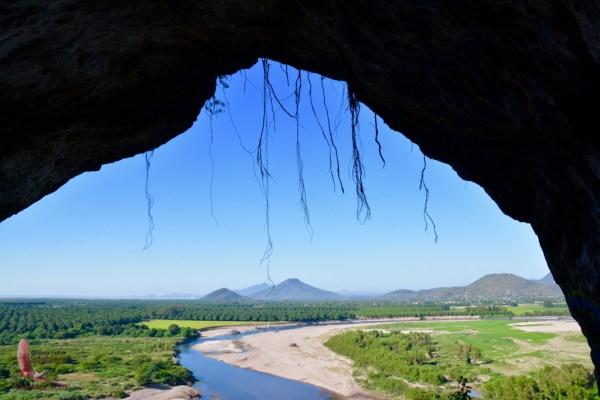
This week I learned from our friend, Joaquin Hernández, that Chametla—just 90 minutes from Mazatlán in the municipio of El Rosario—is the most important archeological site in all of northwestern Mexico! In Chametla are at least two pyramids built in pre-Hispanic times by the Totorames. Both were sacred sites, with platforms on top for sacrifices. Hernán Cortés himself visited Chametla, in 1535, before traveling over to La Paz; there are written documents and paintings that record this fact. Legend has it that he sat in the Cueva del Diablo looking out over the entire valley.
Near Chametla were 22 pre-Hispanic towns. What attracted so many Totorames to Chametla? The area is home to seven hills, which contain many caves. The Rio Baluarte runs through it; it’s very close to the Pacific Ocean; it’s fertile land; there’s jungle as well; and it’s right in the middle of the wonderful estuary system where historically mangroves and shrimp have thrived. In ancient times, there were three regions in southern Sinaloa: Sinaloa, Culiacán, and Chametla. Chametla comprised the territory from Escuinapa in the south to Piaxtla in the north. Only later was Mazatlán founded (on the present site of Villa Unión).
So, where are these pyramids? The first is the setting of the church in Chametla, at the foot of Cerro de San Pedro. I took some photos, but the pyramid is much easier to see live and in person. The church is built at the top, on the platform of the pyramid, while the lower part of the pyramid goes way beyond the church and down the hill. You can see that it’s man-made.
In 1935, when they were renovating the church, they found a secret passageway behind the altar that led to an underground cave. There they found “pagan” icons and relics, so the church quickly sealed it all back up. There was a second entrance to the cave just outside the church, at the entrance to where the original church was located. That cave entrance is now covered with a huge boulder. Click on any photo to enlarge it or view a slideshow.
Cool, huh? Not as visually stunning as a Chichen-Itza, by any means, as this pyramid has been built on and tweaked over and over throughout the millennia; it’s located right in the center of town. But, you can most definitely see its vestiges. The conquista of course was not just about conquering territory or even people; the conquistadores wanted to conquer the entire culture. So many churches are built on sacred sites of the indigenous peoples, as in Chametla.
And where is the second pyramid? It’s a 400-meter pyramid on which the local cemetery is built, also clearly visible. Local people say that when graves are dug, they almost always dig up pottery and other relics from the Totorame. The best specimens of these can be found in the small museum that is right next door to the church.
.


If you go to Chametla, I’d urge you to hike the 365 steps up El Cerro de la Cueva del Diablo. At the top is a man-made cave, obviously another sacred site, with a view of the entire river valley, estuary, ocean… The view is spectacular. It is in the cave that you’ll see an indentation that looks like two butt cheeks, and legend says that’s where Cortés sat. While he wasn’t in Chametla long enough to carve a seat, he may have enjoyed the gorgeous view, with the opening of the cave mirroring the curve of the hill it faces. On many of the hills in the area you’ll find platforms, indicating they were sacred sites; Loma de Ramírez has a 100 meter x 100 meter platform. The area is splendid for hiking, with a diversity of flora and fauna as well as elevation and lots of water.
.
.
by Luis Alfonso Grave Tirado (INAH Sinaloa/Mazatlán Archaeological Museum)
Productive Intensification and Ideology in the Salt Marsh of Escuinapa, Sinaloa. Prehispanic Settlement and Ethnohistorical Data
ABSTRACT. The salt marsh area of Escuinapa, Sinaloa, is part of the so-called Marismas Nacionales, an extensive network of coastal lagoons, marshes, swamps and mangroves in southern Sinaloa and northern Nayarit (Mexico). Thanks to the results of three field seasons of the Archaeological Project Marismas del Sur de Sinaloa and some rescue excavations, it has been possible to establish the prehispanic settlement patterns in the area of the municipality of Escuinapa. Two stages were recognized in which the occupation and exploitation of the estuary’s resources intensified, coinciding with the construction of ceremonial spaces precisely in the historically most productive areas, both in fishing and salt extraction. Such was the importance of these activities that those who practiced them had their own gods: the fishermen worshiped Nycanori and salt workers Narama. It is clear here the use of ideological mechanisms to intensify the production of estuarine resources.
.
Over the past 40 years, the Mexican Pacific coast has undergone a significant transformation due to the introduction of aquaculture techniques, particularly shrimp farms, which have noticeably impacted the coastline. The marshland area of southern Sinaloa, between the Baluarte River and the Teacapán Inlet, has been no exception; on the contrary, it is one of the most affected. Furthermore, in the 1980s, it was subjected to intense looting of shell middens (both natural and man-made) for the purpose of using shells as fill material in the construction of many of the local roads and the airport in Teacapán, a small fishing village [1] .
Partly due to this situation, the Southern Sinaloa Marshes Archaeological Project (PAMSS) was proposed in 2009. Between 2010 and 2014, three field seasons were carried out, every other year, all in the western part of the Escuinapa marshland area, including a portion of Palmito del Verde Island and the entire Teacapán Peninsula, as well as the western slope of Cerro del Muerto (Grave Tirado 2011, 2012b, 2015). The eastern area, meanwhile, was investigated at the end of the last century through archaeological salvage work related to the construction of the Villa Unión-San Blas highway (Grave Tirado 2000, 2005). In addition, some inspection visits have been carried out (Grave Tirado 2016a), so in recent years we have reviewed practically all of the Escuinapa marshes, with the exception of some islands.
Unfortunately, excavations have been carried out at few sites; even so, we are in a position to establish with some clarity the regional settlement pattern; that is, how the different archaeological sites relate to the surrounding landscape and their social environment, in other words, to other settlements and areas of economic and ritual activity. This will allow us to approach the understanding of certain aspects of the past, such as how the environment was exploited and the social and political organization under which this exploitation occurred; that is, how space was appropriated and used, how this same space was transformed into a cultural landscape (Prieto Rodríguez 2011), and even whether it was sacralized, or, to put it in the terms of Knapp and Ashmore (1999), how the environment was mediated by humans.
In sum, I agree with Sugiura Yamamoto (2009) that settlement pattern analysis is “a more efficient methodological and technical resource in terms of time, cost, and results, and perhaps the only one that allows us to obtain a better and more comprehensive understanding of regional history.” And in areas like northwestern Mexico, so far removed from the official budget, sometimes there is no alternative but to conduct only surface studies.
A distinctive feature of the state of Sinaloa is the narrowness of its coastal plain (considering this as the strip between the Pacific Ocean and the 150 meters above sea level of the Sierra Madre Occidental); this narrowness, however, is much more pronounced in the southern extreme, where the flat area barely exceeds 20 km in width, a good part of which is covered by wetlands that make up the so-called Marismas Nacionales (Figure 1).
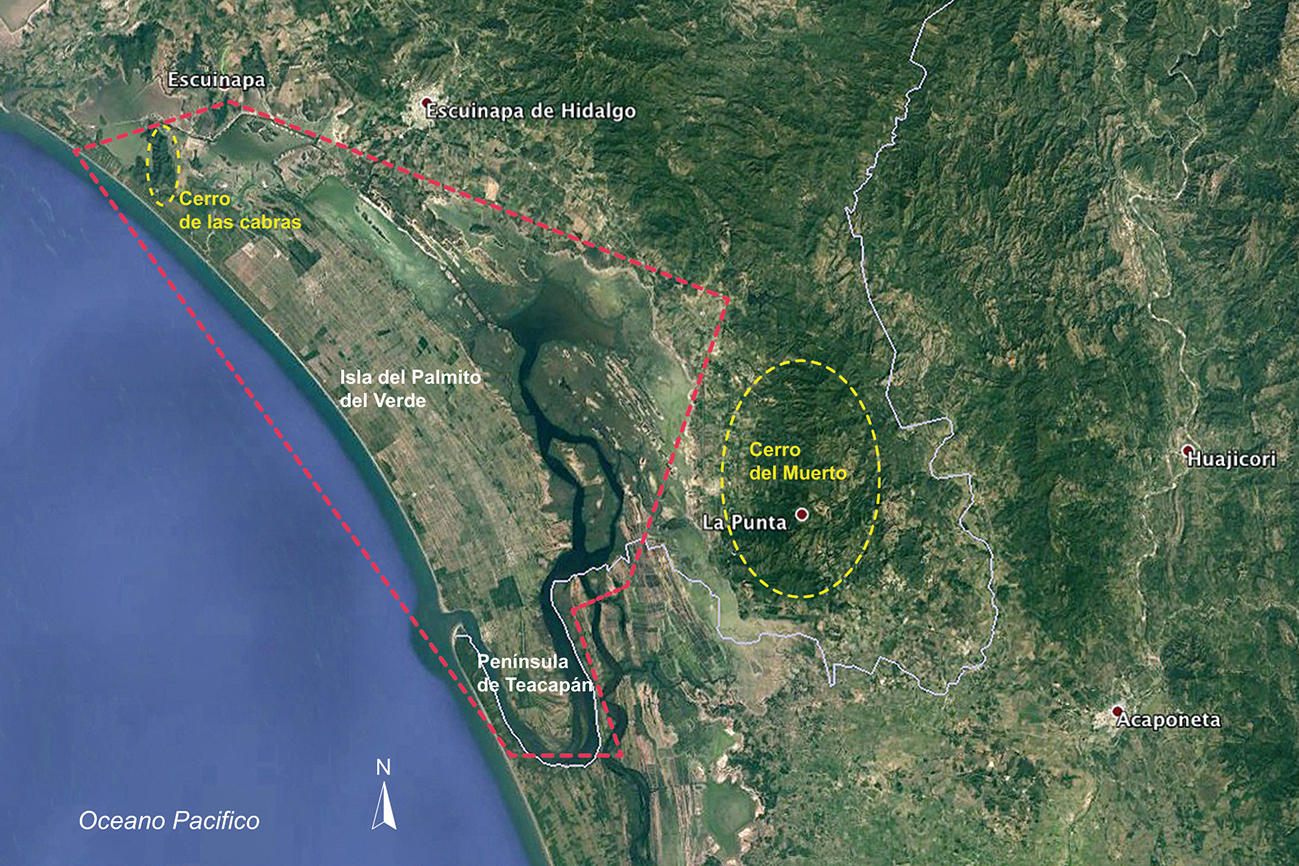
Figure 1. The marshland area of Escuinapa, Sinaloa (© Google Earth image, 22°41’08.97”N 10538’58.73”, modified by the author [DAO Richard Bertaux]).
The estimated area of wetlands is currently 38,670 ha, of which only 5,540 (14%) are permanently flooded. The rest is susceptible to flooding only during high tides and especially during the rainy season (Ramírez Zavala, Cervantes Escobar and Tapia Hernández 2012: 120-121); however, 50 years ago the subtidal zone was almost 16,000 ha (Ramírez Zavala, Cervantes Escobar and Ramírez Zavala 2012); and it was probably even more extensive in pre-Hispanic times (Foster 2017b).
However, even areas that remain flooded year-round, such as the Agua Grande lagoon, are very shallow, since communication with the sea occurs through narrow, winding channels that mitigate the effect of the tides. On the other hand, most of the freshwater inflow occurs during the rainy season and is practically nonexistent during the dry season, resulting in high salinity (Cervantes Escobar and Ramírez Zavala 2012: 44; Ramírez Zavala, Cervantes Escobar and Ramírez Zavala 2012: 67-68). These characteristics, however, have allowed the development of diverse habitats such as “intertidal vegetation, marshes, sandy beaches, muddy bottoms, permanently submerged vegetation, rocky and shell reefs, planktonic communities and mangrove vegetation, among the most notable” (Ramírez Zavala, Cervantes Escobar and Ramírez Zavala 2012: 75).
The mangrove deserves special mention [2] , as under its shade a large number of animal species develop that are susceptible to exploitation both now and in pre-Hispanic times: at least 61 species of fish, among which we can mention the sierra (Scomberomorus sierra) , the chihuil or catfish ( Bagre panamensis , Arius seemani ), the lisa ( Mugil curema , Mugil cephalus ), the pargo ( Lugnatus sp.), the snook (Centropomus sp.), the curvina ( Cynoscion sp.) and several mojarras; as well as various shelled mollusks, including oyster (Ostrea corteziensis) , pata de mula ( Anadara grandis and Anadara tuberculosa ) and clams ( Tivela byronensis and Chione californiensis mainly), and crustaceans such as the crab (Callinectes sapidus) and the white shrimp (Litopenaeus vannamei) .
The region is also an important bird sanctuary and, according to the National Commission for the Knowledge and Use of Biodiversity (CONABIO), “regularly hosts more than 70,000 waterfowl and 104,000 shorebirds.” Among the former, several species of ducks, herons, and moorhens stand out, and the American avocet (Recurvirostra americana) is prominent among the latter; in addition to hawks, the military macaw (Ara militaris) , and parakeets (Forpus cyanopygyus) ; although a total of 396 species have been identified.
Meanwhile, on the island between the sea and the lagoon system (the so-called Isla del Palmito del Verde [3] , to which the Teacapán peninsula belongs), although the sandy soil does not allow for the presence of surface water, it does contain an underground aquifer of almost 267 km² , with a storage volume of 21.7 million m³ , which is replenished each rainy season (Ramírez, Cervantes Escobar, and Ramírez Zavala 2012: 81). Freshwater is less than one meter deep, making agricultural practice possible through the construction of ponds (jagüeyes).
The high productivity and importance of fishing and salt production in the Marismas Nacionales area are clearly demonstrated by the development of highly efficient artisanal fishing systems. For fishing, one such system is known as “tapos” or “cierras,” which consists of a structure of forked posts that completely spans one of the narrow estuary channels. These posts support a type of folding curtain traditionally made of otate (Gadua amplexifolia) poles , but since at least the 1970s, palm petioles have been used instead, and in recent years, PVC pipes have also been employed. The intention is to create an opening between the poles that allows the entry of shrimp postlarvae (5 to 12 mm) while preventing juvenile shrimp of at least 120 mm from escaping and returning to the sea (Macías-Regalado and Calderón-Pérez 1980). Using the same otate poles, semi-enclosed spaces about two meters in diameter called “chiqueros” were constructed where the shrimp congregated and from where they could be harvested using net “spoons.” To prevent the nets from getting stuck in the mud, the bottom of the chiquero was filled with mollusk shells, although gravel is now used. The fisherman stood on a platform called a tapeste (Figure 2).

Figure 2. The “tap” of El Mezcal. Note the use of PVC pipes (© author’s photograph).
Although this technique reached its peak between the 1930s and 1980s, with up to 99 traps identified in the Marismas Nacionales region, 43 in Nayarit, and 56 in Sinaloa, yielding up to three thousand tons of shrimp (Chapa Saldaña 2007), it has pre-Hispanic origins [4] . The first mention of it appears in one of the accounts of Nuño de Guzmán’s conquest of Nueva Galicia between 1530 and 1533. The chronicle is attributed by J. L. Razo Zaragoza (2001) to Pedro de Guzmán, but J. García Icazbalceta (1980) originally published it as the Second Anonymous Account of Nuño de Guzmán’s Journey to Nueva Galicia . In any case, the chronicler had participated in the advance of the Spanish troops towards the Yaquimi River in 1533 and his return notes:
This town of Coliacan is called San Miguel: it is populated in a valley called Horabá, two leagues from the sea: the floodwaters rise to the town itself, through a river that passes through it: the river is stopped there with a wattle and daub of reeds, and they make a device for catching fish, so that even if there were another Seville there, it would be enough to supply itself with what is caught there of mullet and other kinds of very good fish. (Razo Zaragoza 2001: 282)
It is likely that “the river” refers to one of the estuary channels that once extended as far as the present-day town of Costa Rica in the Culiacán Valley, the original site of the Villa de San Miguel (see Ortega León and Grave Tirado, in preparation). The most detailed description of this system, however, is that of Bishop Alonso de la Mota y Escobar, who served as inspector at the end of the 16th century and refers specifically to southern Sinaloa:
The manner and time in which these Indians go fishing is in this way: they wait and attend to the waxing moons of November, December, and January of each year, in which, when the sea rises and enters through this river, a great quantity and diversity of large and small fish enter together to spawn in this river, and they commonly enter at night and not on the surface but through the depths of the water. The Indians are so skilled that, with their ear placed on the surface of the water, they feel and perceive the noise that the fish make at the bottom of the river as they pass. And at this time when the school of fish is rising upstream, the Indians are very quiet and calm, and when they realize that the rising tide is about to recede, they quickly throw out some reeds that they have ready, with which they block the entire river from bank to bank, and it reaches and touches the ground below, and they tie it tightly on both sides of the land. These weirs are made of thick, strong reeds, so tightly joined and fastened together that nothing but water can pass through them. Thus, when the tide rises and the sea returns swiftly to its natural basin, it carries with it the river’s waters, along with the great multitude of various fish that had flowed upstream. When they reach this sluice gate and barrier, the waters pass on, trapping the entire fishery, which, with the river’s outflow, is left almost completely dry. […] These operations, as mentioned, are carried out two or three times a year in large quantities, and such a quantity is caught that it supplies the entire kingdom of Galicia, and a large part of New Biscay and New Spain, with essential fish . [5] (Mota and Escobar 1966: 43-44)
Salt extraction, for its part, is not mentioned in the earliest documents, but it is highlighted in the late 16th and early 17th centuries. One of the few mentions comes from Bishop Mota y Escobar himself (1966: 43), who points out that in Chametla, salt “[…] is produced very close to here in some estuaries that come out of the sea, which when they dry out crystallize and become salt”; and in some of the saltworks, “[…] two thousand hanegas were produced each year” (ibid.: 42) [6] .
A document from 1608 specifies the location of the saltworks in the province of Chametla: “about six leagues from the promontory of Ichquinapan” ( Apud , Moreno Martínez 2010: 4). For his part, Lázaro de Arregui (1946: 104) describes the technique used in 1621: “which is obtained by making small ponds where the water that enters from the tides crystallizes, and in this way they usually produce 20,000 fanegas of salt some years”; that is, between 1,110 and 1,816 tons. We cannot be certain that this technique has a pre-Hispanic origin, but it is still in use today, although only the El Quarrán saltworks remains (Figure 3).

Figure 3. El Quarrán salt ranch (© author’s photograph).
The Escuinapa marshes are perhaps the most archaeologically investigated area in the entire state of Sinaloa, although their study began relatively late. Between 1967 and 1975, the National Marshes Project of the State University of New York at Buffalo was carried out , within which archaeological, ethnohistorical, ecological, and geomorphological investigations were conducted in the marshland area between the towns of Escuinapa, Sinaloa, and Cuautla, Nayarit (Foster 2017a; Scott 1974a and b, 1985, 1999; Scott and Foster 2000; Shenkel 1974).
In this relatively small area (140 km2 ) 594 pre-Hispanic archaeological sites were located [7] , of which the vast majority (557) correspond to oyster shell middens (Ostrea corteziensis) ; while only twenty are made up of clam shells (Tivela byronensis) , four of mule’s foot (Anadara grandis) and thirteen settlements that, in addition to accumulations of clam or oyster, present mounds of earth (Foster and Scott 2017b).
Unfortunately, neither the description nor the map (nor the reports nor R. Shenkel’s 1974 article) indicates the precise location of the oyster shell middens, so we don’t know what percentage of the 557 were located in Sinaloa. We do know that of the 20 clam middens, eight were located on the western edge of the Teacapán Peninsula, in Sinaloa, as well as the four mule’s foot middens, which are on the shores of the Agua Grande lagoon, in the municipality of Escuinapa. Finally, of the 13 settlements with earthen mounds, five are in Sinaloa: four directly on the edge of the marsh: El Mirador, Venadillo, Cristo Rey, and La Tarjea, and one more (Juana Gómez) on the coastal plain, but less than five kilometers from the marsh area.
The last one stands out due to the complexity of the arrangement of its nine mounds, which were distributed in two groups: one of seven mounds in the southwest grouped around a plaza, with the main mound more than five meters high. The other group is to the southeast and only had two mounds (Figure 4) [8] .
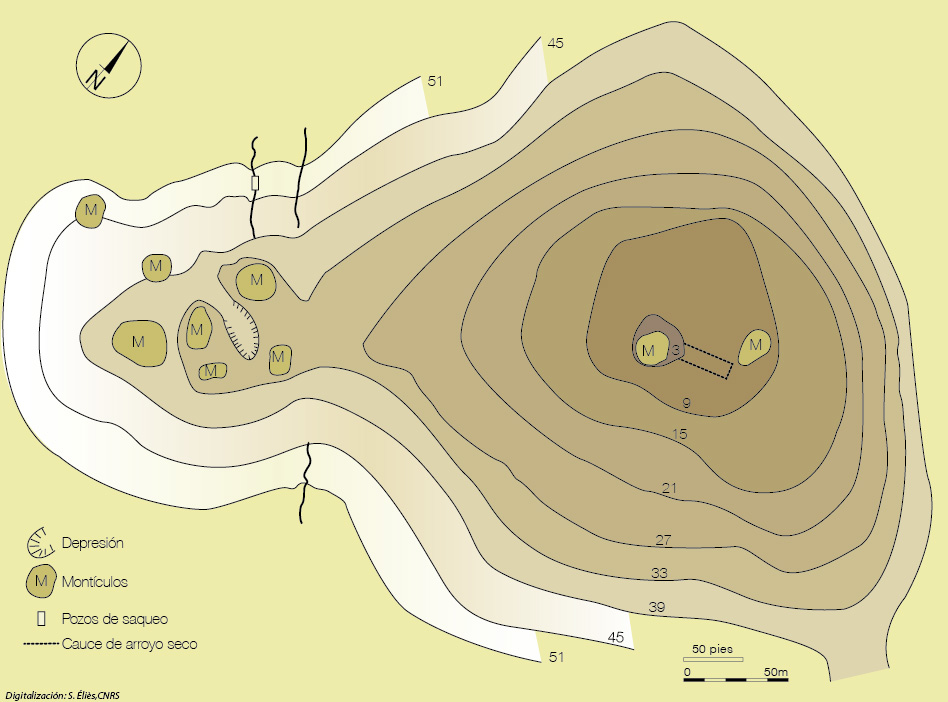
Figure 4. Topographic map of Juana Gómez (© modified from Wolynec et al. 1968 [DAO Sylvie Éliès]).
Foster and Scott (2017a) recognize two main occupation phases in Marismas Nacionales: the Estero period (300-700 CE), typified by clam shell middens, to which the entire settlements of Juana Gómez [9] and La Tarjea and one of the El Venadillo mounds correspond, as well as areas of four other sites in Nayarit. After the Estero period, they note an abandonment between 700 and 900 CE, due to continuous flooding, followed by the Conchera period (900-1531 CE), to which the 557 oyster shell middens and the rest of the earthen mounds correspond.
Special mention should be made of El Calón (Figure 5), one of the four archaeological sites whose main component is the shell of Anadara grandis . El Calón is distinguished from the other 580 shell middens located in the Marismas Nacionales Project by both its architectural characteristics and its chronology. El Calón is a truncated cone more than 80 m in diameter at the base and more than 20 m high, constructed entirely of mollusk shells, most of them indeed of the Anadara grandis species .
Based on radiocarbon dates for five of the shells, Foster and Scott conclude that it was erected between 2400 and 2200 BC, with at least one enlargement between 1600 and 1200 AD (2017a), which would make it the earliest monumental structure in the Americas [10] . However, other participants in the Marismas Nacionales Project, such as R. Shenkel (1974), who was directly in charge of the exploration of El Calón, and D. Cottrell (1972), based on the geomorphology of the area, consider that it was built between 700 and 1000 AD.

Figure 5. Plan of El Calón with the location of the excavation units (© drawing by the author).
With one of its objectives being to resolve this question, the El Calón Archaeological Project was launched (Grave Tirado 2003, 2006). Both the truncated cone and the platform were explored (Figure 5), and it was determined that their construction was planned and occurred at a single stage. Furthermore, despite the frustrating scarcity of archaeological materials, two anthropomorphic figurines of the “White Bathed” type were found, allowing us to establish that it was used, if not constructed, between 500 and 750 AD.
Finally, as part of the archaeological salvage work for the construction of the San Blas-Mazatlán highway (Grave Tirado 2000, 2005), nine settlements were recorded on the shores of the marsh [11] , but curiously only two of them (valle de la Urraca and the island of Huanacaxtle) are shell middens and both are located in the interior of the estuaries, on separate islets. The rest are located in the flat area between the brackish waters and the mountains and were basically occupied by farmers who also fished, since, at least in the three that were explored through excavations (San Miguel La Atarjea, Las Lomitas and Las Mulas), fish bones, crab claws and clam shells (Tivela and Chione) , mule’s foot (Anadara grandis) and oyster (Ostrea corteziensis) were recovered , some of the latter with clear evidence of having been subjected to the smoking process.
The two largest sites, San Miguel La Atarjea and Las Lomitas, feature earthen mounds and were occupied between 250 and 1100/1200 AD, while the remaining sites, including the two oyster shell middens, were occupied between 1100/1200 and 1531 AD.
Thus, by the end of the first decade of the 21st century, we had data indicating sustained use of the estuary’s resources both within the lagoon system and from inland sites; however, the existence of El Calón led us to question the intensity of its exploitation. To answer this and other questions, the Southern Sinaloa Marshes Archaeological Project (PAMSS) was implemented.
Although this project prioritized documenting pre-Hispanic remains, it also sought evidence from the colonial period and from modern and contemporary Mexico. When possible, informal interviews were even conducted with fishermen and salt producers who still practice traditional techniques.
The area surveyed covers approximately 155 km² , where 182 archaeological sites have been recorded. Of these, 136 are from the pre-Hispanic era, only one could be definitively dated to the Colonial period, and two to the 19th century. Conversely, 22 correspond to the 20th century (mostly saltworks), and 12 are contemporary, including three dams and one saltworks still in operation. Here, we will focus on the pre-Columbian period.
Of the 136 sites, 55 are oyster shell middens and 32 are clam middens; 37 settlements feature small earthen mounds, 14 of which also contain accumulations of shells. Four of the sites were established as saltworks, and three other sites were located on the shores of the Agua Grande lagoon with architectural structures built with mollusk shells, particularly the abalone (Anadara grandis) ; in addition to five settlements on hills, four of which appear to have functioned as ritual spaces, three on Cerro del Muerto and one on Cerro de las Cabras (Figure 6).
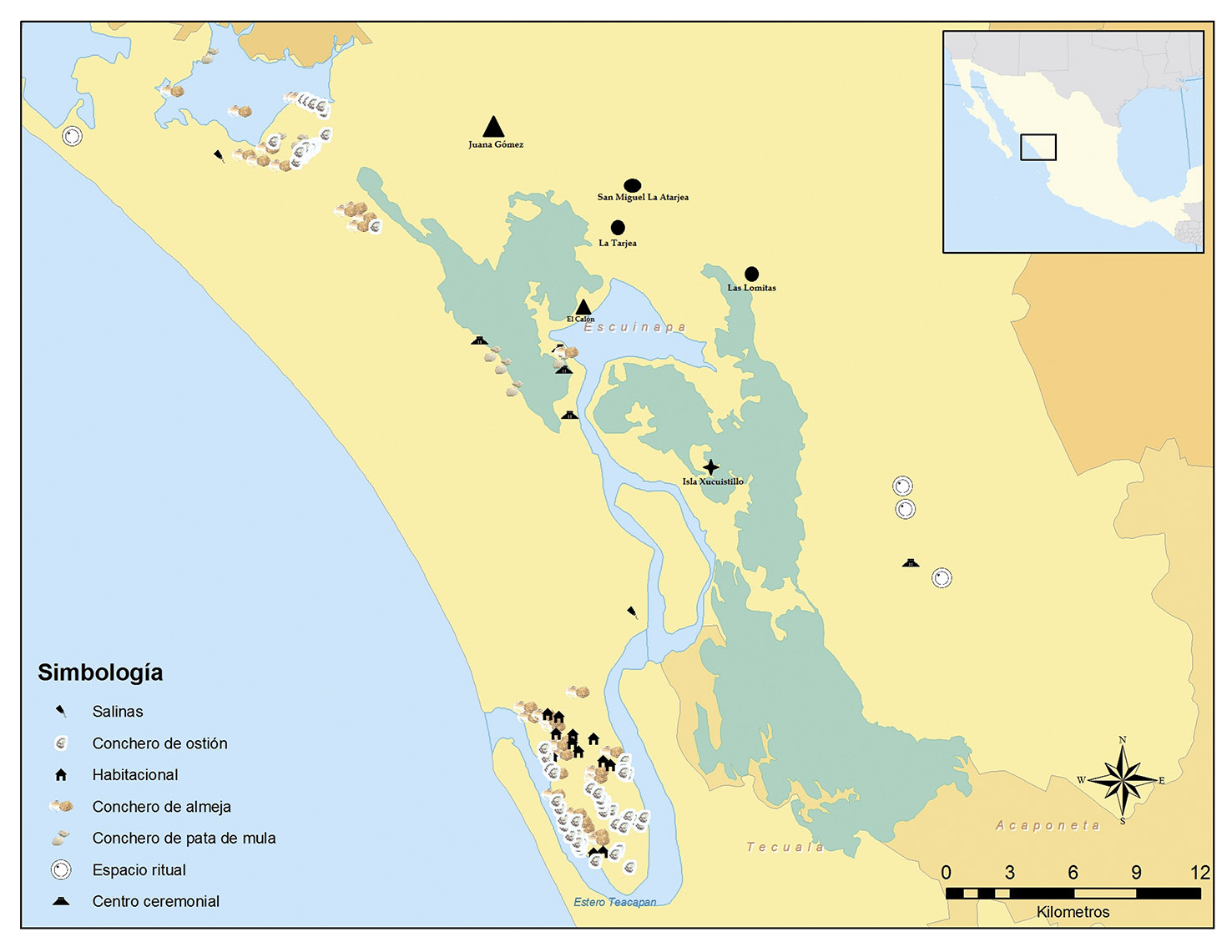
Figure 6. Map with the sites registered in the PAMSS and other settlements mentioned in the text (© drawing by Cinthya Vidal, modified by the author).
Most clam shell middens are located on the Teacapán Peninsula. Although they are generally small, no more than 30 m in diameter and less than 1 m high, two (MSS-158 and MSS-162) were found on the shore of the Los Malines estuary, opposite Cerro de las Cabras. These middens are linear, extending for just over 1.5 km, although in some areas the shell is only superficial, while in others it is more than a meter thick. While those on the Teacapán Peninsula consist of Tivela byronensis , those at Cerro de las Cabras also contained the species Chione californiensis , and even some Anadara grandis , A. tuberculosa (mule’s foot clams), and Ostrea corteziensis (oysters). Nevertheless, all of them correspond to the Baluarte phase (500-750 AD).
For their part, most of the oyster shell middens are also located on the Teacapán Peninsula, with only a few in the area surrounding Cerro de las Cabras. In this latter location, site MSS-148 stands out, measuring over 120 m in diameter and exceeding one meter in height in some areas; the other 36 sites average 35 m in diameter and range in height from 1 to 3 m. The dominant, almost exclusive, species is Ostrea corteziensis , and the chronology of all sites was established within the Acaponeta (900-1100/1200 CE) and El Taste-Mazatlán (1100/1200-1531 CE) phases, with a greater presence of materials from the latter.
Of the 37 sites with earthen mounds, 32 are located on the Teacapán Peninsula in slightly elevated areas that are not flooded with brackish water, and the rest are in the area surrounding the Agua Grande lagoon. Almost all consist of one or two small hills, sometimes associated with shell middens. The sites designated MSS-21 Sarmiento I and MSS-23 Sarmiento II are particularly noteworthy. The former covers almost 36 hectares and has 14 earthen mounds and 3 clam middens; while Sarmiento II has 20 earthen mounds and covers more than 60 hectares (Figure 7). However, both were interpreted as scattered hamlets, with cultivated areas interspersed among the houses. Both were inhabited during the Baluarte phase (500-750 AD) and although the first was reoccupied in the El Taste-Mazatlán phase (1100/1200-1531 AD), the second was not. In fact, 20 of the 37 residential settlements were occupied between 500 and 750 AD, of which only 3 were reoccupied in the Acaponeta phase (900-1100/1200 AD) and from that moment on another 17 sites were inhabited, which remained occupied until the arrival of the Spanish.

Figure 7. Sketch of the MSS-23 Sarmiento I site (© drawing by the author).
The presence of grinding stones, axes, and spindle whorls, as well as pottery and chipped stone artifacts, along with their location, at these sites indicates that part of their subsistence depended on agriculture, despite the absence of surface freshwater in the area. In fact, it could be argued that the presence of these materials does not necessarily prove that crops were cultivated in this area, since agricultural products could have been obtained through trade with settlements on the plains and in the Baluarte River basin, or even, in the case of the spindle whorls, through the harvesting of wild cotton, which is relatively abundant in the marshland. However, it is important to remember that freshwater is abundant underground and is found at a depth of less than one meter. Is it possible that they accessed it by constructing water reservoirs, as is common practice today [12] ? We do not know. The settlement pattern indicates the existence of a permanent or semi-permanent population in areas suitable for cultivation. However, it is certain that the diet was supplemented by fishing, shellfish gathering, and bird hunting.
The other important activity in the marshland area was salt extraction; however, of the 55 saltworks registered so far in the PAMSS (Marshland Archaeological Park), only four show pre-Hispanic evidence. Panzacola is a special case, because unlike the other saltworks where the earth mounds resulting from the construction of the salt pans are randomly distributed, here they show a clear order (Figure 8), leading me to believe that, in addition to being a saltworks, it also functioned as a small ceremonial center. Supporting this interpretation is its location between Cerro del Muerto to the east and Cerro de las Cabras to the west. And it is not the only one.

Figure 8. Sketch of Panzacola (MSS-114) (© drawing by the author).
We have already seen that El Calón is also located in these conditions. It consists of a single, uninterrupted structure that culminates in a quadrilateral surface measuring 12 x 11 m, which is more or less level—or at least that was the original intention. However, due to erosion, it now has a slight slope on all four sides. Its base measures 85 m from east to west and 88 m from north to south, and with a height of almost 21 m, it is a truly monumental building in the middle of the marsh (Figure 9). A pregnant ceramic figurine and three small stone phalluses were found at its summit. Its interpretation as a temple seems beyond doubt (Grave Tirado 2010).

Figure 9. Photo of El Calón. In the background, the Cerro del Muerto can be seen (© photograph by the author).
In the immediate vicinity of Agua Grande Lagoon, we recorded three other settlements with architectural structures also built from mollusk shells. At least two of them feature monumental buildings. MSS-96 El Macho is a platform measuring 40 by 15 m at its base and nearly 6 m high, which stands out clearly in the middle of the marsh. MSS-95 Isla del Macho, while its structures are smaller, exhibits greater complexity. To the southwest is a U-shaped or horseshoe-shaped structure, almost 45 m on each side, with walls just over 8 m wide and nearly two meters high. To the northeast is a platform measuring 70 by 30 m, upon which stands a possible ballcourt and two small mounds (Figure 10).

Figure 10. Sketch of the Isla del Macho site (MSS-95) (© drawing by the author).
Unfortunately, the only materials recovered from these sites are flakes of green mud obsidian and some polished stone tools, so we have no evidence to even establish their relative chronology. However, given that ballcourts at neighboring sites such as Amapa (Meighan 1976) and Chametla (Grave Tirado 2017a) date from after 750 CE, I am inclined to consider them late [13] . In any case, their presence does allow us to glimpse the importance of fishing and salt extraction in pre-Hispanic times, which led to the construction of these ceremonial spaces in what we can consider the heart of the marshland area and precisely in the same area where the largest number of saltworks and dams have historically been concentrated.
In the worldview of pre-Hispanic Mexico, east and west were the most important directions, but north and south were also significant. To the north of these sites is Cerro del Yauco, another of the region’s representative hills, and to the south is Boca de Teacapán, where the waters of the estuary meet the sea. If we draw a line between Cerro del Muerto and Cerro de las Cabras (east-west) and another between Cerro del Yauco and Boca de Teacapán (north-south), at the center of the cross lies Laguna Agua Grande, and with it, El Calón, Isla del Macho, El Macho, and Panzacola, forming the center of the axis mundi (Figure 11).

Figure 11. Map showing the location of the ceremonial centers of the Escuinapa marshes in relation to the landscape elements (© modified on INEGI map Escuinapa F13-5).
In the Colonial era, each of the principal gods of the region had their dwelling place in a specific point of the landscape: “They pretended that the table was the Sierra, the statue of Pyltzintli its seat the sun,” that of Nicanori an arm of the sea, that of Narama a hill they call “horse’s head” and by another name Ychamet which means the House of Maguey and Mezcal, that of Uxxu a rock that is inside the sea…” (Arias and Saavedra 1990: 300). Pyltzintli was the Sun, Uxxu was a goddess of fertility, Nycanori was worshipped by fishermen and bird breeders, and Narama was worshipped by salt workers, those who made wine or pulque and planted chili peppers (ibid.: 209-300).
Currently, the indigenous people of the Sierra del Nayar still conceive of the world as a quincunx with the four directions and the center marked by prominent elements of the landscape (Coyle 2003; Jáuregui and Magriñá 2016; Neurath 2003a, byc); however: the east-west axis has preeminence over the north-south axis.
Exactly on this quincunx axis in the marshland area, but on the other side of the Agua Grande lagoon, an offering was recently discovered accidentally on Xucuistillo Island (Grave Tirado 2016a). It consists of two relatively small bowls (14 cm in diameter by 5 cm high) and five anthropomorphic figurines (Figure 12). The first two are of the “Medium Polychrome Chametla” type, while the figurines correspond to the “Painted White Bath” type, both indicative of occupation between 500 and 750 CE.
The five figurines are seated. Three of them are directly “on the ground” and are female. One has her breasts exposed, and the other two have a kind of mantle spread out in front of them. The other two are male and are seated on stools, one circular and the other quadrangular. In addition to headdresses and necklaces, they wear a kind of loincloth, reminiscent of the hip protectors worn by ballplayers. An offering in an ancient space for playing the ballgame [14] ?

Figure 12. Components of the Xucuistillo Island offering (© photograph by the author [DAO Sylvie Éliès]).
In other words, increased production and the construction of places of worship occurred more or less simultaneously, indicating that one group was already superior to the others [15] ; and this small group was the one that must have encouraged the production of surpluses. Power, according to H. Claessen (1979: 7), is nothing more than “the capacity to impose one’s own will on others.” For his part, M. Weber (1977: 45) states: “Generally speaking, we understand ‘power’ to be the possibility for one or more people to carry out their own will in a common action, even against the opposition of other participants in the action.” To achieve this, force is not always used; threats, manipulation, influence, and authority are also employed, and most of the time this is sufficient. In fact, by exercising physical force, rather than demonstrating power over another person or persons, one reveals a scarcity or even a lack of power over them (Luhman 1995).
So, if force alone wasn’t enough, how were the fishermen, salt workers, and shellfish gatherers of the Escuinapa marshes compelled to produce surpluses? Initially, it may have been through force; however, for long-term control to be effective, ideological mechanisms were necessary. Ideology is “the set of ideas, beliefs, concepts, and so on” presented as common to the entire society, but which in reality belong to the ruling group to legitimize its dominance over the rest of society (Zizek 2003). Archaeologically, ideology is materialized through monuments, symbolic objects, and iconography (Earle 1997: 151); these are indicators of public ceremonies.
The location and orientation of El Calón leave no doubt about its function: it was a stage for collective celebrations (Grave Tirado 2010). Furthermore, the construction of this enormous truncated cone involved a massive investment of labor, as we calculated that 275,746,791.5 shelled mollusks were needed, requiring a well-established organizational capacity.
Thus, ideological manipulation continued to play a significant role in the commercial exploitation of the estuary, primarily through the periodic celebration of collective festivals. In this regard, it is noteworthy that precisely where the most important festival in the municipality of Escuinapa, the Fiesta del Mar de las Cabras [16] , was celebrated until half a century ago, there is evidence of a pre-Hispanic ritual space (Grave Tirado 2016b). The festival is celebrated during the third week of May, practically at the end of the salt season and the beginning of preparations for planting.
Meanwhile, among the remains of the sites destroyed in Teacapán in the 1980s, some elements were recovered that indicate the presence of elite groups, related at least to the ruling group. One is a vessel with Codex-style decoration depicting a possible deity (Figure 13) [17] and the other is a batch of 1699 Spondylus shell beads and 223 greenstone beads, two of which appear to be turquoise (Figure 14) [18] .

Figure 13. Codex-vessel that probably comes from the marshland area (© private collection, photo courtesy of Mauricio Garduño [DAO Sylvie Éliès]).

Figure 14. Lot of shell and greenstone beads recovered at a site on the Teacapán peninsula (© INAH Sinaloa archive, photograph by Israel Cristian Pérez Herrera).
The possession of Codex-type vessels was a clear indicator of high social status in pre-Hispanic Mexico, at least among the Maya (Caso Barrera and Aliphat F. 2008; Fierro Padilla 2016). It is also well known that in ancient Mexico, shell and greenstone necklaces were part of the regalia of high-ranking individuals, whether rulers, priests, or warriors (Ekholm 2008; López Mestas Camberos and Ramos de la Vega 2006; Olguín 1994, to mention a few examples from Western and Northwestern Mexico).
In the 16th century, the warriors of Chametla adorned themselves “with many feathers, shells, snails, and seashells” (Obregón 1988: 102-103). Likewise, in plate 67 of the Lienzo de Tlaxcala (Chavero 1979), which depicts the battle of Chyametlán [Chametla], one of the Chametlan warriors wears anklets with beads. He is the only one with an elaborate feather headdress, dressed in a xicolli ( a type of tunic), and wearing a large nose ornament, which undoubtedly reinforces his identification as a warrior chief (Olivier 2015: 514-565 and 587-588). Furthermore, it is worth noting that some of the figurines from Xucuistillo Island seated on thrones (another symbol associated with power) also wear necklaces and headdresses.
In the Escuinapa marshland area, 160 pre-Hispanic archaeological sites have been recorded [19] (Table 1). Of these, 41 correspond to clam shell middens, 56 to oyster shell middens, 49 showed residential mounds (sometimes with associated shell middens); seven sites have architectural structures built with mollusk shells, particularly mule’s foot shells, four saltworks, and three ritual sites.
Table 1. The marshland archaeological sites recorded in each project and their tentative chronology (© prepared by the author).
| Project/Site Type | National M Project (1967-1975) | San Blas-Mazatlán Project (2000 and 2005) | PAMSS (2010-2014) | Inspection visits | Total | Main timeline |
| Clam shell middens | 8 | 32 | 1 | 41 | 500-750 AD | |
| Oyster shellfish beds | ¿? | 1 | 55 | 56? | 900-1531 AD | |
| Mule’s foot structures | 4 | 3 | 7 | 500-750 dC 900-1100/1200 dC | ||
| Residential (earth mounds) | 5 | 7 | 37 | 49 | 250-500 AD 500-750 AD 750-900 AD 900-1531 AD | |
| Salt mines | 4 | 4 | 900-1531 AD? | |||
| Rituals | 1 | 1 | 1 | 3 | 500-750 AD? | |
| TOTAL | 17 | 9 | 132 | 2 | 160 |
Occupation began around 250 AD in the eastern zone, that is, the flat area between the marshes and the mountains, the most suitable zone for agriculture. The largest settlement from this period is Juana Gómez, which even has a small central plaza. Later, between 500 and 750 AD, the small Teacapán peninsula was also inhabited, and although agriculture was likely practiced there as well, its location is more related to fishing and shellfish gathering. This is when the more or less intensive exploitation of clams began, and the construction of El Calón also dates to this period, suggesting that fishing intensified as well.
During the period from 750 to 900 AD, the western part of the marshes became practically uninhabited, with only four settlements remaining occupied. In contrast, although the population decreased, the eastern area remained occupied [20] .
Between 900 and 1531 AD, even though the eastern zone was practically depopulated, the Teacapán peninsula was reoccupied and the exploitation of the estuary’s resources increased; the clearest evidence is, of course, the large number of oyster shell middens, although it is likely that the rest of the shell architectural structures are from this period, as are the saltworks sites, particularly Panzacola.
In summary, the occupation of the Escuinapa marshes began sometime between 250 and 500 CE, and the exploitation of their resources took place between 500 and 750 CE. A notable decrease followed between 750 and 900 CE, with further intensification from 900 CE until the arrival of the Spanish. The settlement pattern suggests that the intensification of production was encouraged by the ruling group through the celebration of collective festivals, likely at the beginning and end of the fishing and salt extraction seasons, which roughly correspond to the rainy and dry seasons, respectively.
In this sense, the location of the ceremonial centers in relation to the sunrise on the summer solstice at Cerro del Muerto and the sunset on the winter solstice at Cerro de las Cabras becomes relevant. Both events still mark the beginning and end of each season among the indigenous groups of Nayar. The execution of these ceremonies makes the person who performs them, usually a member of the group in power and sometimes the ruling head himself (Grave Tirado 2017b), the guarantor of the continuity of the world [21] .
Even so, the order breaks down and El Calón ceases to function and for a time (750-900 AD), the occupation and exploitation of the Escuinapa marshes decreases, although not in the neighboring area of the lower basin of the Baluarte River where the population increases and the institutionalization of power is accentuated (Grave Tirado 2017a), which implies a political readjustment.
However, from 900 AD until the arrival of the Spanish, the islands were once again extensively occupied and exploited even more intensively than before. New ceremonial centers were also built (Isla del Macho and Panzacola).
However, neither Juana Gómez nor any other site in the marshes in any of the different periods meets the necessary conditions to have been the seat of a power capable of erecting El Calón and the rest of the ceremonial centers, and, on the other hand, the southern region of Sinaloa-northern Nayarit and in general the entire northwestern coast was divided throughout its pre-Hispanic history into small territorial units (Figure 15), with a fairly limited area of political influence (Grave Tirado 2012a; Ortega León and Grave Tirado 2018, in preparation).
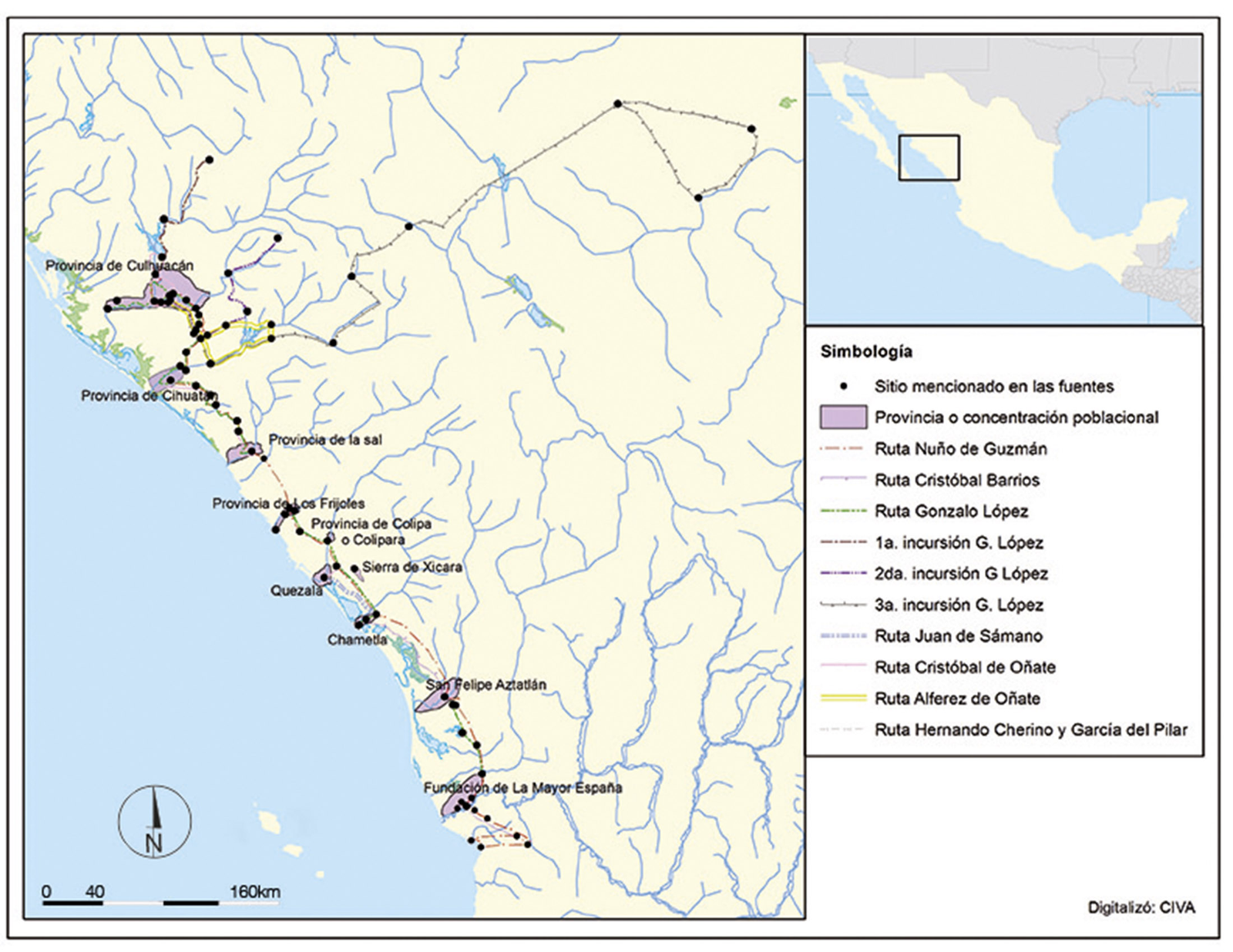
Figure 15. Map showing the provinces on the Nayarit and Sinaloa coast at the time of the arrival of the Spanish (© drawing by Cinthya Vidal).
Now, if we consider that they are located almost in the center of the southern Sinaloa-northern Nayarit region, a culturally and linguistically homogeneous area since it is possible to reach it by water from practically any point within it, could this be one of those strange cases of cooperation between politically autonomous groups, with these spaces having been built and used by all the small political-territorial units? That is, they would have functioned as a kind of sanctuary, that is, a sacred space of “collective recognition and convocation, which become centers of the ethnoterritories” (Barabas 2003: 25).
The existence of these types of sanctuaries is historically documented. During the Colonial period, the Nayarit settlement of Tzacaymota, although located in Cora territory, was also visited by Tzanames, Huichols, Tepehuanes, Vigitecs, and Totorames, and it was “[…] a common belief that all the native peoples of this land send offerings to this temple of Nayarit, the first fruits of all their harvests” (Arias and Saavedra 1990: 305). Ceremonies were also held there, “with many rancherías gathering (on the March moon)…, for which they hold many dances and celebrations that they call mitotes” (ibid.: 293). Furthermore, in the main town of the marshland area in the 17th century, Olyta, located precisely at the mouth of the Teacapán River, propitiatory ceremonies for a good catch were still performed.
It is customary in the town of Olyta at the beginning of the waters, for all the natives and elders to gather and choose the most worthy one as captain or atzaquani (to close the waters of the shrimp fishery)… and when it is time, which is recognized by the entrance of the sun, that it is the Nycanori or in their natural language, which is the totorame Yequi, which they interpret in the Mexican language quihaihuini, which is rainmaker and creator of the waters and the fish. The captain then immediately fasts for five days, during which he eats neither salt nor chili and remains chaste throughout the harvest, believing that if the shrimp is to die, he offers after the fast a ball of cotton seeds wrapped in twine and hanging from it some red heron feathers, and as he goes to bed at night he says these words: Neamoc, tamex yequi, which mean: “Lord, son of the rain god and creator of birds and fish, give us shrimp,” repeating these words many times, with which they say he appears to him in dreams and answers him: Amyn Moctanex Noxuu, which means: “Friend, I will give you shrimp,” and in the morning he informs the people, giving an account of what happened, and then they discuss their fishing, offering in the waters wine that they call Alasán and other things, and the first one to go fishing is the said Atzaquani, who, after he takes out the first shrimp, they prepare a cup for him, a drink that they call Paxnal; who takes the shrimp that fit in his hand and throws them into the Paxnal and drinks and gives what is left over to the dogs (ibid.: 305-306).
And the production of shrimp and fish was so great that they could trade with nearby regions and even with distant areas. A. de la Mota y Escobar (1966: 42) says, for example: “they catch a lot of snook, shrimp and clams, which supply all the mining towns and other surrounding villages, and for this reason the Indians here have some wealth”; and L. de Arregui (1946: 98) adds: “and even to Mexico City, despite being 150 leagues away, they take shrimp from this province.”
Thus, through the settlement pattern, several of the processes that occurred in the Escuinapa marshes in the pre-Hispanic era could be glimpsed, from confirming a permanent occupation, its fluctuations over time; the intense exploitation of resources, but also how through ideological mechanisms productive intensity was fostered in the Escuinapa marshland area in the pre-Hispanic era [22]
[1] Indeed, during the governorship of A. Toledo Corro (1981-1986), this airport was built almost exclusively for the private use of the governor himself and his friends (Ortiz Pinchetti 1983). It is currently under the protection of the Mexican Navy, and we were not allowed access to verify the shell fill.
[2] As in the rest of the Mexican Pacific, there are four species of mangrove, although the dominant one is the red mangrove (Rhizophora mangle) and on the shores there is the black mangrove (Avicennia germinans) , the white mangrove (Laguncularia racemosa) and the so-called false mangrove or buttonwood (Conocarpus erectus) .
[3] Although it is not exactly an island, at least since colonial times it has been called that.
[4] “Where preservation of perishable material is poor, ethnographic analogy together with ethnohistorical data are the means by which archaeologists can shed light on the ancient subsistence activities in aquatic environments” (Williams 2009: 608).
[5] The chronicles refer to another technique, that of poisoning. For example, Lázaro de Arregui notes that in the fisheries of Chametla in 1621: “The herb that is very profitable for food and farming is what they call barbasco, which comes in many forms and in abundance, and the one most used here is the root of some medium-sized plants, very similar to licorice, although the leaves are whiter. And with four loads of this root, a man goes with six or eight young men to the mouth of a small river or estuary, and blocking the mouth with a net of thread or branches, he throws the crushed barbasco into the river or estuary as far as it can reach when the sun is already hot, and within an hour it intoxicates all the fish, and kills them in such a way that two hundred arrobas are lost because they cannot be used much more, and perhaps a piece of the sea is contaminated with barbasco and the beach is left full of dead fish; and what is killed in this way spoils quickly if it is not then processed and salted” (Arregui 1946: 52-53). Although this technique has been considered to have been introduced by Europeans, for A. Brokcmann (2004: 116-120) it is of pre-Hispanic origin and points out that it is the most widespread among indigenous fishing techniques in Mexico.
[6] The standard measure in Spain for a hanega or fanega was equivalent to 55.5 kg, in a “salt ranch” 111,000 kg of salt were produced (111 tons); but in Mexico a fanega was also equivalent to 90.8 kg, so it would be 181,600 kg (181.6 tons).
[7] They also recorded another 48 oyster shell middens on the beach of Boca de Teacapán, all on the Nayarit side, some up to 3 km long and more than 6 m high, but they conclude that they correspond to activities carried out in the Colonial period (1531-1821 AD)
[8] Unfortunately, only five mounds are preserved today.
[9] However, in the archaeological rescue work carried out in 2008, we determined that the occupation did indeed begin around 250-300 AD, and the construction of the mounds corresponds to the period between 500 and 750 AD, and it also remained inhabited at least until 900 AD (Grave Tirado and Nava Burgueño 2012).
[10] The San Lorenzo platform dates from the period between 1150 and 900 BC, while the Pyramid of La Venta was erected between 600 and 400 BC. Even the Old Temple of Chavín began its construction around 850 BC
[11] Two mule-foot shell middens were also visited in the vicinity of El Calón, which apparently correspond to the two sites of these characteristics recorded in the last field season of the National Marshes Project (Foster and Scott 2017b: 73).
[12] In fact, as can be seen in Figure 7, at the MSS-23 Sarmiento II site, among the archaeological mounds there are two modern waterholes.
[13] The horseshoe-shaped complex is similar to some at Amapa (Meighan 1976) and other sites in Western Mesoamerica such as Sayula (Liot et al. 2007) and the Atemajac Valley (Beekman 1996); while the arrangement of the ball court and the mounds on a platform is reminiscent of that at Chametla (Grave Tirado 2017a).
[14] In addition to the components of the offering on the island, only a small clam shell midden with material from the same chronology was observed.
[15] It is precisely between 500 and 750 AD when what we call social complexity manifests itself in the region and also in neighboring regions architectural earthen structures were erected in the Baluarte River basin (Grave Tirado 2017a), the Acaponeta River basin, specifically the La Presa site with its more than 60 ha extension and its 63 mounds (Gámez Eternod 2004).
[16] It is still celebrated today, but about six kilometers further south, and although it has a secular character, it presents elements that indicate that it originated as a fertility festival. In any case, it is one of the most effective mechanisms for maintaining the identity of the people of Escuinapa (Grave Tirado 2016b).
[17] Likewise, on the cover of the book The Archaeology, Ethnohistory, and Environment of the Marismas Nacionales. The Prehistoric Pacific Littoral of Sinaloa and Nayarit, Mexico , a tripod vessel with codex-type decoration is shown that comes from the site of Chalpa, also in the marshland area, but on the Nayarit side (Foster 2017a).
[18] Although the donor of the lot assured us that they were inside a vessel that we identified as being of the El Taste satin type, one of the indicators of occupation between 100/1200-1531 AD, technologically some beads seem to correspond to the period from 500 to 750 AD (Gibrán de la Torre, personal communication, August 2018).
[19] Plus the already mentioned indeterminate number of oyster shell middens in the National Marshes Project between 1967 and 1973.
[20] In one of the first approaches of the National Marshes Project to the chronology, the hiatus between 750 and 900 that is later proposed is not mentioned. Says Sweetman: ” Ceramics from the non-shell levels consisted of wares from the Chametla sequence, Baluarte phase, and some Tierra del Padre phase, or from about AD 250 to 700-750. Ceramics from within the shell zones showed influences from both the Chametla and the Amapa sequences Lolandis/Tuxpan through El Taste/Ixcuintla, or AD 700-750 through 1300 ” (Sweetman 1974: 60).
[21] Still among the Huichol: “Religious practice induces the belief that success in subsistence and reproduction – that is, the successful unfolding of natural cycles – depends on the gods and their representatives, the jicareros…” (Neurath 2003c: 77).
[22] Undoubtedly, one of the points that deserves further discussion is the use of mollusk shells as a building material. While this is not unique to the Americas, or even to Mexico, it is not a common practice either. However, space limitations prevent us from delving deeper into this topic, and it will be the subject of another publication. In Mexico, among the areas where shells were used in architecture, we can mention the coast of Tabasco (Ensor 2003, 2008) and the Huasteca region of Tamaulipas (Ramírez Castilla 2009). We could also add the coast of Chiapas (Voorhies 2015); however, these are more the result of accumulations over time than planned architecture, similar to the famous “sambaquis,” residential and funerary mounds on the Brazilian coast that can reach up to 30 meters in height. A case more similar to what we present here are the shell mounds of Robert Island on the Gulf Coast of Florida, which functioned as temple bases (Pluckhahn, Thompson and Rink 2016).
The difficulty in ranking the world’s great pyramids stems largely from the “hidden” labor and geological shortcuts utilized by ancient engineers. While a structure like the Great Pyramid of Giza is composed entirely of quarried stone transported to a site, many North American giants, such as Tonina in Mexico, are essentially “sculpted” hills. By terraforming an existing limestone ridge into a series of seven massive terraces, the Maya created a towering acropolis that reaches higher than almost any other in the Americas. However, because much of its internal mass is a natural hill rather than transported material, purists often debate whether its height should be compared to “true” pyramids built entirely from scratch through the sheer manual labor of carrying basketloads of earth or stone.
Architectural “completeness” also skews our modern perspective of height and volume. Most Mesoamerican pyramids were not intended to end at their stone summits; they were pedestals for sanctuaries or cellae. At sites like Teotihuacán, evidence suggests that the massive Pyramid of the Sun once supported a colossal temple made of wood and thatch. Because these organic materials perished centuries ago, the structure appears shorter today than it was in its prime. In contrast, Mayan temples like those at Tikal feature heavy stone sanctuaries topped with massive roof combs. While these stone structures survive, a pyramid with a vanished 40-foot wooden temple might have originally looked far more imposing than a smaller stone-topped contemporary that we see today.
Finally, the distinction between a “structure” and a “platform” creates a counting nightmare for historians. Many pyramids sit on top of massive artificial terraces that cover several city blocks—as seen with La Danta in Guatemala or the Great Pyramid of Cholula. If one includes the base platform as part of the pyramid’s height, the structure becomes a world-record breaker; if one counts only the final steep ascent, it appears much smaller. This lack of a standardized “baseline” means that any list of the tallest pyramids is as much a matter of archaeological definition as it is of physical measurement.
| PYRAMID Name | SITE NAME | PYRAMID Height (ft) | BASE Height (ft) | Cella Height (ft) | BASE Dimensions (ft) | VOLUME (cu ft) | NOTES |
|---|---|---|---|---|---|---|---|
| Khufu Pyramid | Giza Egypt | 481 ft | 0 | 0 | 755 x 755 ft | 91,636,272 | Mesoamerican pyramids can’t compare with Giza heights. |
| Tonina Acropolis | Tonina, Mexico | 241 | 241 ft | 25-30 ft | 1,050 x 1,050 (est) | ~2,500,000 | Built from a natural hillside; recently confirmed as one of the tallest. |
| La Danta | El Mirador, Guatemala | 236 | 33-66 ft | 25-30 ft | 1,017 x 1,935 | 98,881,000 | Massive base platform; often cited as the largest by total volume in the world. |
| Great Pyramid | Cholula, Mexico | 217 | 0 | 0 | 1,480 x 1,480 | 157,150,000 | Largest base area of any pyramid; total volume exceeds Giza. |
| Pyramid of the Sun | Teotihuacan, Mexico | 216 | 0 | 0 | 738 x 738 | 41,495,000 | The largest structure in the city of Teotihuacán. |
| Tikal Temple IV | Tikal, Guatemala | 212 | 0 | ~40 ft | 192 x 146 | 6,710,000 | Tallest “classic” Maya temple with its characteristic roof comb. |
| Calakmul Str. II | Calakmul, Mexico | 180 | 0 | ~15 ft | 460 x 460 | ~3,500,000 | Largest building in the powerful city-state of Calakmul. |
| Temple of Great Jaguar | Tikal, Guatemala | 154 | 0 | ~30 ft | 123 x 135 | ~1,200,000 | Also known as Temple I; iconic Petén-style pyramid. |
| Pyramid of the Moon | Teotihuacan, Mexico | 141 | 0 | 482 x 426 | ~7,000,000 | Built at the north end of the Avenue of the Dead. | |
| Nohoch Mul | Coba, Mexico | 137 | 0 | ~12 ft | ~150 x 150 | ~1,000,000 | Tallest pyramid on the Yucatán Peninsula. |
| Pyramid of Magician | Uxmal, Mexico | 115 | 0 | ? | 227 x 162 | ~1,500,000 | Unique elliptical base and Puuc-style architecture. |
| Lamanai High Temple | Lamanai, Belize | 108 | 0 | ~10 ft | ~170 x 170 | ~800,000 | Tallest temple in Belize; offers views over the New River Lagoon. |
| Becan Edificio IX | Becan, Mexico | 105 | 0 | ? | ~130 x 130 | ~600,000 | The highest building in the Chenes-style site of Becan. |
| Monks Mound | Cahokia, USA | 100 | 30 (Terrace) | 0 | 1,037 x 790 | 22,000,000 | Largest prehistoric earthwork in the Americas; 100% man-made. |
| El Castillo | Chichen Itza, Mexico | 98 | 0 | ~18 ft | 181 x 181 | ~1,100,000 | Famous for the equinox shadow of the feathered serpent. |
| Edzna Five-Story Bldg | Edzna, Mexico | 94 | 0 | ? | ~195 x 195 | ~750,000 | Combines a residential palace with a pyramid temple. |
| Temple of Inscriptions | Palenque, Mexico | 89 | 0 | ? | 197 x 139 | ~1,150,000 | Funerary monument for King Pakal the Great. |
| Temple of the Cross | Palenque, Mexico | 82 | 0 | ? | ~100 x 100 | ~350,000 | One of the Group of the Cross structures at Palenque. |
| Altun Ha Temple | Altun Ha, Belize | 54 | 0 | ? | ~120 x 120 | ~200,000 | Formally the Temple of the Masonry Altars. |
| Etzna Temple Masks | Edzna, Mexico | 18 | 0 | ? | 90 x 54 | ~30,000 | Smaller temple noted for its giant stucco masks. |
| El Tajin Niches | El Tajin, Mexico | 60 | 0 | ? | 115 x 115 | ~300,000 | Unique construction with 365 niches representing days of the year. |
| Copan Temple 16 | Copan, Honduras | 66 | 0 | ? | ~140 x 140 | ~400,000 | The tallest building on the Copan Acropolis. |
| Tikal Temple II | Tikal, Guatemala | 125 | 0 | ? | 123 x 135 | ~800,000 | Located directly across the Great Plaza from Temple I. |
| Cahal Pech Temple | Cahal Pech, Belize | 77 | 0 | ? | ~80 x 80 | ~150,000 | Dominant structure in the central acropolis. |
| Xunantunich Castillo | Xunantunich, Belize | 130 | 0 | ~20 ft | ~150 x 150 | ~1,000,000 | Notable for the massive friezes on its upper levels. |
| Kinich Kakmo | Izamal, Yucatan, Mex. | 111-118 feet | 33-42 ft | 0 | 656 ft × 590 ft | ~24,720,266 | the largest structure on the Yucatán Peninsula by volume. |
| Monte Alban N. Plat. | Monte Alban, Mexico | 131 | 50 | 0 | 984 x 656 | ~10,000,000 | Technically a massive platform base for several temples. |
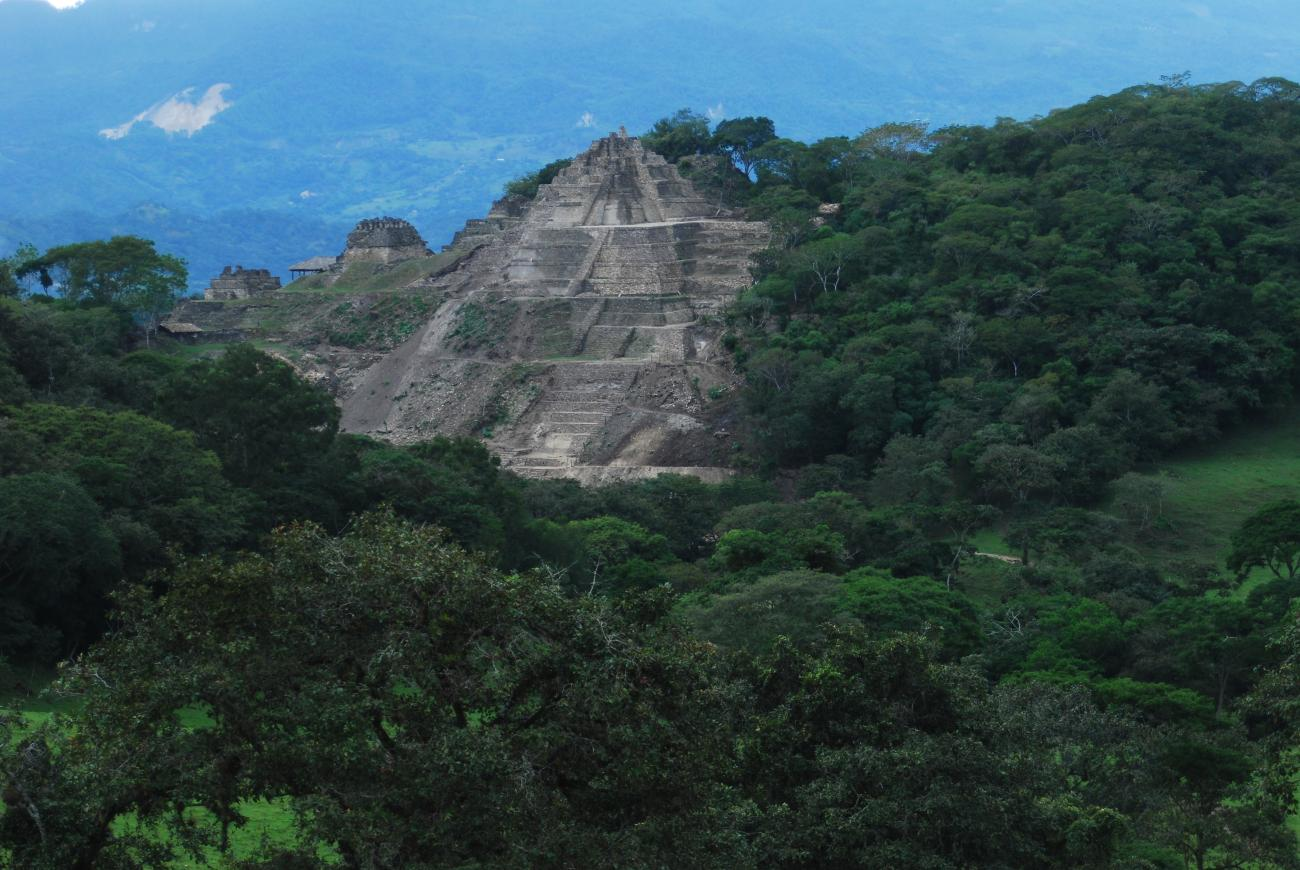
The following LIDAR profile of La Danta at El Mirador shows that the lower platform is clearly a reshaped hill just like Tonina, and thus should NOT be counted as part of the pyramid height.
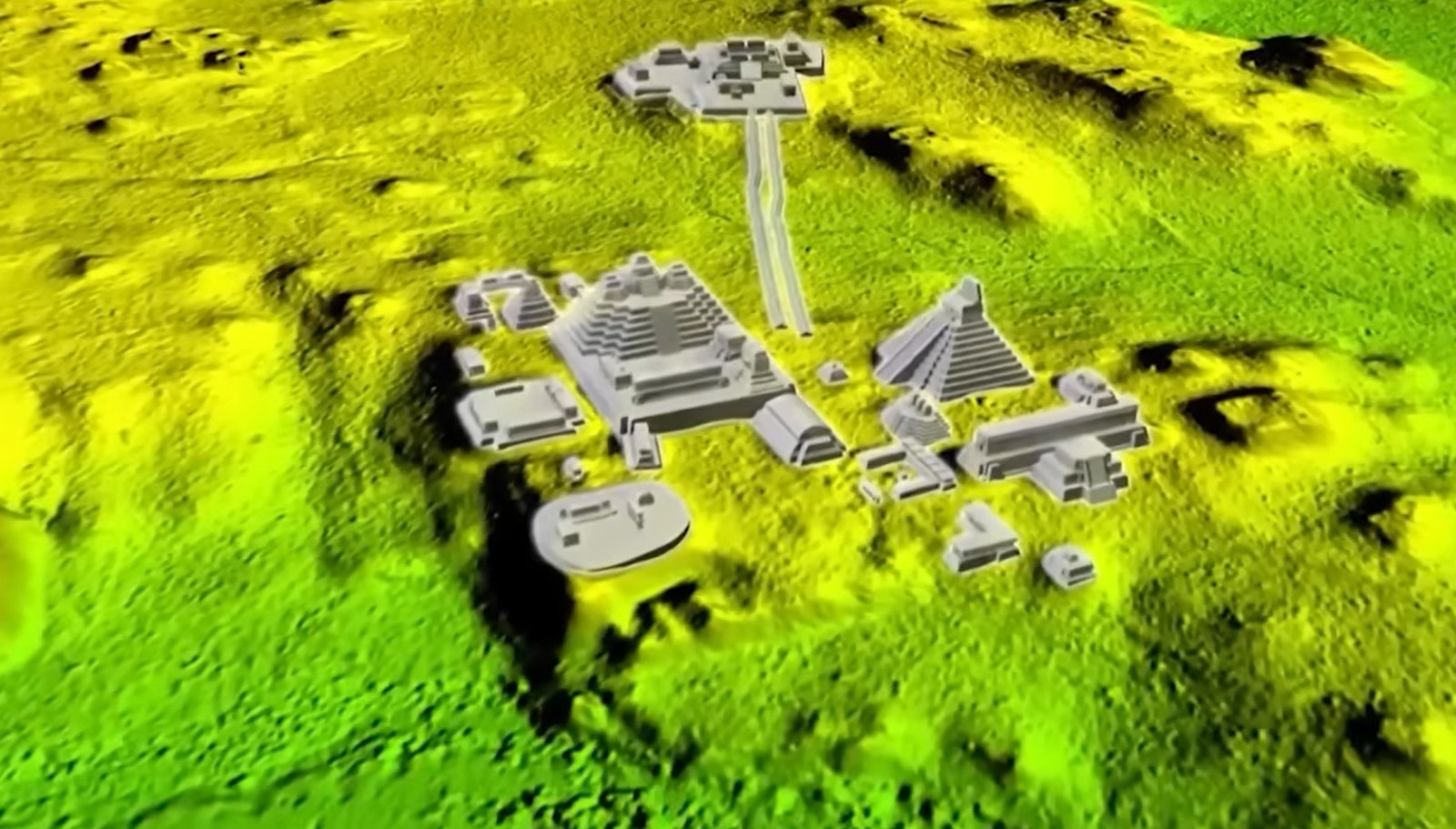
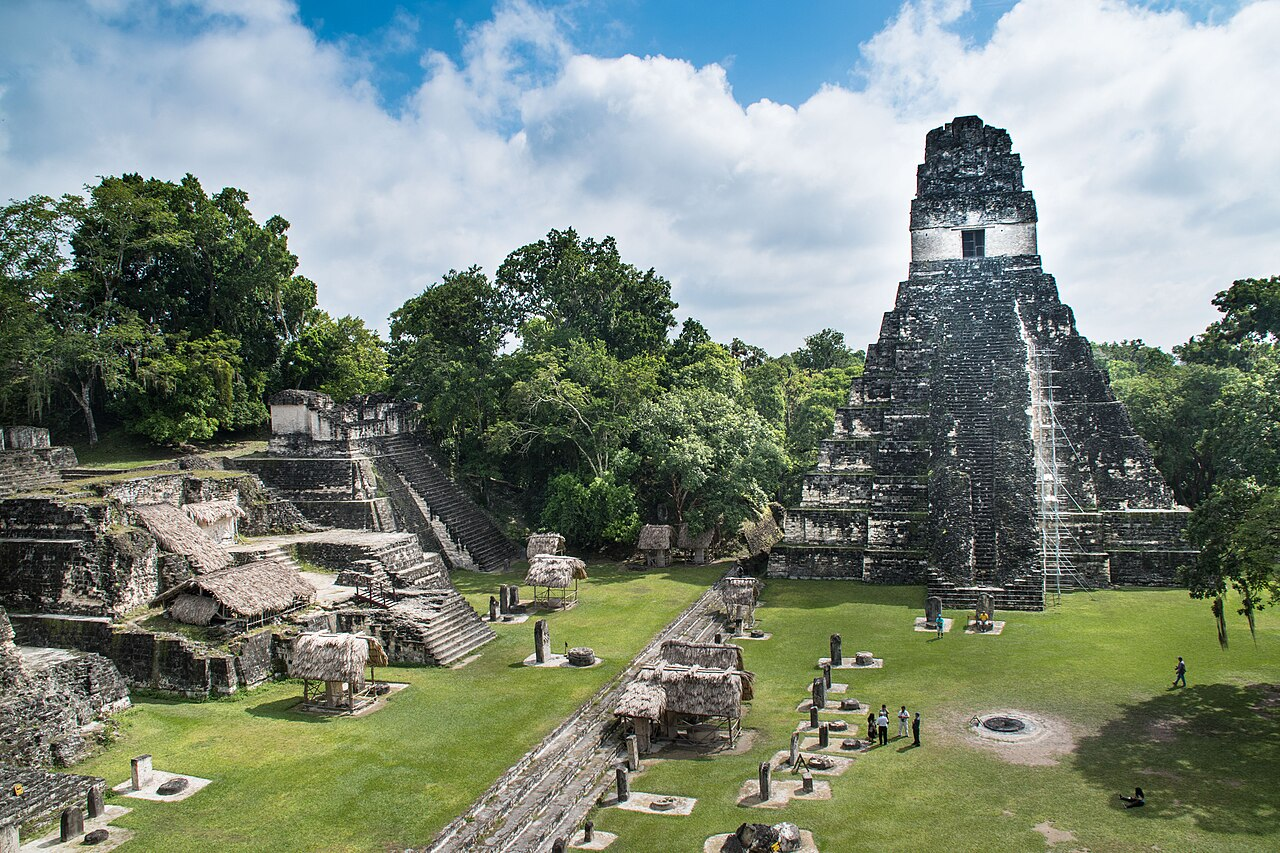
The following article explores a nuanced perspective on the structure of the LDS Church and all religious organizations, suggesting that what appears to be a single institution is, in reality, three distinct spiritual “churches” existing simultaneously.
While casual observers and many adherents see the Church as a monolithic organization defined by its leadership and ordinances, the scriptures reveal a far more complex spiritual topography. Throughout religious history, the divisions of humanity have often been presented in dualistic terms—Heaven and Hell, the saved and the damned, or the wheat and the tares. This binary perspective, prevalent in the Old Testament and much of the Book of Mormon, serves as a necessary foundation for moral polarization. However, following the ministry of Christ and the subsequent revelations of the Restoration, a third, higher distinction emerges.
Just as the Apostle Paul spoke of the “third heaven” and identified three distinct glories in the afterlife—symbolized by the sun, the moon, and the stars—so too are there three distinct churches within the Church: the Celestial, the Terrestrial, and the Telestial. These are not merely future destinations in the afterlife but are current spiritual states and “societal dimensions” that exist right now within the pews and hierarchies of every religious sect.
A central tension in Christian theology exists between the words of Christ, who stated that “only those who DO the father’s will will be saved,” and the words of Paul, who suggested that salvation comes to all who “confess Christ.” This apparent contradiction is reconciled through the lens of these three churches.
Scripture suggests that the “confession” of Christ is the entry point into the spiritual system—it is the “Light of Christ” or the divine conscience that illuminates every soul entering the world. This light teaches the “law of Christ” (the law of love) to all sentient beings, regardless of their religious labels. However, “doing” the Father’s will is what determines the “glory” or degree of spiritual nature one ultimately inherits.
The sources argue that God judges all people “according to their works, according to the desire of their hearts”. Therefore, the three churches represent three levels of obedience to this divine nature: those who reject it while professing it (the Tares), those who serve it as a matter of duty (the Wheat), and those who become one with it (the Bread of Life).
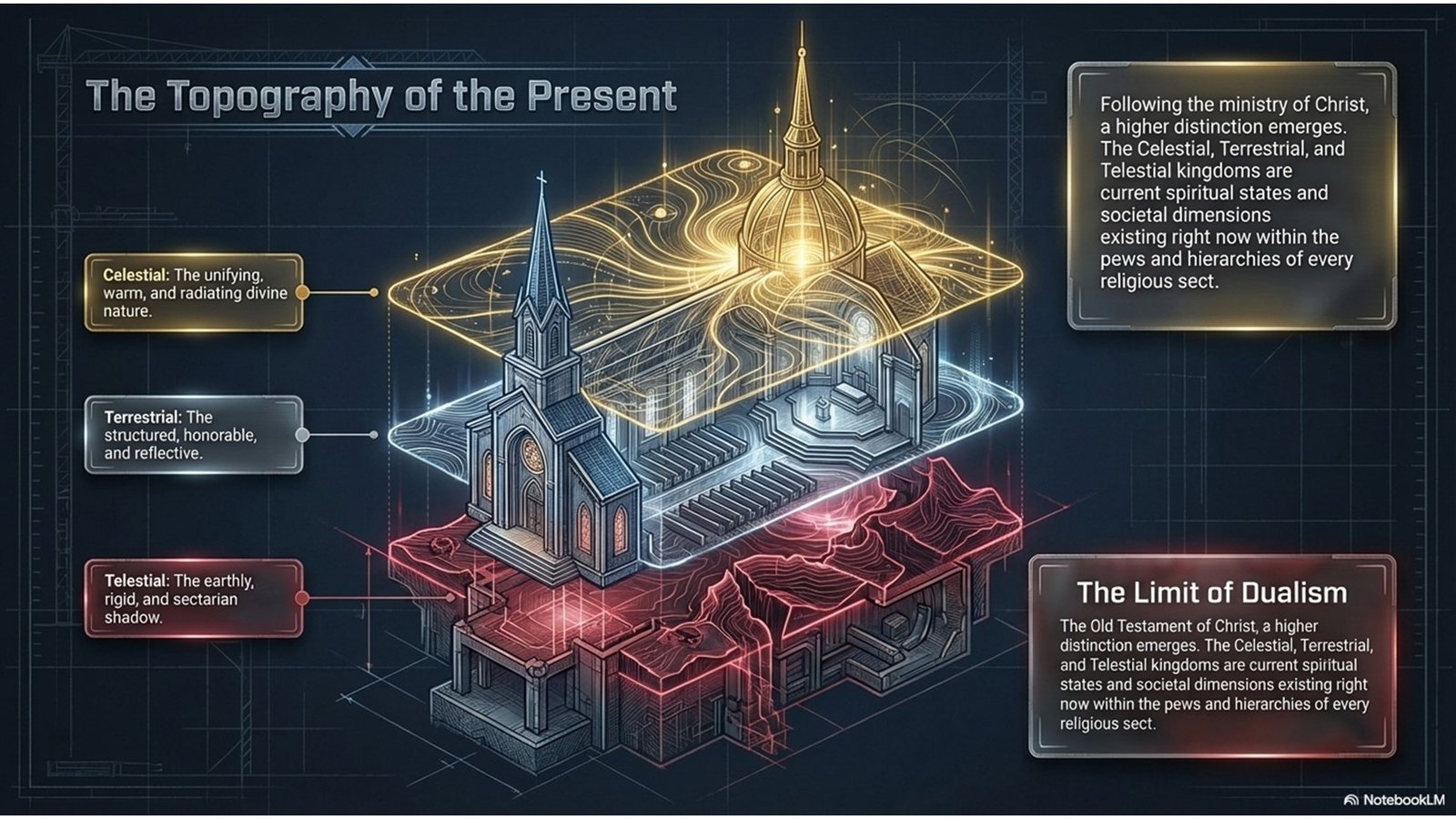
The first church within the organization is the Telestial Church, comprised of what the scriptures call “the tares”. This group is unique because it exists at every level of the organization, including the very top. Like the Pharisees of Christ’s day, these individuals often possess the outward “priesthood” and are the most vocal in their “orthodoxy,” yet they do not truly know the God they profess.
The Telestial mindset is defined by sectarianism and pride. These are they who say they are “of Paul, and of Apollos, and of Cephas,” or in a modern context, they who derive their spiritual identity from their loyalty to specific leaders or “only true church” claims rather than the Spirit of the Gospel. Because they prioritize the “dead works” of outward ordinances and sectarian division over the “law of love,” they are described as those who “crucify Christ afresh” and put Him to an open shame.
In this church, religion is used as a tool for control and “unrighteous dominion”. They are the “captives” of false traditions who, despite having access to the Light, “choose darkness” and create “hells” out of their religious societies.
The second church is the Terrestrial Church, represented by “the wheat”. These are the honorable, good-hearted people of the earth who strive to live the law as they understand it. In the spiritual hierarchy, they are “partially saved” in that they inhabit a “heaven-like state” of peace and civility, yet they lack the “fullness of glory”.
The inhabitants of the Terrestrial Church exist within the kingdom as servants. They receive the “presence of the Son, but not the fullness of the Father”. They are working toward perfection, often through the “schoolmaster” of religious law and ordinances, but they have not yet achieved the “unity of faith” required to see God “as He is”. They are the “just men” who are in the process of being “made perfect,” but they still see “through a glass darkly,” relying on the “letter of the law” rather than the “Spirit which gives life”.
The third and highest distinction is the Celestial Church, also known as the “Church of the Firstborn”. This is not merely a group of “wheat” separated from the “tares,” but a group that has been transformed into the “bread of life itself” [Prompt]. These are the individuals who have “partaken of the divine nature,” obeying God’s voice with all their hearts until they have become “sons and heirs of God”.
The Celestial Church is composed of “spirits of just men made perfect” who have overcome all things through Jesus. They no longer see through a glass darkly; they have become like Him and “see him as he is” [Prompt]. These are the co-creators with God and the “saviors on Mount Zion” [Prompt]. They do not follow the law because of a “written code” but because the law has been written on the “fleshy tablets of their hearts”.
In this church, the “only true church” doctrine is understood not as an exclusivist claim, but as a state of perfect unity and unconditional love. They have achieved a “fullness of glory” where there is no more dualism, only “one glorified nature”.
The scriptures teach that these three churches—the Tares, the Wheat, and the Bread—must “grow together” within the same organization until the “harvest”. This arrangement is not an accident but is intelligently designed to accelerate spiritual growth.
By pairing the “wheat” (those learning love) with the “tares” (those obsessed with control), God provides a “turbo-boosted” environment for progression. The Wheat learn patience, forgiveness, and unconditional love by dealing with the pride and manipulation of the Tares. Meanwhile, the Tares are given a constant example of Christ-like service that might eventually lead them to repentance.
Finally, the “Bread”—the Sons of God—act as the “welding link” that eventually gathers all things into one. They understand that while the earthly church is a “schoolmaster” and an “idol” built by human hands to represent the divine, the true “Church of God” transcends all organizational lines. It is the spiritual assembly of all who “repent and come unto Christ”.
In conclusion, the “Only True Church” is not a specific denomination, but a heavenly reality that earthly organizations are commanded to align with. Within our current mortal congregations, we find the Tares who prioritize power, the Wheat who prioritize service, and the Bread who prioritize divine unity.
The ultimate goal of religion is to transform the “Tares” into “Wheat” and the “Wheat” into the “Bread of Life,” until all are gathered together in one. Only when we lose our pride and our desire to be “right” or “exclusive” can we truly join the “Church of the Firstborn” and see God as He is—not through a glass darkly, but face to face.
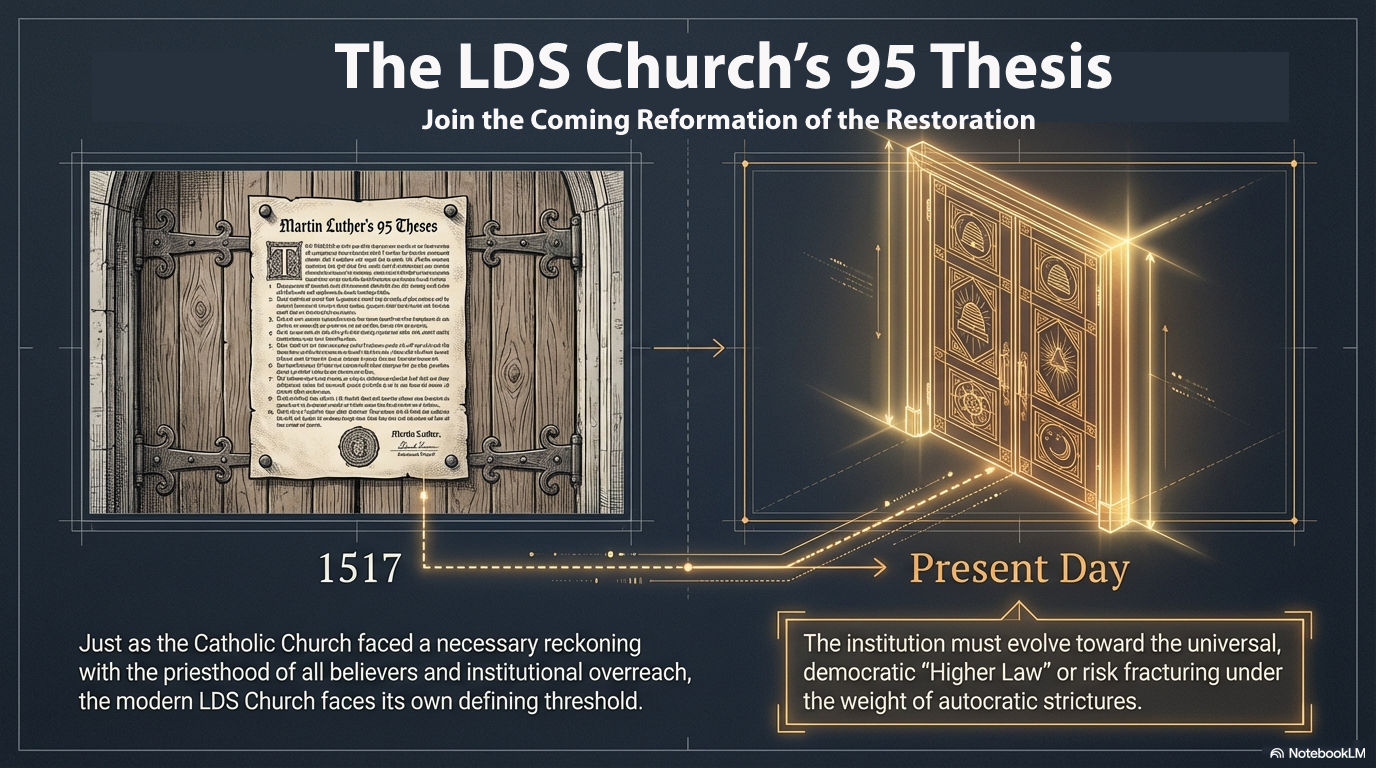
Out of love for the truth and from a desire to elucidate it, the following statements are offered for the reformation of the Restoration, seeking to universalize and enrich the LDS faith by aligning its traditions with its founding revelations.
Let us, through our repentance on these things show the Jew, Gentile and Muslim the correct gate to heaven, which is individual and collective repentance of sin for our own misdeeds and those of our leaders. Let us not elevate Mohammed, Moses or Brigham or Joseph Smith and justify their iniquities, but lift up Christ and His long suffering toward imperfect leaders.
-TO ADD. (Mythraic Prophesies, and their connection to Judaism)
-BOM prophesies (also Isaiah)
-Kolbrin prophesies.
Several major archeological and textual finds dating to the 2nd and 1st centuries BCE (the “Intertestamental Period”) show that Jewish groups were already interpreting their law, sacrifices, and rituals as a “blueprint” for a suffering or sacrificed Messiah.
These texts provide a “bridge” between the Old and New Testaments, proving that the idea of a sacrificed Messiah wasn’t a later Christian invention, but a pre-existing Jewish expectation.
Discovered in 1947, these texts date from roughly 250 BCE to 68 CE. They represent the views of the Essenes, a Jewish sect that viewed the Jerusalem Temple as corrupt and looked for a coming “Teacher of Righteousness.”
He will proclaim to them the jubilee, thereby releasing them from the debt of all their sins… Then the “Day of Atonement” shall follow at the end of the tenth jubilee period (490 years), when he shall atone for all the Sons of Light and the people who are predestined to Melchizedek. (11Q13 Melchizedek Scroll)
While portions of 1 Enoch date back to 300 BCE, the “Similitudes” are often dated to the 1st Century BCE.
Found in the Apocrypha, this text contains a “prophecy” (Chapter 2) that early Christians found so accurate it was almost haunting.
Several apocryphal texts suggest that the Angel of the Lord (the emanation of YHWH you asked about earlier) was the one who personally instructed Moses on how to set up the Tabernacle rituals.
| Text | Date | Messianic “Shadow” |
| Dead Sea Scrolls (4Q285) | ~100 BCE | A Davidic leader who is “pierced” or “killed.” |
| 11QMelchizedek | ~100 BCE | The Messiah performing a final “Atonement.” |
| Wisdom of Solomon | ~150 BCE | The “Child of God” undergoing a “shameful death.” |
| Testament of Levi | ~2nd Century BCE | A New Priest who replaces animal sacrifice with himself. |
These texts show that the “Hebrew” view of the law was not just a list of rules. To these ancient Jews, every lamb, every altar, and every vestment was a “type” or “shadow” of a living Person.
When the “Gentile” church later codified the Trinity, they focused on What God is (substance). These older Jewish texts focus on Who God is through What He Does (Sacrifice and Atonement).
Would you like me to look specifically at the Book of Jubilees? It dates to the 2nd century BCE and contains a very detailed explanation of how the Passover points to a cosmic redemption
MAN:33:17 In the Book of the Bearers of Light is written: ‘Osireh says to those about him, “I am the first among lightbearers. I am the one instructed by The Great God, I am the one with knowledge concerning the building of the first Shrine of Mysteries. I, alone of those now upon Earth, hold the key to the Sacred Mysteries. I know the secret of things that are past, of things that are and of things that are to be.
MAN:33:18 God says to Osireh, “Behold the land before you, it is a chosen land for safeguarding the Sacred Mysteries. Out of its womb shall come the Child of Truth. which shall die and rise again to lead men in the struggle to glory. In the Day of his rising, the Earth will be distressed and know it not. Nor will it open its arms to the Child, which will go unrecognised and even be despised and mocked. Yet, in that day will be produced a salve to heal the scars of mankind. In that day, when men shall have forgotten the way of righteousness and turned from Truth. the light will come unto them.” These words were spoken by God. (Kolbrin, Manuscripts-Annexed Scroll#1)
An example of quotes from 300’s BC from Greek historian Theopompus showing that BEFORE the time of Christ, the concept of a Millennium where Satan is bound already existed. As well as the concept that the Zodiac or Precession cycle was baked into the cultural religions, and that it was split into 3000 year periods, each ruled by a ‘god’ or dispensation head of some sort.
They have also many stories to relate concerning the gods, for example that Horomazes… created six gods, the first three deities respectively of good-will, truth, and orderliness, the others of wisdom, wealth, and a good conscience. By the latter rivals as it were to these were formed of equal number. Then Horomazes extended himself to thrice his stature as far beyond the sun as the sun is beyond the earth, and adorned the heaven with stars, appointing one star, Sirius, as guardian and watcher before all. He made also other twenty-four gods and placed them in an egg, but Areimanius produced creatures of equal number and these crushed the egg . . . wherefore evil is mingled with good. At the appointed time however Areimanius must be utterly brought to nought and destroyed by the pestilence and famine which he has himself caused, and the earth will be cleared and made free from obstruction, the habitation of a united community of men dwelling in happiness and speaking one tongue. Theopompus further reports that according to the magi for three thousand years in succession each of the gods holds sway or is in subjection, and that there will follow on these a further period of three thousand years of war and strife, in which they mutually destroy the works of one another. Finally Hades will be overthrown, and men will be blessed, and will neither need nourishment nor cast a shadow. And the deity who has accomplished these things will then take rest and solace for a period that is not long, especially for a god, and moderate for a sleeping man. To this effect then is the legendary account given by the magi. (Plutarch ca. 100 A.D. Cumont, ii, p.33-36, De Iside et Osiride, ch. 46. Theopompus lived in the 4th c. B.C.)
He fashioned Time of Long Dominion as the first creation that was infinite. Before the Mixture, the perpetuity of Ohrmazd was fashioned finite from the infinite. For from the primal creation, when he created the creatures, to the end, when the Evil Spirit will become powerless, there is a measure of twelve thousand years, which is finite…
On the Fashioning of the Lights
These are excerpts from The Bundahišn, The Zoroastrian Book of Creation. (Domenico Thrope Translation, Oxford Press). As you can see it is DEEPLY steeped in astronomical ideas mixed with religion, and tied in with the precessionary cycle cut into 3,000 year segments. Note the FIXED stars are EXACTLY the same as what Joseph smith wrote in the Egyptian translation book
He fashioned Time of Long Dominion as the first creation that was infinite. Before the Mixture, the perpetuity of Ohrmazd was fashioned finite from the infinite. For from the primal creation, when he created the creatures, to the end, when the Evil Spirit will become powerless, there is a measure of twelve thousand years, which is finite…
1 Ohrmazd fashioned the lights and set them between the sky and the earth: the “fixed” stars (constelations) and the wandering stars (planets), then the moon, and last the sun. 2 This is how: First, he fashioned the firmament and set the “fixed” stars in it, foremost among them the twelve signs of the Zodiac called Aries, Taurus, Gemini, Cancer, Leo, Virgo, Libra, Scorpio, Sagittarius, Capricorn, Aquarius, and Pisces. These are further divided and reckoned in twenty-seven lunar mansions that are called Padēwar. 5 He appointed four generals over those stars, one for each of the four directions, and he appointed a single general over these four. He appointed many well-known, counted 1 stars, in every direction and everywhere, with the aim to invigorate and strengthen the stars. 6 As itsays: “Sirius is the general of the east, Deneb is the general of the south, Vega is the general of the west, and Ursa Major is the general of the north.” Polaris, which they call “the stake 2 in the center of the sky,” is the supreme general. The star Pārand, the star Mazdā-dād, and others of this kind are also district commanders. 7 Astronomers now call these inerrantes stars, and instead of “large,” “small,” and “medium,” they use the expressions “first magnitude,” “second magnitude,” and “third magnitude.” On the Fashioning of the Lights. 8 He established the firmament like the year: the twelve constellations are like the twelve months, and each constellation has thirty degrees, just as each month has thirty days. 9 He appointed Ursa Major in the north, where hell would be established after the Adversary’s onslaught. In order to arrange the continents during the Mixture (movement), a band ties each of the seven [haft/attached] continents to it. That is the reason why it is called Ursa Major [Haftōring]. 10 Ohrmazd established the sphere of the stars like a spinning wheel, so that during the Mixture (nightly movement) it would keep revolving. 11 He fixed other, unmixable (unmoving) stars above these, so that when the Adversary came they could repel him in battle and keep him from carrying his pollution higher up. He appointed the Glory of the good Mazdā-worshiping dēn as general over them. That place is called “the core of the battle,” the manifestation of purity in the Mixture. The reason why they are called unmixable (unmovable) stars is because the Adversary did not pollute them. Astronomers call this “the sphere above the sphere.” This sphere has no reckoning and progression, for they cannot observe in the pure ones any characteristics of the mixable ones. 12 Above that he fashioned the moon in which the seed of cattle is stored, 13 and above that the sun whose horses are swift. 14 He appointed the sun and moon as captains of the mixable and unmixable stars; that is, they are all bound to the sun and moon. 15 Above the sun he fashioned the place of the Amahraspands, which are fastened to the endless light, the throne of Ohrmazd. 16 These are the six stations of the six creations (planets), corresponding to the six material creations.. 15 Again, a period of six thousand years elapsed before the Adversary came: three thousand years in a spiritual state and three thousand years in a pure material state. Those six thousand years were from Aries to Virgo, each constellation ruling one thousand years.
Cosmic history is thus divided into four periods of three thousand years each. (On the chronolology of arabs of twelve thousand years)
In other words, they saw the most important astronomical cycles as 1. The 24,000 year precession cycle. 2. The precession cut in half as a summer and winter or 12,000 each. 3. Then those halfs cut into quarters or FOUR periods of 3,000 years. So in all they cut the 24k precession INTO EIGHT SEGMENTS. They overlaid 8 onto 12. Or the Lunar cycle onto the Solar.


