
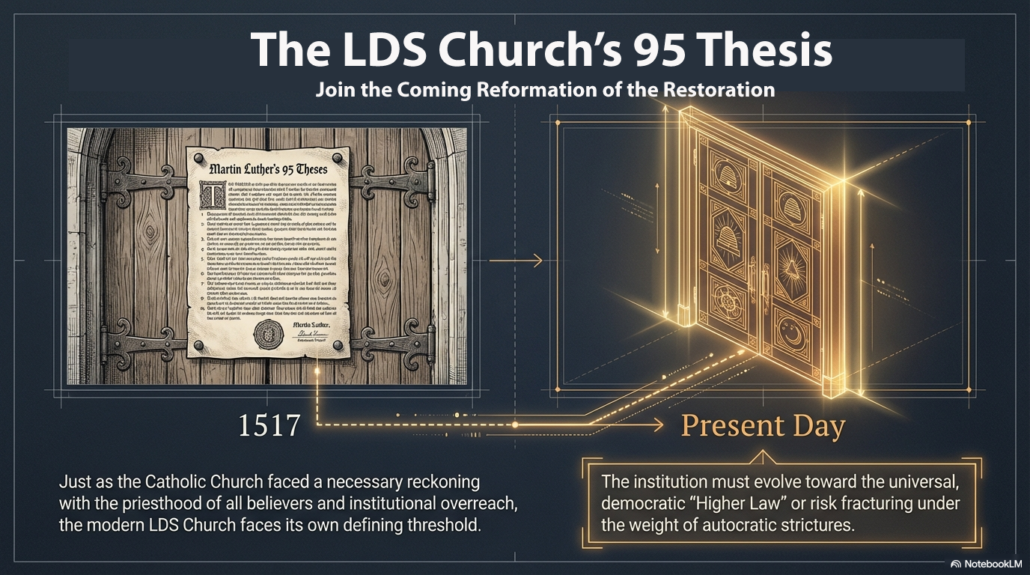
95 Thesis of LDS Church Restoration & Reformation
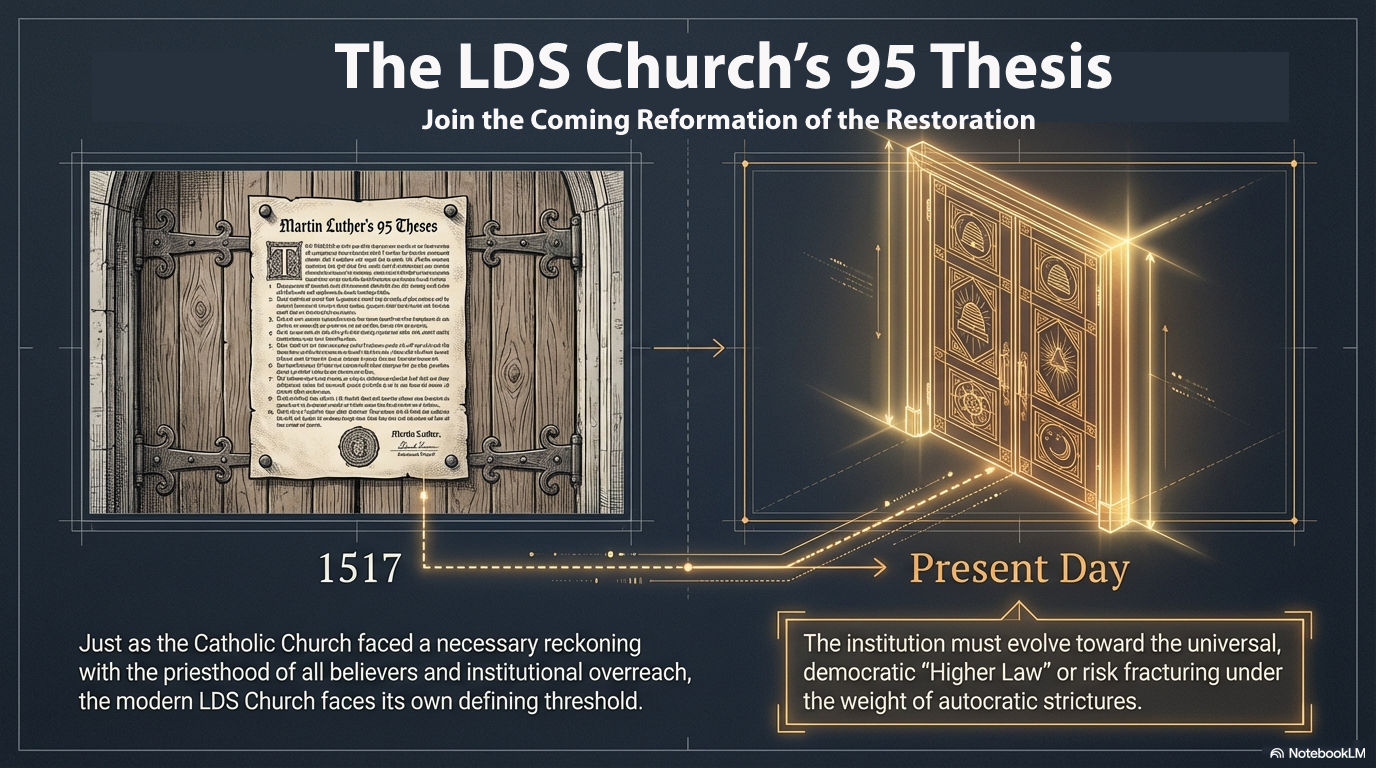
Out of love for the truth and from a desire to elucidate it, the following statements are offered for the reformation of the Restoration, seeking to universalize and enrich the LDS faith by aligning its traditions with its founding revelations.
The Nature of the Church and Repentance
- When our Lord and Master Jesus Christ said, “whosoever repenteth and cometh unto me,” he willed the same to be his church. Such was the founding revelation & principle of the restored latter-day church of Christ. (D&C 10:67)
- This word cannot be understood as referring solely to a specific temporal sect or priesthood organization. (1 Ne 14:10, Moroni 7:16–17, Mark 9:38–40, 2 Nephi 10:16, Matt 12:30)
- Yet it does not mean solely a spiritual change; such inward rebirth is worthless unless it produces outward service, an organized community, physical church structure, or priesthood of believers and humanitarian work. (Eph 2:20, D&C 27:12–13, Matt 16:18)
- Yet still, the definition of the church remains only this—to repent and come to Christ—until our entrance into the kingdom of heaven. (D&C 10:67–68)
Limits of Priesthood Authority
- Amid the needed organization or literal religious priesthood, the leaders neither desire nor are able to bind any member to decisions except those confirmed by the Spirit and common consent. (D&C 26:2; D&C 28:13, D&C 107:27)
- The prophet or high priest of said priesthood cannot grant any special standing before God, except by declaring that such status has already been granted by God to the repentant. (D&C 50:15–20)
- God grants his doctrinal seal to no church leader unless they first humble themselves and seek the democratic voice of the entire body of the church. (D&C 124:144, D&C 102:5–19, D&C 104:71–85)
Symbols and Ordinances
- Temporal ordinances are imposed only on the living; according to the scriptures, no physical ritual should be a requirement for the dead, except to aid in the communion & binding of the living and dead. (D&C 137:1–10)
- Therefore the Spirit is kind to us insofar as the scriptures always make exception for the ignorant and those who die without the law. (D&C 137:7)
- Those teachers act ignorantly and wickedly who, in the case of the dead, suggest that temple work is an absolute requirement for celestial glory — It is instead a beautiful symbol for the living and holy communion with the dead. (D&C 137:7–9)
- Those tares who changing symbolic similitudes into literal requirements, and systems of voluntary communion into autocratic structures were evidently sown while the watchmen of the church slept. (D&C 128:13)
- In former times, ordinances were seen as types and shadows; not as the spiritual realities of salvation themselves. (Hebrews 10:1)
- The dead, as the living, are freed from the veil by death and have a right to be judged by their hearts regardless of earthly ceremonies. (D&C 137:9)
Fear vs. Love in the Afterlife
- Imperfect understanding of God’s mercy necessarily brings with it great fear that families will be kept apart in heaven. (D&C 137:1–10)
- This fear of being restricted by an invisible force is sufficient to constitute a spiritual purgatory of the mind. (Alma 31:12–21)
- Celestial, terrestrial, and telestial glories differ the same as assurance of love differs from the bondage of the law. (D&C 76:77–98)
- It seems as though for souls in the spirit world, knowledge of Christ’s mercy should decrease fear and increase peace. (D&C 138:29–30)
- Furthermore, it is proved by scripture that souls in “prison” are not outside the state of merit, being able to grow and repent. (D&C 138:29–30)
- Nor is it proved that non-members, at least not all of them, are excluded from the presence of God simply for lacking ordinances. (D&C 137:7)
The Fallacy of Institutional Remission
- Therefore the prophet, when he uses the words “the church is the only path,” does not mean the temporal sect, but the heavenly or spiritual brotherhood. (D&C 10:67–68)
- Thus those teachers are in error who say that a man is saved solely by his membership in any temporal organization. (D&C 10:67)
- As a matter of fact, the priesthood remits to members no penalty of sin which, according to the law of Christ, must be resolved in the heart. (D&C 121:36–46)
- If full salvation could be granted to anyone by virtue of priesthood keys alone, it would be granted only to the most perfect. (D&C 121:37)
- For this reason many people are deceived by the high-sounding promise that “following the prophet” guarantees they cannot go astray. (D&C 3:9–11)
- That power which a General Authority has over the church corresponds to the power any local Bishop should have by common consent. (D&C 107:36)
- The leaders do well when they grant guidance, not by a “divine dictatorship,” but by way of humble persuasion. (D&C 121:41)
- They preach human doctrines who say that as soon as the tithing is paid, the windows of heaven are opened for “fire insurance.” (2 Nephi 28:13)
- It is certain that when money is fully centralized in an organization, greed can be increased; but when the poor are served, the result is in God’s hands. (2 Nephi 28:13)
- Who knows whether all members wish to be governed by a central authority, since many find more Spirit in local autonomy. (D&C 107:36–37)
- No one is sure of the integrity of their own witness, much less of having a perfect knowledge of the “only true church.” (Alma 32:21)
The True Cost of Mercy
- The person who truly seeks Christ is as rare as the person who truly needs no priesthood office; indeed, they are rare. (D&C 121:34–40)
- Those who believe they are certain of salvation because they hold a temple recommend will be disappointed, together with their teachers. (2 Nephi 28:14)
- Men must be on guard against those who say that the “keys” are the inestimable gift by which man is reconciled to God. (D&C 121:41)
- For the graces of priesthood are concerned only with the management of symbolic ordinances established for man. (Hebrews 10:1)
- They who teach that repentance is not necessary for those who have had their “calling and election made sure” preach unchristian doctrine. (D&C 3:9–11)
- Any truly repentant person has a right to full remission of sin even without the intervention of an LDS Bishop. (Alma 38:8–9). But oh how blessed is that Saint who is fellowshipped by a righteous leader!
- Any true disciple, whether LDS or not, participates in all the blessings of Christ; this is granted by God without priesthood titles. (Moroni 7:16–17)
- Nevertheless, the authority of the restored keys is not to be disregarded, for it is a proclamation of the heavenly order. (D&C 107:18–19)
- It is difficult, even for the most learned apostles, to commend the need for institutional loyalty and the need for individual conscience. (D&C 121:37)
- A disciple who is truly contrite seeks to abase himself; the focus on priesthood rank, however, causes men to seek for honors. (Matthew 23:6–12)
- Priesthood “mantles” must be preached with caution, lest people erroneously think they are preferable to the gifts of the Spirit. (D&C 46:7–8)
- Christians are to be taught that leaders do not intend that the building of temporal investments or physical religious structures should be compared with works of mercy. (2 Nephi 28:13)
- Christians are to be taught that he who gives to the poor does a better deed than he who funds fine sanctuaries. (2 Nephi 28:13)
- Because love grows by works of love, man becomes better; he does not become better by means of rituals alone. (1 Corinthians 13)
- Christians are to be taught that he who sees a needy man and passes him by, yet pays his tithing to a charity, church or wealthy institution, buys God’s wrath. (Matthew 19:21)
- Christians are to be taught that they must reserve enough for their family needs and by no means squander their “living” on institutional excess. Such is not righteous sacrifice but folly. (1 Timothy 6:10)
- Christians are to be taught that the choice to follow a prophet is a matter of free choice, not to be coerced by threats of damnation or destruction. (Alma 29:4)
- Christians are to be taught that God, in granting revelations, needs and desires our agency more than our blind obedience. (Moses 4:1–3)
- Christians are to be taught that priesthood is useful only if they do not put their trust in it, but keep their fear of God because of it. (Hebrews 7:14, D&C 121:41)
- Christians are to be taught that if the leaders knew the exactions of the tithe-collectors, they would rather the temples were burned to ashes than built with the skin of the poor. (2 Nephi 28:13)
- Christians are to be taught that the Church should wish to give of its own corporate wealth to many of those from whom it now insists tithing. (D&C 105:3)
- It is vain to trust in salvation by “following the prophet,” over the conscience given in Christ’s Spirit, even though the prophet were to offer his own soul as security. (D&C 3:9–11)
The True Treasures of the Church
- They are enemies of Christ and the Church who forbid the saint of sharing of “too sacred” witnesses in order that vague innuendo may be preached instead. (Ether 3:19–20)
- Injury is done to the Word of God when, in the same meeting, more time is devoted to the prophet’s or priory’s biography than to the Gospel. (1 Nephi 11:32)
- It is the Lord’s sentiment that if the “Only True Church” claim is celebrated with one bell, then the global spiritual brotherhood should be preached with a hundred. (D&C 10:67)
- The true treasures of the church, out of which the Lord distributes grace, are not known among the people because they are too oft hidden by institutional pride. (2 Nephi 28)
- That these treasures are not temporal wealth is clear; for many leaders do not distribute the church’s billions but only gather them. (2 Nephi 28:13)
- Nor are they the exclusive merits of LDS leaders, for even without our sect, the Spirit always works grace for the inner man of the nations. (Moroni 7:16)
- Anciently, the poor of the church were called its treasures; but we have made fine sanctuaries our treasures. This must not be. (2 Nephi 28:13)
- Without want of consideration, we say that the “keys” of service, given by the sacrifice of Christ, are that treasure. (Matthew 20:26–28)
- For it is clear that God’s power is of itself sufficient for the remission of sins through faith. (Ether 12:16–22)
- The true treasure of the church is the most holy gospel of the glory and grace of God. (D&C 10:67)
- But this treasure is naturally most odious, for it makes the first to be last and rejects elitism. (Matthew 20:16)
- On the other hand, the treasure of “divine election” is naturally most acceptable, for it makes the last to be first. (Matthew 20:16)
- Therefore the treasures of the gospel are nets with which one formerly fished for the hearts of men. (Matthew 4:19)
- The treasures of institutional exclusivity are nets with which one now fishes for the wealth and loyalty of men. (2 Nephi 28:13)
- The “graces” which some apologists acclaim as the greatest are actually understood to be such only insofar as they promote institutional gain. (2 Nephi 28:13)
- They are nevertheless the most insignificant graces when compared with the grace of God and the piety of the cross. (1 Corinthians 1:17)
- Bishops and Stake leaders are bound to admit/follow the directives of the central church with all reverence,
- But they are much more bound to strain their eyes and ears, and balance central directives with what the Spirit teaches them and their parishioners, lest these men preach their own traditions instead of what God has commissioned! (Matthew 15:6–9, reform#4)
- Let him who speaks against the truth of the heavenly church or universal pluralism be corrected. (3 Nephi 16:4–7)
- But let him who guards against the lust for power and “divine dictatorship” be blessed. (D&C 121:41)
- Just as the church justly thunders against those who contrive harm to the institution. (D&C 107:84)
- Much more does God intend to thunder against those who use the church as a pretext to contrive harm to agency and truth. (Moses 4:3, Alma 29:4)
- To consider polygamy so great that it could be forced upon women by an “angel with a drawn sword” is a ridiculous idea and a slap to the dignity of God & his Christ. (Alma 42:27–28, Moroni 10:12–14)
- We say on the contrary that polygamy was a lower law allowed because of the hardness of hearts. (Matthew 19:8, Jacob 4:14–15)
- To say that even Joseph Smith, if he were now here, could not err is a muted form of blasphemy. (D&C 3:4)
- We say on the contrary that even the present prophet has greater graces at his disposal—that is, the power to repent and admit mistakes. (D&C 3:10)
- To say that a corporate logo or the “mantle of authority” is equal in worth to the character of Christ is an error. (D&C 121:45)
- The bishops and teachers who permit such idol-worship to be spread among the people will have to answer for this. (Alma 31:12–21)
Sharp Questions of the Layman
- This unbridled preaching of ‘muted’ or renamed infallibility makes it difficult for learned men to rescue the church from the shrewd questions of the people. (D&C 121:41–42, offcdeclaration 1)
- Such as: “Why does not the Church empty more its storehouses & resources to build sanctuaries, and shopping malls incommensurate with efforts toward eliminating the poor among us?!”. (2 Nephi 28:13)
- Again: “Why are temple sealings taught to be “required” for the dead when God knows their hearts and can save them without our intervention?” Nay, it is communion with our dead in Christ which will save us both! (D&C 137:7–9)
- Again: “What is this new piety where a wealthy man doest so often buy his way into leadership while a poor person is judged, and passed over because of their coffee or their clothing?!”. (Matthew 15:6–9)
- Again: “Why are the laws of consecration, long since dead in practice, now satisfied by a percentage of income, which leaveth the rich rich, and the poor poor, as though equality were no longer required?!”. (D&C 49:20)
- Again: “Why does not the Church, whose wealth is greater than many nations, build & clean its meeting houses & temples with its own compounded money rather than the tithing of poor believers?!”. (2 Nephi 28:13)
- Again: “What does the Church ‘seal’ for those who by their own goodness already have a right to full union in heaven?”. (D&C 137:9)
- Again: “What greater blessing could come than if the Church bestowed its wealth & effort on the poor & needful a hundred times a day, or at least fully once each Fast Sunday, as it now does but occasionally!?”. (D&C 105:3)
- “Since the Church seeks the salvation of souls rather than money, why does it suspend temple recommends over tithing when the Spirit is given freely!?”. (Romans 14:17)
- To repress these sharp arguments by excommunication or “shaming” dissidents alone, and not to resolve them by giving evidence of efforts to reform, makes the people unhappy!
- If, therefore, these reforms from our founding scripture were encouraged and preached in proper proportion according to the Spirit, all these doubts would be resolved; indeed, they would not exist! (Matt 23:23–24, D&C 105:10)
Final Exhortation
- Away, then, with all those prophets who say to the people “all is well in Zion” when Zion is not well. Or say, “the prophet cannot lead you astray,” when there is no such promise, but instead instruction on how to remove a wayward president!. (2 Ne 28:21, OD 1, Matt 23:24, D&C 107:81–84, D&C 3:9)
- Blessed be all those prophets who say to the people, “Look to Jesus and repent, for we have all made mistakes”. (Romans 3:23, D&C 3:10)
- Christians should be exhorted to be diligent in following Christ, their Head, through whatever consequences, penalties, doubts, and individual conscience. (Acts 14:22)
- And thus be confident of entering into heaven through the testing of their own agency rather than through the false security of an institution. (John 5:39–47, Alma 29:4)
Let us, through our repentance on these things show the Jew, Gentile and Muslim the correct gate to heaven, which is individual and collective repentance of sin for our own misdeeds and those of our leaders. Let us not elevate Mohammed, Moses or Brigham or Joseph Smith and justify their iniquities, but lift up Christ and His long suffering toward imperfect leaders.

