
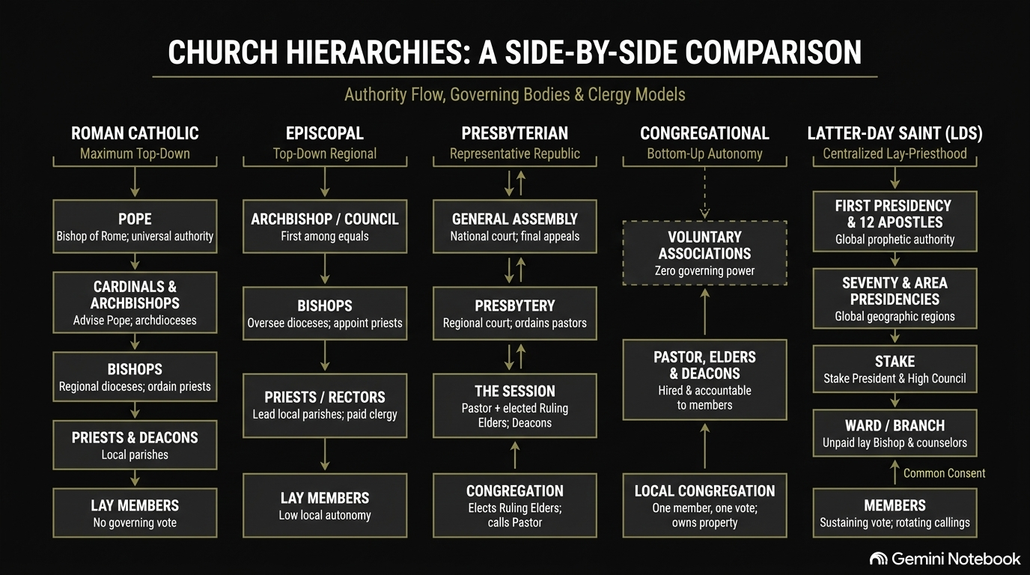
Comparing Church Hierarchies
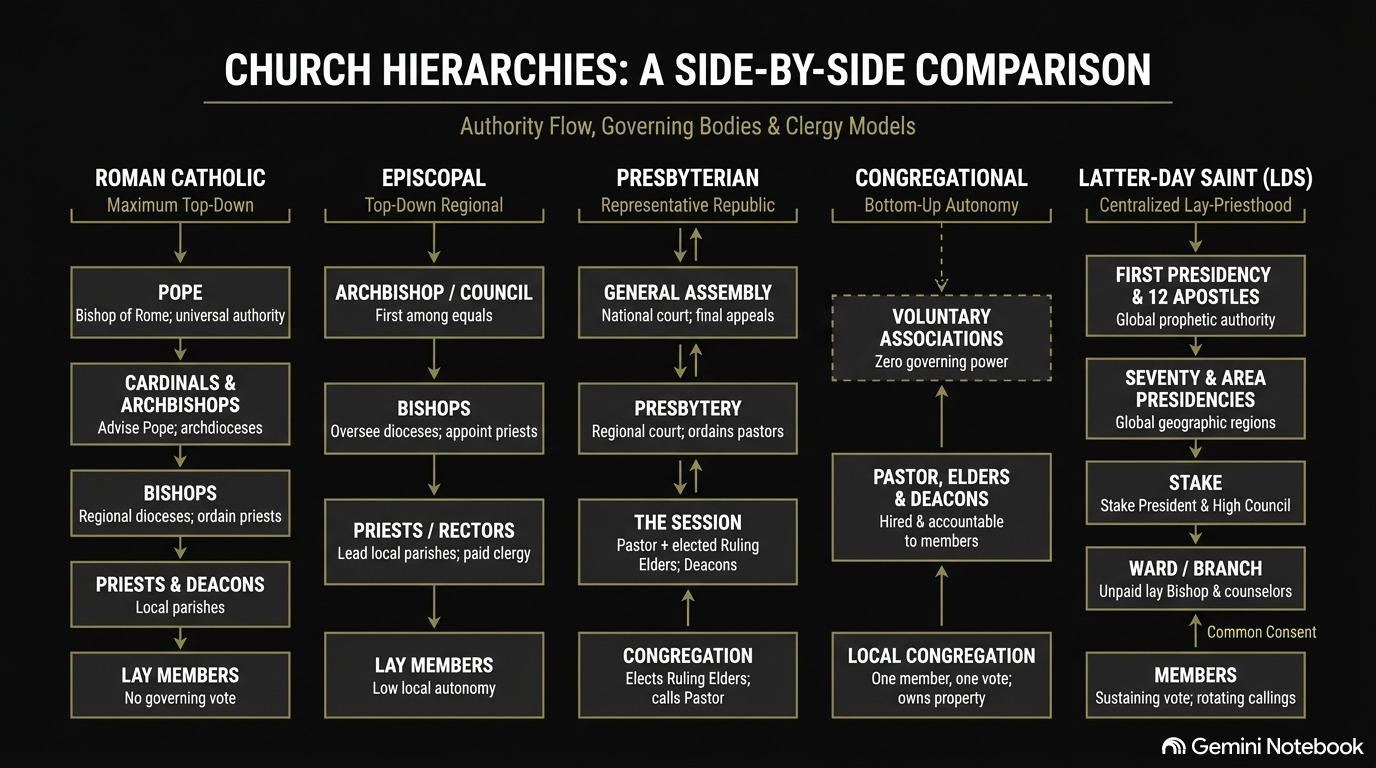
.
When people talk about differences between Christian denominations, they usually focus on theology—baptism, communion, or salvation. Yet one of the biggest dividing lines in Christian history isn’t about doctrine at all; it is about church polity—how a religious institution is politically organized, who holds governing authority, and how decisions flow between local congregations and broader leadership.
Drawing from Pastor Matthew Everhard’s breakdown of church governance in Presbyterian Polity: Explained! Session, Presbytery, General Assembly, Christian denominations historically organize around three classic models of polity—Episcopal, Congregational, and Presbyterian—while The Church of Jesus Christ of Latter-day Saints (LDS) operates under a distinct centralized lay-priesthood hierarchy.
1. Episcopal Polity: Top-Down Hierarchy
Derived from the Greek word episkopos (“overseer” or “bishop”), Episcopal polity places governing authority in the hands of individual bishops. Authority flows strictly from the top down, often rooted in the doctrine of apostolic succession—the belief that bishops inherit unbroken authority tracing back to Jesus’s original apostles.
- Who uses it: The Roman Catholic Church, Eastern Orthodox Churches, the Anglican Communion (including the Episcopal Church), and most Methodist and Lutheran bodies.
- How it works: Individual bishops oversee geographic regions called dioceses, appointing or approving priests/rectors to lead local parishes. In the Roman Catholic model, a single supreme bishop—the Pope—sits at the apex of the global hierarchy, assisted by cardinals and archbishops.
2. Congregational Polity: Bottom-Up Local Autonomy
At the opposite end of the political spectrum is Congregational polity, where each local church is completely independent and self-governing. No outside bishop, board, or national headquarters can dictate doctrine, appoint a pastor, or own the local congregation’s property.
- Who uses it: Baptist churches (such as the Southern Baptist Convention), Congregationalist churches, Churches of Christ, and most non-denominational and Pentecostal congregations.
- How it works: Authority rests directly with the local members, often operating on a democratic “one member, one vote” principle. The congregation hires and fires its own pastors, approves budgets, and elects lay deacons or trustees. When congregational churches join national “conventions” or “associations,” those bodies are strictly voluntary cooperatives for missions and seminaries—they hold zero governing power over local churches.
3. Presbyterian Polity: Representative Republic of Elders
Taking its name from the Greek presbyteros (“elder”), Presbyterian polity was developed during the Protestant Reformation (notably by John Calvin in Geneva and John Knox in Scotland) as a middle path between top-down bishops and isolated local congregations. It functions much like a representative constitutional republic—similar in structure to the American system of federal, state, and local governance.
As highlighted in Pastor Everhard’s overview, Presbyterian governance is built on graded courts of elders rather than single individuals holding unilateral power:
- The Session (Local Level): The congregation elects local lay leaders called Ruling Elders who serve alongside the pastor (Teaching Elder) as equal voting members of the Session. Together, they oversee the spiritual life, discipline, and ministry of the local church. (Deacons separately handle mercy ministry and physical needs.)
- The Presbytery (Regional Level): All teaching elders and representative ruling elders from every church in a geographic district meet regularly as a Presbytery. The Presbytery examines, ordains, and installs pastors, resolves local church disputes, and holds accountability over local Sessions.
- The Synod & General Assembly (National Level): Presbyteries send elected elder commissioners to broader regional Synods (in larger denominations) and an annual national General Assembly, which sets overarching constitutional policy (The Book of Order), adjudicates final theological appeals, and coordinates global missions.
4. Where Does the Latter-day Saint (LDS) System Fit?
The Church of Jesus Christ of Latter-day Saints does not fit neatly into any of the three classic Protestant/Catholic categories. While it visually resembles an Episcopal structure in its global centralization, it replaces paid professional clergy with a universal lay priesthood and incorporates a congregational common consent vote:
- Global Top-Down Leadership: At the apex sits the First Presidency (the President/Prophet of the Church and two counselors), supported by the Quorum of the Twelve Apostles—15 ordained apostles who hold worldwide administrative and doctrinal authority. Below them, Quorums of the Seventy and Area Presidencies administer global geographic regions.
- Regional & Local Units (Stakes and Wards): Locally, congregations are organized geographically (rather than members choosing which parish to attend) into Wards (led by a Bishop and two counselors) and Branches (smaller units). Roughly 5 to 12 wards are grouped into a Stake (similar to a diocese), led by a Stake President and a 12-member High Council.
- Unpaid Lay Ministry & “Common Consent”: Unlike Episcopal priests or Presbyterian teaching elders, local LDS bishops, stake presidents, and teachers are unpaid lay volunteers who hold regular secular jobs and rotate out of leadership callings every 5 to 9 years. Furthermore, while leaders are nominated from the top down rather than campaigning or being hired by a congregation, every leadership calling is presented to the local membership for a formal sustaining vote (“common consent”) before taking effect.
Interactive Organizational Diagrams: Comparing All Four Systems
Explore the command structure, flow of authority, and key governing bodies across all four church governance systems below:
Side-by-Side Summary
| Feature | Episcopal | Congregational | Presbyterian | Latter-day Saint (LDS) |
| Direction of Authority | Top-down (Bishops) | Bottom-up (Local members) | Representative (Graded elder courts) | Top-down (Apostles) with local sustaining vote |
| Who Ordains Clergy? | Bishop | Local congregation | Regional Presbytery | Higher priesthood authority (Stake/General) |
| Clergy Model | Professional, paid priests/bishops | Professional, paid pastor hired by church | Professional Teaching Elders + lay Ruling Elders | Unpaid lay ministry at local & stake levels |
| Local Church Autonomy | Low (Diocese holds authority) | Complete (Fully independent) | Moderate (Accountable to Presbytery) | Low (Geographic wards; centralized curriculum) |
To explore how Presbyterian courts—the Session, Presbytery, and General Assembly—operate in detail, watch Presbyterian Polity: Explained! Session, Presbytery, General Assembly
.
Interactive Church Governance Comparison
Select a religious governance model below, then click any tier to inspect how authority and leadership operate.
.
New Testament leadership roles come primarily from Ephesians 4:11 (“So Christ himself gave the apostles, the prophets, the evangelists, the pastors and teachers”) and 1 Timothy 3 / Titus 1 (elders/overseers and deacons).
Different Christian traditions map these Greek offices onto their modern leadership structures in very different ways—either treating them as permanent formal offices, functional spiritual gifts, or restored priesthood callings.
Biblical Offices, Greek Roots & Modern Church Equivalents
| Biblical Role | Key Bible Passages | Greek Root & Literal Meaning | Episcopal (Catholic, Anglican, Methodist) | Presbyterian / Reformed | Congregational (Baptist, Non-Denom) | Latter-day Saint (LDS) |
| Apostle | Luke 6:13; 1 Cor. 12:28; Eph. 4:11 | Apostolos (ἀπόστολος) “One sent forth” / messenger | Bishops (viewed as successors to the Apostles; Catholic Pope holds Petrine primacy). | No living office (Apostolic authority rests solely in the New Testament Scripture). | No living office (Functionally mirrored in pioneering Church Planters / Missionaries). | Quorum of the Twelve Apostles & First Presidency (literal ordained Apostles). |
| Prophet | Acts 11:27; 1 Cor. 12:28; Eph. 4:11 | Prophētēs (προφήτης) “One who speaks forth” God’s message | No formal office (Role fulfilled through faithful preaching; Pentecostal/charismatic wings recognize prophetic gifting). | No formal office (Preaching/expounding Scripture is seen as the ongoing prophetic voice). | No formal office (Preachers/revivalists in Baptist churches; recognized gift in Pentecostal churches). | President of the Church (the Prophet) & Apostles (sustained as “prophets, seers, and revelators”). |
| Evangelist | Acts 21:8; Eph. 4:11; 2 Tim. 4:5 | Euangelistēs (εὐαγγελιστής) “Bringer of good news” | Methodist: Traveling revivalists / District Superintendents / Missionaries. Catholic/Anglican: Missionaries & diocesan evangelization directors. | Ordained Evangelists / Missionaries (Ministers sent by a Presbytery to plant new churches where no Session exists yet). | Itinerant Revivalists, Apologists, & Missionaries (e.g., Billy Graham-style preaching ministries). | Full-Time Missionaries & Stake Patriarchs (historically called “Evangelists” in early LDS scripture, D&C 107:39). |
| Pastor (Shepherd) | Eph. 4:11; 1 Pet. 5:1–4 | Poimēn (ποιμήν) “Shepherd” / caretaker of a flock | Parish Priest (Catholic/Orthodox), Rector/Vicar (Anglican), or Appointed Elder/Pastor (Methodist). | Teaching Elder / Minister of Word & Sacrament (senior or associate pastor). | Senior Pastor / Lead Pastor (hired by the local congregation). | Ward Bishop (unpaid lay shepherd of a local congregation) & Ministering Brothers/Sisters. |
| Teacher | Acts 13:1; 1 Cor. 12:28; Eph. 4:11 | Didaskalos (διδάσκαλος) “Instructor” / master teacher | Theologians, Catechists, Seminary Professors, & Teaching Deacons/Priests. | Teaching Elders, Seminary Professors, & Adult Sunday School Teachers. | Bible Teachers, Small-Group Leaders, & Seminary Professors. | Sunday School, Seminary, & Institute Teachers, plus Aaronic Priesthood Teachers (ages 14–15). |
| Elder / Overseer | Acts 14:23; 1 Tim. 3:1–7; Titus 1:5–9; 1 Pet. 5:1 | Presbyteros (πρεσβύτερος) “Elder” & Episkopos (ἐπίσκοπος) “Overseer” | Separated into two tiers: Episkopos = Bishop Presbyteros = Prbiest / Methodist Elder | Treated as one office: Ruling Elders (lay board on the Session) & Teaching Elders (pastors). | Often treated as one office: Board of Elders (plurality of lay/staff elders leading the church) or Senior Pastor. | Elders Quorum (all adult male Melchizedek Priesthood holders) & Seventies / High Priests. |
| Deacon | Acts 6:1–6; Phil. 1:1; 1 Tim. 3:8–13 | Diakonos (διάκονος) “Servant” / table-waiter / attendant | Transitional Deacons (en route to priesthood) & Permanent Deacons (liturgy, charity, preaching). | Board of Deacons (lay men/women elected to handle mercy ministry, benevolence, and physical care). | Board of Deacons (lay leaders assisting the pastor with benevolence, ordinances, or governance). | Deacons Quorum (ordained boys ages 12–13 who pass the sacrament and assist the Bishop). |
.
Key Differences to Notice Across Traditions
- Why “Elder” and “Bishop/Overseer” Split: In the New Testament (such as Titus 1:5–7 and Acts 20:17, 28), Paul uses presbyteros (elder) and episkopos (overseer/bishop) interchangeably for the same local church leaders.
- Presbyterian and Baptist churches keep them as one single office (elders are the overseers).
- Catholic, Orthodox, Anglican, and Methodist churches separated them into two distinct ranks: presbyteros became the local priest/elder, while episkopos became a regional bishop over multiple congregations.
- The Unique LDS “Evangelist” Connection: While most Protestant traditions equate evangelists with traveling revival preachers (like Methodist circuit riders or Baptist evangelists) or overseas missionaries, early Latter-day Saint revelation (Doctrine & Covenants 107:39) explicitly identified the New Testament office of Evangelist with the Patriarch—an ordained high priest in each Stake who gives lifelong personal prophetic blessings (patriarchal
- blessings) to church members.
.
LDS REFORMATION
Just as many protestant sects have slipped away from the early Church organizational structure created by Christ and revelation to his early Church, a few small aspects of LDS hierarchy have also slipped away from their intended structure.
- Prophets. Prophets are to be called of God, not men. They are NOT the same as Apostles or Presidency of the High Priesthood, but the presidency of the High Priesthood holds the keys OVER the discerning and exercising of the gifts of the Spirit, of which Prophecy is one.
- Stake Patriarchs. Patriarchs should be prophets and hold the keys of prophecy. But they should also have a far more involved job of counseling and shepherding the youth.
- Bishops. Bishops were never meant to be congregational leaders in the early Christian (0-300 AD), OR in the early LDS church as Joseph Smith set it up. In the days of Joseph Smith (1831–1844), the LDS office of bishop was primarily a regional financial, temporal, and judicial administrator, not a congregational pastoral and spiritual head of a single local unit (a ward). They also served until death in a way that more closely matched what we know of the early church. This is a major deviation and change. Its not something I’m pushing for changing immediately, but the church should look at the way we use this title and office and pray for guidance on whether it really conforms to the intended system.
In the days of Joseph Smith, Local branches and congregations were presided over by Elders & later High Priests. NOT bishops. In Kirtland and Missouri, the Stake Presidency oversaw spiritual affairs while the Bishop oversaw temporal affairs independently at the same level. (much like the quorum of the 12 and presiding Bishopric of the church) - Congregations should be called branches, and led by a Branch President (The Presiding Elder). The entire concept of a ‘ward’ is unscriptural and was introduced in 1839 from American municipal government (borrowed from districts of England). The current system destroys the separation of ‘spiritual’ and ‘temporal’ powers set up in the initial revelations of the church. The Church is meant to be BOTH a religious and political organization. The Melchizedek Priesthood leads the spiritual (religious) affairs of the church, and the Aaronic Priesthood leads the temporal (political) affairs of the church. Where national political systems break down or are found wanting, the Aaronic Priesthood steps in and helps to whatever degree necessary with the social programs usually associated with political systems (Welfare/Housing/Schooling/Healthcare & Medicine).
WE NEED TO SET IN ORDER THESE IMPORTANT ASPECTS OF THE CHURCH IN ORDER TO PROPERLY BUILD ZION THROUGHOUT THE WORLD.
(Churches such as the Seventh Day Adventists and Assembly of God have grown significantly faster than the LDS church SPECIFICALLY as a consequence of their more effective use of social programs such as education/hospitals/etc)
Bishops (who are equal in authoritative level to Stake Presidents) are then in turn to be presided over by the Presiding Bishopric (who are equal in authoritative level to the traveling twelve/apostles). This organization is to be over ALL temporal affairs of the church and the Twelve/Melchizedek priesthood is TO GET ITS NOSE OUT OF TEMPORAL AFFAIRS, and focus wholly on the spiritual welfare of the church!!!