
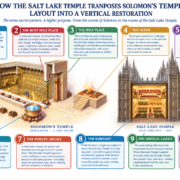
From Jerusalem to Salt Lake: How the Salt Lake Temple Transposes Solomon’s Layout into a Vertical Restoration
When Brigham Young and architect Truman O. Angell laid out the blueprints for the Salt Lake Temple in the mid-19th century, they were not merely designing a house of worship; they were engaged in a radical act of bilical architectural and theological translation.
Central to Latter-day Saint (LDS) theology is the doctrine of Restoration—the belief that ancient order, priesthood authority, and sacred rites have been restored to the earth in the modern era. Nowhere is this principle more explicitly materialized than in the comparison between the biblical Temple of Solomon and the Salt Lake Temple.
While Solomon’s temple operated on a lateral, one-story axis moving west from the outer court to the Holy of Holies, the Salt Lake Temple takes that exact ritual trajectory and transposes it vertically into a multi-story design. By stacking these sacred spaces, Latter-day Saints created an architectural climb that mirrors both ancient Israelite temple worship and the progressive spiritual ascension of the Christian soul.
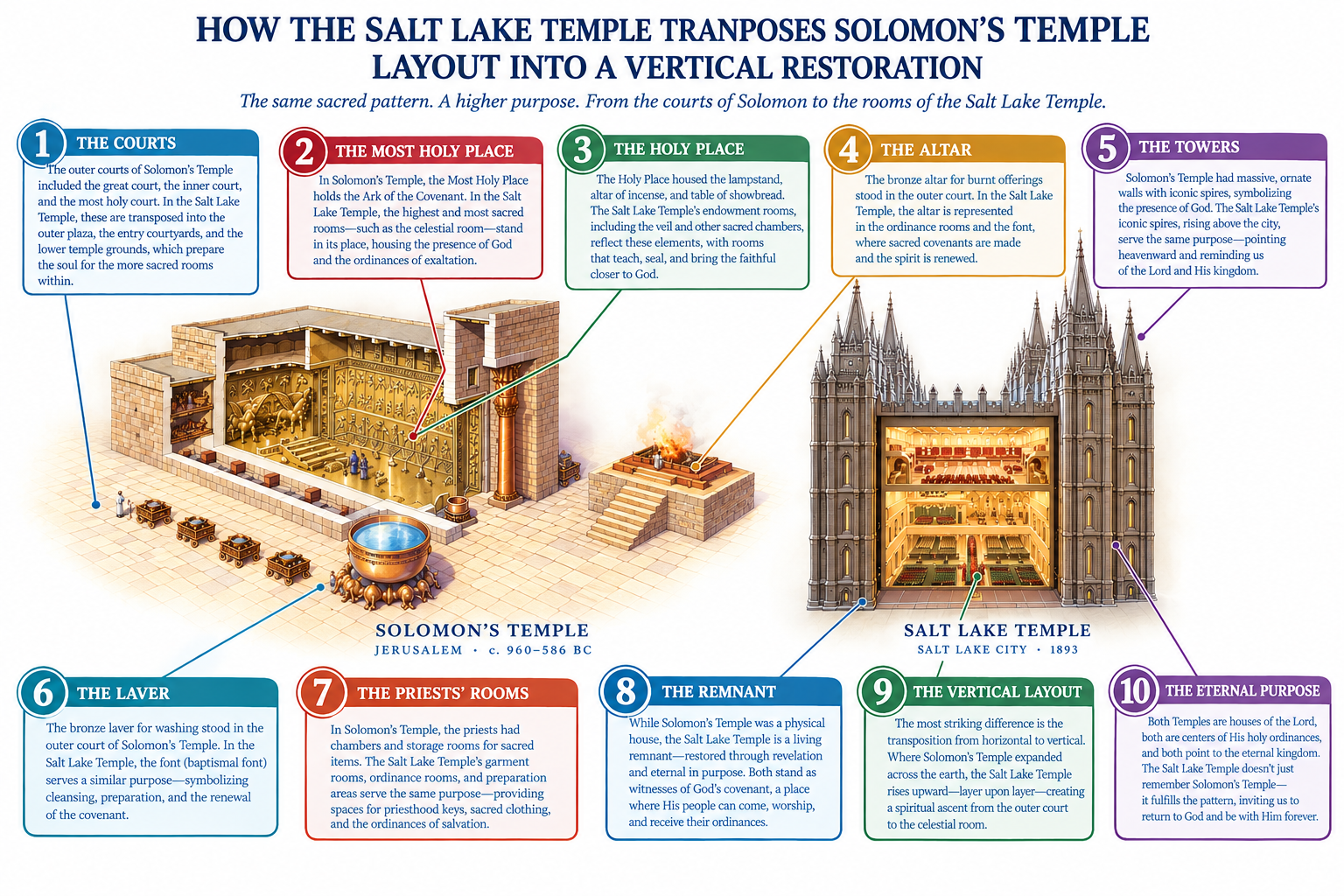
Floor 1: The Outer Court Transposed — Washing, Anointing, and Baptism
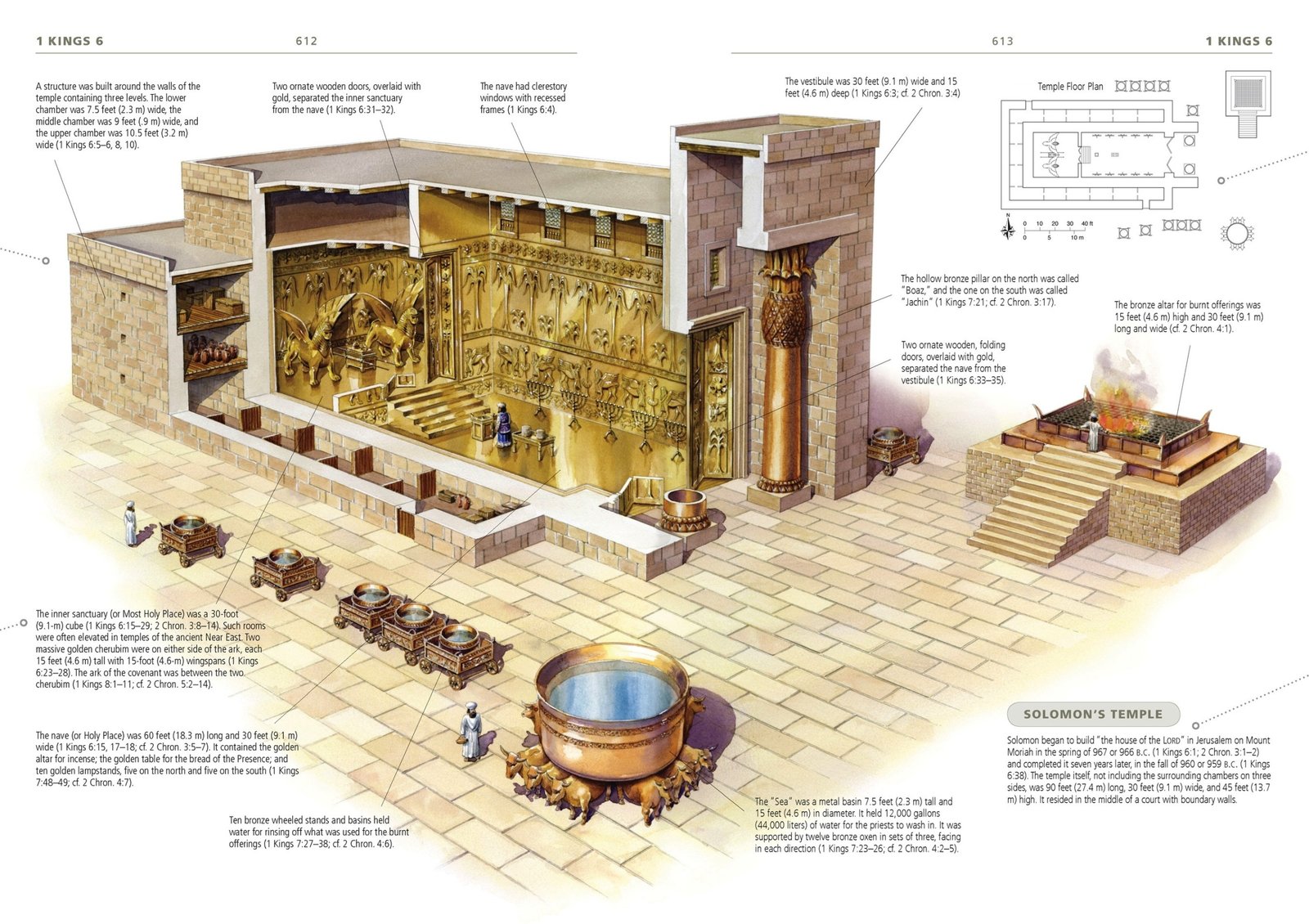
To understand the lower level of the Salt Lake Temple, one must first step into the Outer Court of Solomon’s Temple. Anciently, the outer precinct was defined by purification, sacrifice, and preparatory consecration before a priest could enter the sacred structure itself.
Solomon’s Temple (Horizontal):
[ Outer Court / Brazen Sea ] ──► [ Holy Place / Veils ] ──► [ Holy of Holies ]
Salt Lake Temple (Vertical):
[ Top Floor ] Assembly Hall (Church of the Firstborn)
▲
[ Floor 3 ] Celestial Room & Holy of Holies (Split Sacred Center)
▲
[ Floor 2 ] Initiatory & Endowment Rooms (The Holy Place)
▲
[ Floor 1 ] Baptistry & Washings (Solomon’s Outer Court / Brazen Sea)
In Solomon’s court stood two prominent features: the Altar of Burnt Offering and the Brazen Sea—a massive bronze basin resting on the backs of twelve oxen, accompanied by ten smaller mobile lavers (1 Kings 7:23–26). Here, Levite priests underwent ritual washings to cleanse away physical and ritual impurity, followed by consecrated anointings with sacred oil to sanctify them for divine service.
In the basement level of the Salt Lake Temple, this ancient outer court finds its direct modern counterpart:
- The Baptistry and the Twelve Oxen: Just like Solomon’s Brazen Sea, the Salt Lake Temple baptistry centers around a large baptismal font supported by twelve cast-iron or bronze oxen, representing the twelve tribes of Israel. However, the ordinance has evolved: where Solomon’s basin was used for the physical washing of living priests, the LDS font is used for vicarious baptisms for the dead—extending salvation retroactively to ancestors.
- Initiatory Rites (Washings and Anointings): Adjoining the lower level are sacred spaces dedicated to “Initiatory” ordinances. Scholars like Dr. Hugh Nibley have extensively documented how these modern Latter-day Saint ordinances directly reflect ancient Near Eastern and early Jewish royal/priestly initiations. In ancient Israel, Aaron and his sons were washed with water, anointed with consecrated olive oil, and clothed in holy garments (Exodus 40:12–15). In the Salt Lake Temple, LDS patrons undergo symbolic washings and anointings, followed by the bestowal of the temple garment, setting them apart as “priests and priestesses” ready to ascend to higher instruction.
- Confirmations & Sacramental Substitutes: Rather than animal sacrifice, the modern LDS temple substitutes the “sacrifice of a broken heart and a contrite spirit,” accompanied by the confirmation and bestowment of the Holy Ghost—the spiritual culmination of the lower-floor rites.
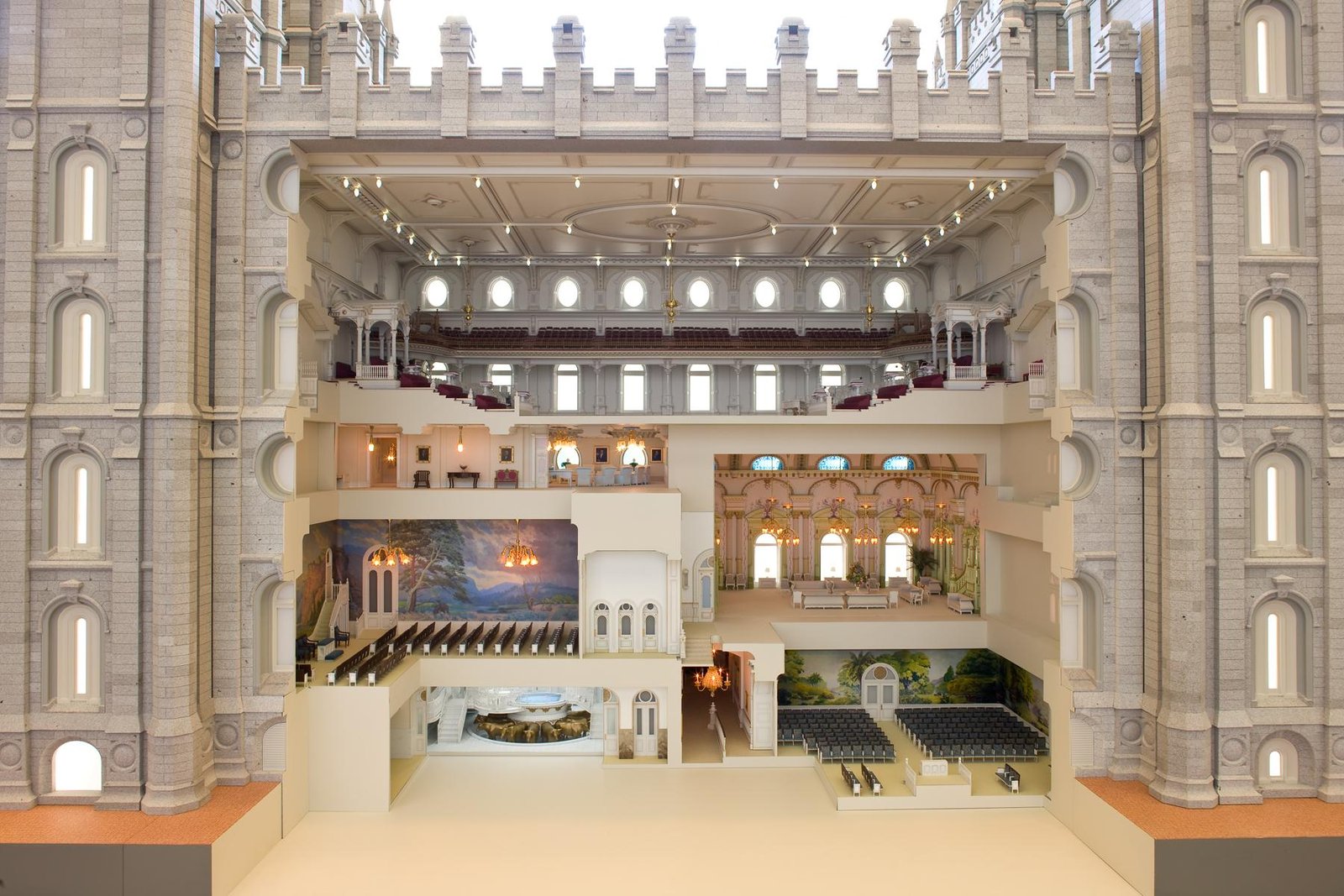
Floor 2: The Holy Place — The Endowment, Symbols, and the Veil
Ascending from the lower level to the middle floors, the patron leaves the “outer court” and steps into the equivalent of Solomon’s Holy Place (Hekhal). Anciently, this was an elongated hall accessible only to ordained priests. It contained three main sacred implements:
- The Shewbread Table: Representing the covenant, sustenance, and the twelve tribes.
- The Menorah: The seven-branched golden lampstand symbolizing divine light, wisdom, and the presence of the Shekinah.
- The Altar of Incense: Positioned directly in front of the inner veil, where sweet-smelling smoke ascended daily, representing the prayers of the saints rising to God (Psalm 141:2).
Hugh Nibley’s extensive comparative research into ancient Jewish liturgy, apocryphal literature, and the Egyptian Book of the Dead highlights that the Holy Place was fundamentally a space of preparatory instruction, covenant-making, and symbolic ascent. The priest entered this room to perform precise, prescribed gestures and prayers before approaching the veil that separated humanity from the throne of God.
In the Salt Lake Temple, these ancient implements and rites are transposed into the multi-stage Endowment ceremony:
- Instruction and Progression: Patrons move through progressive creation and instruction rooms (Creation, Garden, World, and Terrestrial Rooms). This journey parallels the light of the Menorah, guiding the initiate through increasing levels of spiritual illumination.
- Covenants and Prayer: The Shewbread and the Altar of Incense are mirrored in the modern LDS temple altar. Here, patrons make solemn covenants of obedience, consecration, and purity. Around these altars, patrons join in circle prayers—a practice Nibley frequently compared to ancient Christian and early Jewish prayer circles (apocryphal Acts of John)—offering up collective prayers right before the veil.
- The Veil of the Temple: At the conclusion of the instruction in the Terrestrial Room, patrons arrive at a physical veil. Just as the ancient Israelite priest had to pass the Altar of Incense and demonstrate ritual readiness at the woven veil of Solomon’s temple, the Latter-day Saint patron approaches the veil to demonstrate their knowledge of sacred tokens, names, and covenants before being admitted into the divine presence.
Floor 3: The Holy of Holies — Split into the Celestial Room and the LDS Holy of Holies
In Solomon’s Temple, the Holy of Holies (Kodesh HaKodashim) was a perfect cube, dark and silent, housing the Ark of the Covenant topped by the Mercy Seat. It represented the literal throne room of Yahweh. It was strictly off-limits to everyone except the High Priest, who entered only once a year on the Day of Atonement (Yom Kippur) through the veil.
The Salt Lake Temple makes a profound theological shift: it splits the functions of Solomon’s Holy of Holies into two distinct spaces.
Solomon’s Holy of Holies (Single Space)
├── Entered only by High Priest (Yom Kippur)
└── Housed Ark of the Covenant & Relics
│
▼ Transposed & Split
Salt Lake Temple Upper Level (Dual Spaces)
├── 1. The Celestial Room (Open to ALL endowed patrons)
│ └── Signals Christ opened the veil for all faithful saints.
└── 2. The LDS Holy of Holies (Restricted to Church President/High Priests)
└── Houses sacred altar; traditional site of modern sacred relics.
1. The Celestial Room: Heaven Opened to All
The primary space patrons enter after crossing the veil is the Celestial Room. Unlike Solomon’s dark, restricted inner sanctuary, the Celestial Room is brilliantly lit, beautifully appointed with chandeliers, mirrors, and fine furnishings, symbolizing the celestial kingdom of God.
By allowing all worthy Latter-day Saints who have made temple covenants to enter this room, LDS theology illustrates a core New Testament doctrine: through the atonement of Jesus Christ, the veil of the temple was rent in twain (Matthew 27:51). The divine presence is no longer restricted to a single solitary High Priest; heaven has been opened to every obedient follower who enters into the covenant. Here, patrons also perform eternal sealings (marriages), linking families forever in God’s presence.
2. The LDS Holy of Holies: Preserving the High Priestly Sanctuary
While the Celestial Room democratizes the divine presence, the Salt Lake Temple preserves the ancient high-priestly sanctuary through a dedicated Holy of Holies—a small, highly inner room adjoining the Celestial Room.
- The Sacred Altar: At the center of the LDS Holy of Holies sits an altar, corresponding directly to the Mercy Seat above the Ark of the Covenant. This room is reserved for the President of the Church (the presiding High Priest) and higher priesthood ordinances (such as the Second Anointing).
- The Repository of Sacred Relics: In Solomon’s day, the Ark of the Covenant contained Israel’s most sacred physical relics: the stone tablets of the Law, Aaron’s rod that budded, and a pot of manna (Hebrews 9:4). Latter-day Saint tradition and lore hold that the LDS Holy of Holies serves a similar repository function—housing key relics of the Restoration, such as the original manuscript of the Book of Mormon, early revelations, or sacred artifacts preserved from the Prophet Joseph Smith.
The Top Floor: The Assembly Hall and the New Testament “Church of the Firstborn”
If the first three levels of the Salt Lake Temple transpose and refine the Old Testament pattern of Solomon’s Temple, the upper-most floor adds an entirely new dimension drawn directly from New Testament theology.
Taking up the entire top floor of the Salt Lake Temple is the grand Priesthood Assembly Hall, complete with tiered pulpits at both the east and west ends representing the Melchizedek and Aaronic priesthoods.
──────────────────────────────────────────┐
│ PRIESTHOOD ASSEMBLY HALL │
│ (Top Floor – Mount Zion / Heavenly City)│
└──────────────────────────────────────────┘
▲
│
┌──────────────────────────────────────────┐ │
│ SOLOMON’S TEMPLE (OT) │ │
│ Outer Court ──► Holy Place ──► Holy of │───────────┘
│ (Veil) Holies │ (Extends OT Pattern into NT Eschatology)
This room represents the “General Assembly and Church of the Firstborn” described in Hebrews 12:22–23:
“But ye are come unto mount Sion, and unto the city of the living God, the heavenly Jerusalem, and to an innumerable company of angels, to the general assembly and church of the firstborn…”
In early Latter-day Saint theology, the “Church of the Firstborn” represents the exalted body of saints in heaven who have received the fullness of priesthood blessings. By building a grand assembly hall atop the temple, the architecture makes a powerful physical statement: the ultimate destination of the saint’s spiritual path is not merely individual entrance into the Celestial Room, but communal gatherers in the heavenly city.
The lower floors guide the individual step-by-step from the world (Outer Court), through instruction and covenants (Holy Place), to individual reconciliation with God (Holy of Holies). The top floor brings that redeemed individual into the collective council of the Priesthood—bringing the heavenly church down to earth, where God’s servants assemble to govern, instruct, and prepare the world for the Second Coming of Christ.
Conclusion
The Salt Lake Temple is a masterwork of comparative theology written in stone, wood, and glass. By taking the lateral, linear layout of Solomon’s ancient temple and folding it upward into a vertical structure, the early Latter-day Saints created a visual and physical allegory of spiritual ascent.
From the baptismal oxen in the basement to the veil in the middle floors, the split Holy of Holies, and the heavenly Assembly Hall at its peak, the Salt Lake Temple bridges the Old and New Testaments—translating ancient Levite rituals into modern Christian restorationism.
Direct Correspondences: Solomon’s Temple vs. Salt Lake City Temple
| Dimension / Aspect | Solomon’s Temple (Ancient Israel) | Salt Lake City Temple (LDS) |
| Spatial Axis | Lateral / Horizontal (Westward progression across one level) | Vertical / Multi-Story (Ascension upward across multiple floors) |
| Lower Precinct / Floor 1 | The Outer Court | The Basement / Baptistry Level |
| Water Vessel | The Brazen Sea (resting on 12 bronze oxen) | The Baptismal Font (resting on 12 oxen) |
| Purification Rites | Washing of Levite priests; animal sacrifices | Baptisms for the dead; Initiatory Washings & Anointings |
| Spiritual Focus | Cleansing of physical and ritual impurity | Cleansing from sin, personal consecration, ancestor redemption |
| Middle Section / Floor 2 | The Holy Place (Hekhal) | The Endowment / Instruction Rooms |
| Sacred Implements | Menorah (Light), Shewbread (Covenants), Altar of Incense (Prayer) | Temple Altars, Creation/Garden/World/Terrestrial Rooms |
| Rites & Progression | Priestly duties, incense offering, approaching the veil | Presentation of the Endowment, covenant-making, prayer circle |
| Boundary | Woven Veil separating Holy Place from Holy of Holies | The Temple Veil separating Terrestrial from Celestial Room |
| Upper Section / Floor 3 | The Holy of Holies (Kodesh HaKodashim) | Split into Two Spaces: |
| Public/Patron Space | None (Restricted strictly to the High Priest once a year) | The Celestial Room: Open to all endowed, covenant-keeping members (symbolizing Christ renting the veil) |
| High Priestly Sanctuary | The inner sanctuary housing the Ark of the Covenant | The LDS Holy of Holies: Restricted room for the Church President / High Priests |
| Sacred Contents | Tablets of Law, Aaron’s Rod, Pot of Manna (Inside Ark) | Sacred altar (Mercy Seat); historical LDS church relics |
| Top Floor / Celestial Peak | No direct OT equivalent (Extends into NT Eschatology) | The Priesthood Assembly Hall |
| Biblical Source | Inspired by Hebrews 12:22–23 | “General Assembly and Church of the Firstborn” |
| Symbolic Meaning | The divine throne room of Yahweh in heaven | The heavenly council of Saints brought to earth; priesthood governance |