
The Mentinah Archives & The Highland-Continental Model
The debate surrounding the geography of the Book of Mormon has historically been divided into two primary camps: the Mesoamerican model, which places the scriptural events in the jungles of southern Mexico and Guatemala, and the Heartland model, which locates them in the rivers and mounds of the American Midwest. Both models offer compelling archaeological insights, yet both often struggle to accommodate the full continental scale and the “sea to sea” migrations described within the text itself.
However, a revolutionary geographic framework known as the Highland-Continental Model has emerged. Grounded in extensive research, historical timelines, and archaeological correlations, this model is uniquely capable of reconciling the seemingly contradictory elements of Book of Mormon geography. Most importantly, it is the only geographical model that seamlessly aligns with the extraordinary historical and physical migrations detailed in The Mentinah Archives.
What are the Mentinah Archives?
The Mentinah Archives are the translated ancient records of the Nemenhah people, a group that originally branched off from the Nephite and Lamanite civilizations shortly before the birth of Christ. Discovered in the Wasatch Mountains of Utah between 1999 and 2001 by an elder of the Sahhatan nation, Phillip “Chief Cloudpiler” Landis, these records were preserved in stone boxes wrapped in pitch-sealed cedar bark. The physical collection consisted of hundreds of tiny metal plates, which were read using a perfectly carved crystal skull that acted as a natural magnifier.
According to the text, the Nemenhah were a diverse group of Nephites, Lamanites, and Ammonites who fled the corruption, war, and secret combinations of the “Land Southward” to establish a peaceful, egalitarian society based on the covenants of the Temple (or “High Place”) and the Law of Consecration. Their records trace their lineage from Zoram, Mulek, Aaron, and Judah, documenting their struggles and spiritual triumphs as they migrated throughout North America up until the mid-19th century.
The Highland-Continental Geography
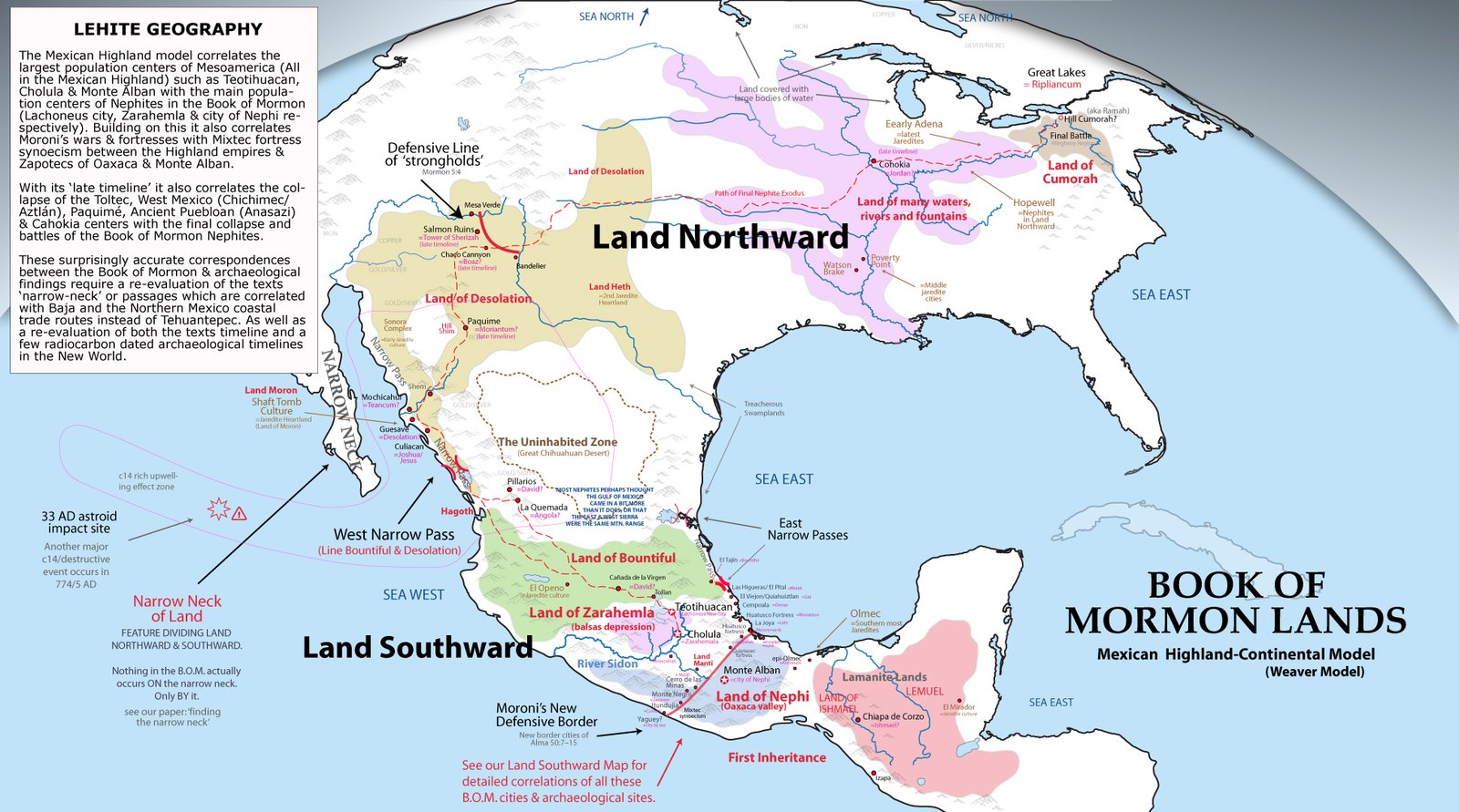
The brilliance of the Highland-Continental Model lies in its grand, continental scale. Unlike limited geography theories, this model proposes that the core Book of Mormon lands—including the Land of Nephi and Zarahemla—were located in south-central Mexico. Specifically, it correlates the towering mountaintop ruins of Monte Albán in Oaxaca with the City of Nephi, and aligns the massive, dominant empire of Teotihuacan with the peak of the Nephite civilization.
From this Mesoamerican core, the model identifies the vast, arid regions of northern Mexico, the American Southwest, and Utah as the scriptural Land of Desolation. Under this framework, “Desolation” is not a small neck of land, but an immense, barren frontier separating the high civilizations of the south from the wild, forested “Land Northward”.
This geographical layout explains a profound spiritual mystery: why the Latter-day Saints were led by prophecy to settle in Utah.
When the Mormon pioneers arrived in the Sanpete Valley of Utah in the mid-19th century, they were met by indigenous Paiute and Ute wisdom keepers who had been forewarned of their conquest in dreams. Recognizing Brigham Young as the predicted leader of the new faith, these chiefs attempted to consecrate their sacred, strictly guarded metal libraries to the United Order. Young, however, told them to seal the records back up, famously declaring, “We have not wherewith to translate these records”.
The dry, highly desiccating environment of the Sanpete Valley (which the Nemenhah called the Valley of Menintah, meaning “Place of Salt”) was spiritually and physically prepared to act as a preservation vault. The high salt content of the surrounding Redmond Salt mines kept the ancient mountain caves moisture-free, preventing the delicate copper-and-bronze alloy plates from corroding over the centuries
The Epic Migrations: From the Grand Canyon to the Great Lakes
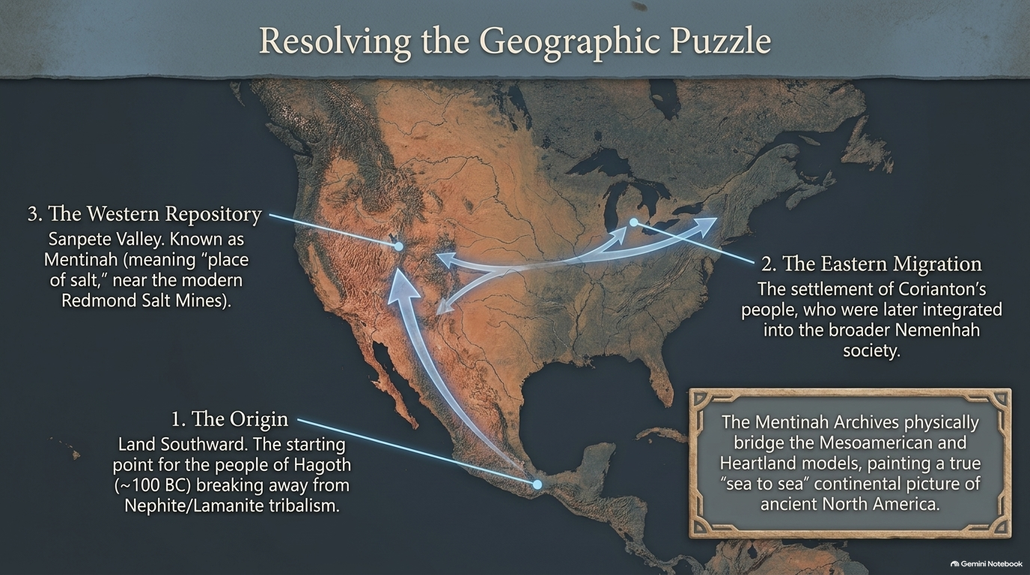
The Highland-Continental Model provides the perfect canvas for the great migrations recorded in the Mentinah Archives, showing how the descendants of Hagoth populated the North American continent.
1. Hagoth’s West Coast & Canyon Voyage
Around 55 B.C., a Zoramite shipbuilder named Hagoth (Hagot) built a fleet of massive wooden ships near Bountiful. Desiring to escape the toxic political climate of the south, he and a group of Ammonite Lamanites set sail up the West Sea (the Pacific coast / Gulf of California). Running low on provisions, they disembarked at the barren mouth of the Colorado River. Hagoth and a small party built oar-propelled boats to explore inland, navigating up the muddy Colorado River (which they called the River Akish, meaning “red earth”).
They traversed the colossal, sheer precipices of the Grand Canyon of Arizona, suffering from fevers and hunger, before emerging into the rich, forested mountains of the Four Corners region, where they founded their first settlements. To escape rising Gadianton combinations, they eventually retreated north and west into the Sanpete Valley (Menintah), closing all roads to the Land Southward and utilizing the natural canyon defiles as defensive bulwarks.
2. Corianton’s Northeast Migration to the Great Lakes
The archives also detail the fate of Corianton (the son of the Prophet Alma) and his wife Isabel, who fled the Land Southward forever. Moving far to the northeast, Corianton’s group settled in the Great Lakes and Hudson Bay region, where they conjoined with northern woodland tribes. Because of the bitter northern winters, Corianton’s people developed a unique, highly insulated architectural style, building houses with timber frameworks, inner walls of thick bark cloth, and exterior shells of cement as thick as an outstretched hand. High Priest Hementah and his family later made a massive trek across the Great Plains to visit Corianton’s beautiful city, cementing a cultural alliance between the mountain and lake populations.
3. The Eastern Exodus to Missouri (Minisourit)
Over the centuries, as the climate shifted and the Nemenhah faced rising internal apostasy and external Gadianton combination raids, many Nemenhah abandoned the Sanpete Valley. Families led by the seers Winet and Momet migrated eastward across the Great Plains to the forests of the mighty Mississippi River (Misisip). There, they built the settlement of Minisourit (modern-day Missouri). They constructed earthworks and massive defensive mounds, utilizing ancient Jaredite foundations and preserving their sacred plates beneath the floors of their High Places.
Transoceanic Visitors and the Frankish Lineage
By mapping Book of Mormon geography on a continental scale, the Highland-Continental Model also illuminates the Archives’ accounts of visitors from across both oceans. It documents the arrival of Fua Tzen (Fuazen), an oriental sage who sailed across the West Sea to Mentinah. Though Fuazen initially taught the practice of polygamy, he humbly accepted the Nemenhah temple teachings and returned across the Pacific to establish a peaceful, structurally similar religion among his own people.
Most astonishingly, the Archives record a visitation by Nephi, the translated disciple of Christ, to the Nemenhah of Minisourit. Nephi presented a sacred vellum epistle from Queen Batilde of Gaul (Galium), the wife of King Clovis, ruler of the Frankish kingdom across the East Sea. This royal genealogy traced the lineage of King Clovis directly back to Josephes, the son of Jesus Christ and Mary Magdalene.
Only a continental model can tie together Oaxacan ruins, Southwestern desert sanctuaries, Great Lakes civilizations, and transoceanic contacts into a single, cohesive, and historically verifiable canvas. The Mentinah Archives stand as a voice crying from the dust of the Wasatch hills, testifying that the geography of God’s covenant people was never a localized footnote, but a grand, continental saga
Outline of Geographic Travels in the Mentinah Archives
- Hagoth’s Sea Voyage and Canyon Trek
- Starting Point & Preparation: Following the death of Captain Moroni, Hagoth built a massive ship after the pattern of Nephi’s ship at Bountiful near the Isthmus.
- West Sea Voyage: Many Nephites boarded and sailed northward into the West Sea, passing the Land Desolate and disembarking at the mouth of a barren, great river.
- Command to Provision: Shiblon commanded Hagoth to build a fleet of ships to send provisions and families to the Land Northward via both the West and East Seas. Hagoth took his family and a group of Ammonite Lamanites up the West Sea route.
- The Canyon Passage: Traveling inland up the great river, they encountered vast canyons with incredibly steep, towering precipices far higher than Nephite temples.
- Hardships: The party suffered intensely from extreme heat, lack of wild game, and severe fevers caused by drinking the muddy, unpotable river water.
- Settlement: After many days, they emerged from the precipitous canyons into a rich, mountainous land filled with rivers, plants, and forests. They established their first settlements in the Four Corners region and built the city of Hagoth.
- Citation: The Book of Hagoth, Chapter 1 (verses 1–18).
- The Migration of the Nemenhah to the Valley of Menintah
- Division of the People: Due to the rising threat of Gadianton robbers, the Nemenhah divided into two bodies: one led by Hagoth and the other by the healer Hementah.
- The Mountain Journey: Hagoth’s group traveled north and west along mountain trails to find a secure homeland.
- Establishing the Fastness: They settled in a protected valley they named Menintah (meaning “Place of Salt” due to the high salt content in the southern part of the valley).
- Defensive Geography: The valley was a natural mountain fortress, accessible only through a narrow canyon in the south, a narrow canyon in the west, and an extremely narrow defile in the north. They closed all roads to the Land Southward to shut out Gadianton combinations.
- Discovery of Jaredite Tombs: While searching for building stone, they discovered ancient cave tombs of the Jaredites in the mountains of this valley, utilizing them to store their metal records.
- Citation: The Book of Hagoth, Chapter 1 (verses 37–40), The Book of Hagmeni, Chapter 1 (verse 5), and The Record of Sahnempet (verses 2, 7).
- The Northeast Journey to the Great Lakes and the City of Corianton
- Plains Expedition: Hementah, Pa-Hementem, and Shi-Tugohah made a massive journey northeastward across the Great Plains.
- Northeast Wilderness: They traveled far into the cold North Country, characterized by dense forests, streams, and massive lakes.
- Discovery of Corianton’s City: They arrived at the beautiful city of Corianton, which was established by Alma’s son Corianton and his wife Isabel after they fled the Land Southward forever.
- Climate Adaptation: Because of the extremely cold winter climate, the houses in this city were constructed with wood frameworks and inner walls of thick bark cloth, covered in layers of cement as thick as a man’s outstretched hand.
- Cultural Exchange: The travelers studied this insulated architecture and shared their sacred Ammonite sweatlodge purification rituals with Corianton’s people.
- Citation: The First Book of Shi-Muel, Chapters 6 and 7 and The Second Book of Shi-Muel, Chapters 1 and 2.
- The Mission to the Land Southward along the East Coast
- Call to Preach: The sons and daughters of Sahnempet (Sanhagot, Shigath, Shimnet, Hempapet, Him-pah-neth, and Pa-Akim) were called to preach repentance in the wicked cities of the south.
- Desert Transit: They traveled south on foot, bypassing the great canyons on the east, and crossed a rugged desert before turning east toward the East Sea gulf.
- Tamahualip: They arrived at Tamahualip, a city of friendly Tamahu-Ah fisher folk, who transported the missionaries down the coast in boats, allowing them to bypass the Land of Desolation.
- Preaching in the South: They landed on the east side of the Land Southward to preach in the heavily corrupted cities of Laman, Josh, Gad, and Kishkumen.
- Return Journey: Following their volatile missions, the party returned to the Land Northward accompanied by 81 Lamanite and Nephite converts (52 men, 17 women, and 12 children).
- Citation: The First Book of Pa Natan, Chapters 1, 2, and 7.
- Visitors from Across the Sea
- Fua Tzen (Fuazen): A traveler and sage who sailed across the West Sea to Mentinah. He initially taught the practice of polygamy, but after learning Nemenhah temple teachings and receiving confirmation from the Holy Ghost, he accepted correction. He returned across the sea to teach his people, establishing a new religion structurally similar to Nemenhah.
- Citation: The Book of Manti, Chapters 3 and 4.
- The Clovis Genealogy: Nephi, the immortal disciple of Christ, visited the Nemenhah of Minisourit. He presented a sacred velum containing an epistle from Queen Batilde, wife of King Clovis of the Frankish kingdom in the distant land of Galium (Gaul) across the East Sea. The epistle detailed the royal lineage of Clovis, declaring that their line descended directly from Josephes, the son of Jesus Christ and Mary Magdalene.
- Citation: The Book of Momet Akekt, Chapters 2 and 3.
- Fua Tzen (Fuazen): A traveler and sage who sailed across the West Sea to Mentinah. He initially taught the practice of polygamy, but after learning Nemenhah temple teachings and receiving confirmation from the Holy Ghost, he accepted correction. He returned across the sea to teach his people, establishing a new religion structurally similar to Nemenhah.
Summary Table of Geographic Travels in the Mentinah Archives
| Travel Event / Group | Geographic Starting Point & Destination | Key Geographic Landmarks & Transit Methods | Primary Figures / Historical Impact | Textual Citation (Book & Chapter) |
|---|---|---|---|---|
| Hagoth’s Canyon Voyage | Start: Bountiful (Land Southward) Destination: Mountainous Land Northward (Four Corners region) | West Sea, mouth of great river, massive canyons with towering precipices. Transit via large wooden ships and boats. | Hagoth, Hagmeni, Cumenihah, Hementah. Established the Nemenhah nation (“The People”). | Book of Hagoth, Chapter 1 |
| The Valley of Menintah Migration | Start: First settlements of Hagoth (Colorado region) Destination: Valley of Menintah (Sanpete Valley, Utah) | River Akish, northern mountain trails. Enclosed valley accessible only by narrow southern/western canyons and a northern defile. | Hagoth, Hementah. Founded the capital city of Mentinah; stored metal records in dry, ancient Jaredite cave tombs. | Book of Hagoth, Chapter 1 & Book of Hagmeni, Chapter 1 |
| Northeast Plains Journey | Start: Principal Nemenhah settlements (Menintah Valley) Destination: Northeast Forest/Lakes Country (Great Lakes/Hudson Bay area) | Great Plains, dense northern forests, streams, and lakes. Transit via foot and pack animal. | Hementah, Pa-Hementem, Shi-Tugohah. Met Corianton and Isabel; adopted insulated bark-cloth/cement building styles and sweatlodge ceremonies. | First Book of Shi-Muel, Chapters 6 & 7 |
| Southern Mission along East Sea | Start: Valley of Menintah (Land Northward) Destination: East side of Land Southward (Zarahemlah border) | Great canyons, vast desert, East Sea (gulf), Tamahualip. Transit via foot, then Tamahu-Ah fishing boats down the coast. | Sanhagot, Shigath, Shimnet, Hempapet, Him-pah-neth, Pa-Akim. Preached in Laman, Josh, Gad, and Kishkumen; returned with 81 converts. | First Book of Pa Natan, Chapters 1, 2 & 7 |
| Visitors Across the Sea (Chinese & Clovis) | Start: West Sea lands (Orient) & Frankish kingdom of Galium (Gaul) across the East Sea Destination: Mentinah & Minisourit | Oceans, West Sea, East Sea, Misisip River. Transit via ocean sailing ships, then foot travel by Nephi. | Fua Tzen (Fuazen); Nephi, Queen Batilde, King Clovis. Fua Tzen renounced polygamy. Nephi delivered the Clovis royal lineage tracing back to Josephes, son of Jesus and Mary Magdalene. | Book of Manti, Chapters 3 & 4 & Book of Momet Akekt, Chapters 2 & 3 |
Native American Folklore and the Story of the Fish
The story of the giant fish in The Book of Hagoth—where a large river fish intervenes in a moment of life-or-death river travel, provides meat and medicinal entrails, and is commemorated annually during the “telling of the heroes”—shares striking parallels with several traditional Native American legends and oral histories across North America.
In Native American folklore, the Giant Fish (often a Giant Sturgeon, Catfish, or River Monster) appears in three major cultural regions:
1. The Columbia Plateau & Nez Perce (Nimiipuu) Oral Traditions
In the Pacific Northwest and Columbia River Basin—the very region associated with the Numi’Pu (Nez Perce) mentioned in the Mentinah Archives’ forewords—there are prominent legends involving swallowed or saved travelers in river canyons:
- Coyote and the Monster (Iceye’ye): In Nez Perce tradition, a legendary monster in the Salmon and Clearwater River canyons swallowed the animal peoples. The hero Coyote (Iceye’ye) deliberately went down the monster’s throat with flint fire tools and stone knives. Inside the stomach, he cut fat from the monster’s heart to feed the trapped, starving people, lit a fire to warm them, and cut through the monster’s side to set everyone free.
- Coyote and Wishpoosh (The Great River Monster): In Columbia River / Plateau legend, Coyote fought a giant water monster down the Columbia River gorge. After being swallowed, Coyote used a knife inside the creature’s stomach to cut its sinews, killing the beast and bringing its body ashore to feed and create the tribes of the region.
2. Great Lakes & Woodland Traditions (Ojibwe, Menominee, Anishinaabe)
In the Great Lakes and Eastern Woodlands, the Lake Sturgeon (Mashe-Namak or Maeci-Namaeq, literally “Big Sturgeon” or “Great Fish”) is revered as both a sacred life-giver and a formidable spirit of the deep waters:
- Mashe-Namak (The Big Sturgeon): In Menominee and Ojibwe mythology, Mashe-Namak is a giant fish monster living in deep rivers and lakes. In the classic tale, the culture hero Nanabozho paddles his canoe down the river to confront the giant sturgeon. The fish swallows Nanabozho and his canoe whole. Inside the stomach of the giant fish, Nanabozho discovers other trapped creatures and people, and uses his wisdom, fire, and medicine to cut through the fish and rescue them.
- Commemorative Ceremonies: Great Lakes tribes held annual sacred rites honoring the Big Sturgeon as the “King of Fish,” recognizing it as a savior species that provided oil, heavy meat, and life-saving nourishment during harsh winters when other game was scarce.
3. Southeastern Woodland Traditions (Cherokee)
- The Dakwa (The Giant Fish of the Tennessee River): The Cherokee preserve a legend of the Dakwa, a monstrous fish dwelling at the mouth of Toco Creek. The Dakwa capsized a hunter’s canoe and swallowed the warrior whole. Inside the dark stomach, the hunter found sharp mussel shells and used them to cut his way through the fish’s stomach wall. The thrashing fish swam into shallow water near the riverbank, allowing the hunter to escape alive to his village, where he was celebrated as a hero.
Summary of Common Folklore Motifs
Folklore scholars identify these stories under universal indigenous motifs:
- The “Jonah” / Swallowed Hero Motif: A traveler or culture hero enters a giant water creature’s belly, finds sustenance or medicine inside, and emerges to save the people.
- The Medicine Fish: Giant fish (particularly sturgeon and salmon) are viewed as sacred beings whose meat, oil, and internal organs contain potent medicine and life-saving nutrients provided by the Creator in times of extreme physical distress.
CHIASMIS OF THE Book of Mormon Narrative in relation to Utah/USA/MINTENAH RECORD?
-Nephi settles in Mesoamerica & create greatest Zion empire on the Continent.
—Nephites are driven into USA area of North America/the Land Northward (mixing with natives) where they are eventually destroyed.
—Gentiles restore Christianity, as they settle in USA area of North America/ the Land Northward, mixing with natives.
-Gentiles are driven into Mesoamerica to once again create greatest Zion empire.
Read it.

I’ve followed your work for a few years and am fascinated by how your mind can take in so much information! I have a deep love for the Sacred Record of the Nemenhah. I am LDS, and I’ve been studying it for two years, and it has had a deep impact on me spiritually. Unfortunately, there are not many people who have truly read it so that you can have a meaningful discussion.
I tried to be a skeptic, but the Spirit kept showing me over and over that this record was real. Of course, there are a few things that are hard for me to wrap my mind around, but I hope to come to a deeper understanding about it at a later time.
You have left a beautiful outline of the structure, but I have one question that I haven’t been able to answer. I was hoping you might have an opinion.
How does Moroni, finding the Jaredite record in the Mentinah Library, fit with Ether 1: 1–2 and Ether 15:33?
If the records found by Limhi’s people were in Sanpete (the Land of Desolation), that is where the great battle must have taken place, because they saw bones scattered everywhere. How do you bridge the gap between Sanpete and Cumorah?
Thanks Letitia. If we are to believe the Mentinah record, I believe what it suggests is NOT that Sanpete is where the final battle occurred NOR that Moroni found the book of Ether in the Sanpete libraries.
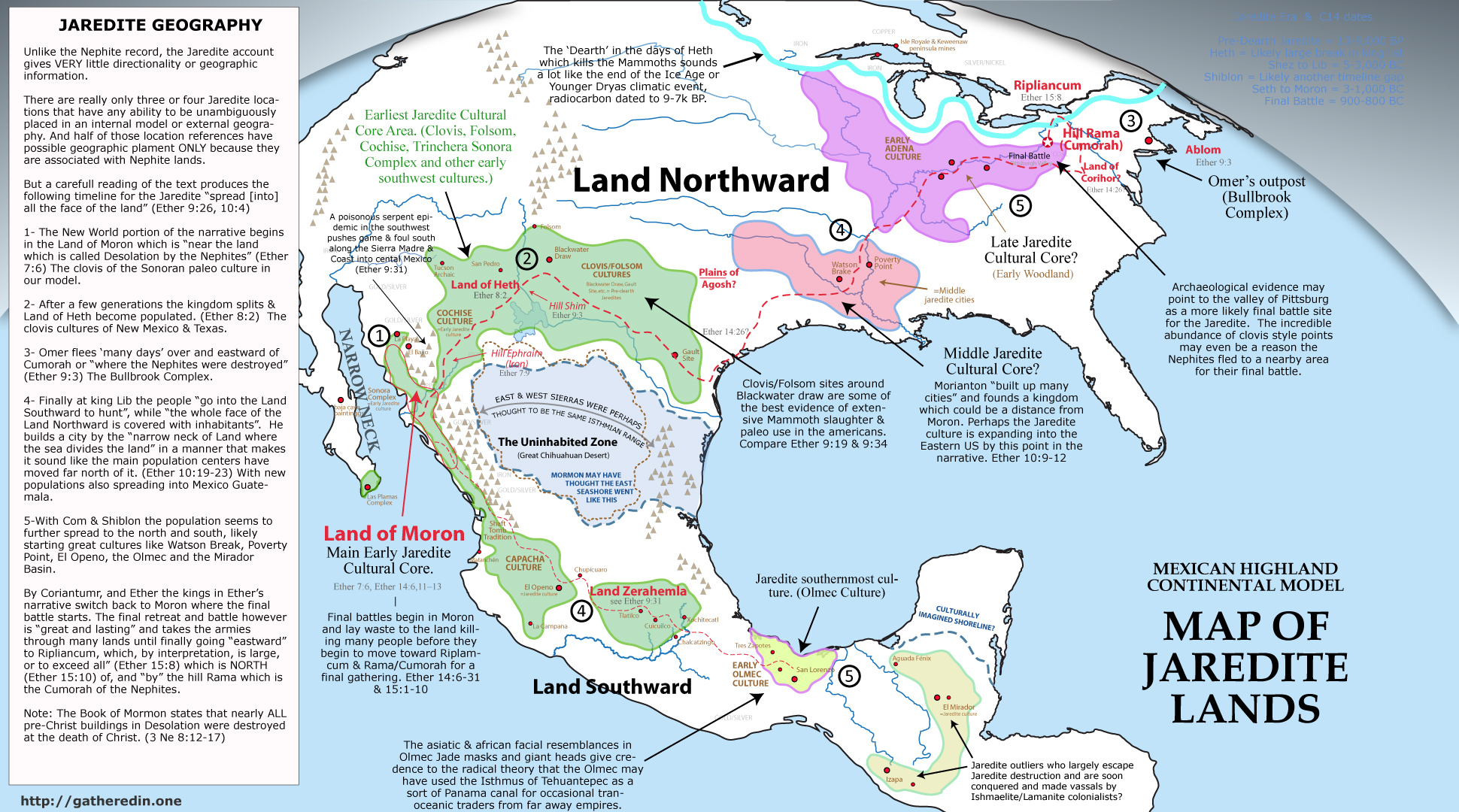
These are all different places. 🙂 (I’ve added some maps to clarify this)
The Book of Mormon is clear that the final battle started in Moron, the part of the Land Desolation which was by the West Sea (see Ether 7:6 with Mormon 3:7–8, Mormon 4:3–8), it then stretched to (and was finished in) Cumorah. (see Ether 9:3) I believe this is CLEARLY the same hill/land Joseph found the plates in, in New England. (D&C 128:20)
So Moroni found OTHER Jaredite records in Sanpete, ones not in the Book of Mormon. Likewise the book of Ether is an abridgement of the plates fround by the people of Limhi’s search party, and we don’t know where those were found. We can’t even be sure it was in desolation.
I think its quite likely that the mummies found in Burrows cave were Jaredite. And that the Nephites found a number of record vaults in San Pete which they then added to (this is what the record says if I remember right). All of these are seperate and differnt from the 24 plates the Book of Ether came from, and in a fully seperate land from Cumorah or Moron or the main heart of Desolation (which I believe was near Mazatlan, but the LAND desolation stretched from Northern Mexico all the way into the Plains of the Midwest).