
Three Churches in ONE. The Trinitarian Nature of the Church
The following article explores a nuanced perspective on the structure of the LDS Church and all religious organizations, suggesting that what appears to be a single institution is, in reality, three distinct spiritual “churches” existing simultaneously.
The Hidden Triad: Three Distinct Churches Within the One
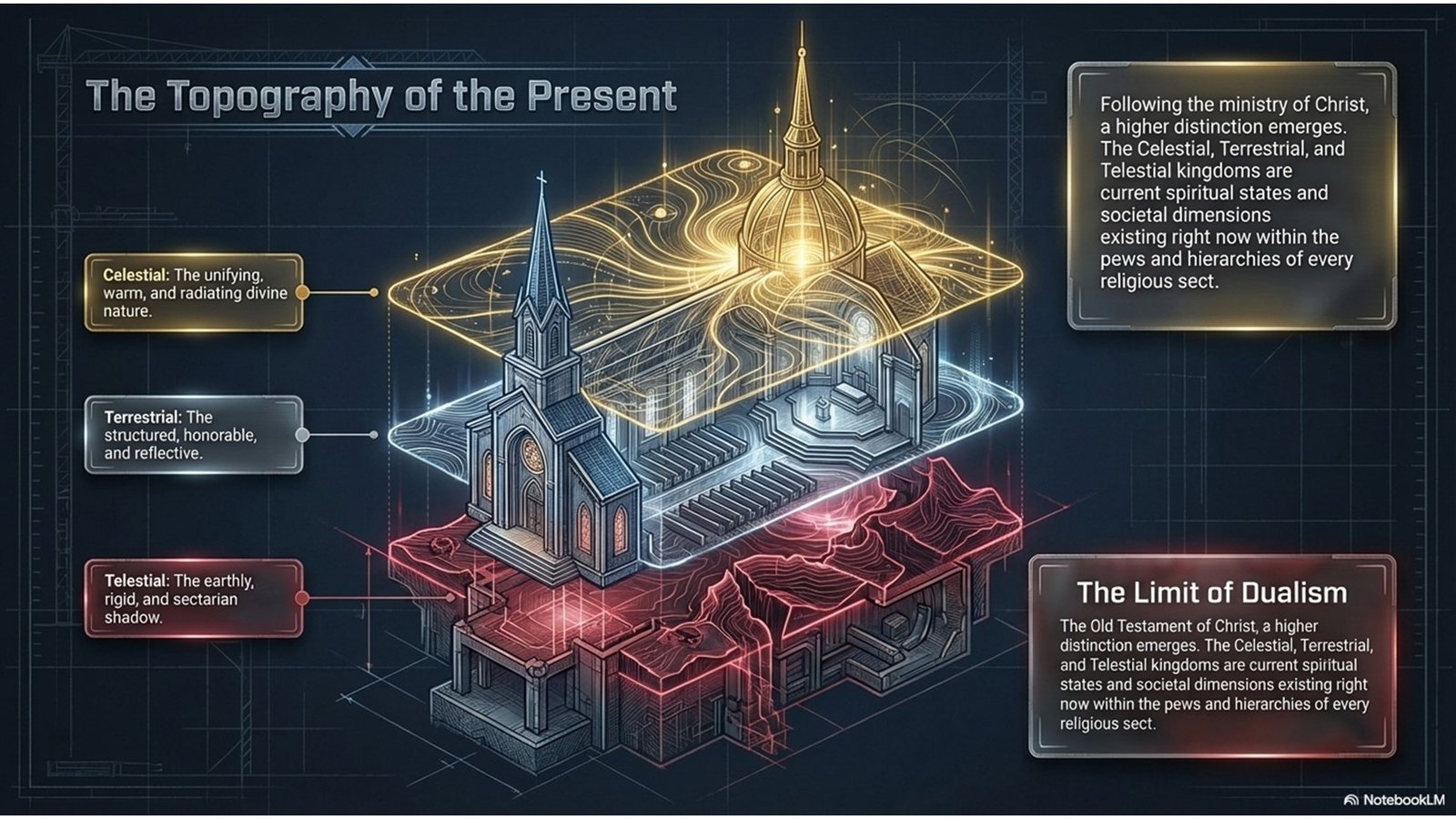
While casual observers and many adherents see the Church as a monolithic organization defined by its leadership and ordinances, the scriptures reveal a far more complex spiritual topography. Throughout religious history, the divisions of humanity have often been presented in dualistic terms—Heaven and Hell, the saved and the damned, or the wheat and the tares. This binary perspective, prevalent in the Old Testament and much of the Book of Mormon, serves as a necessary foundation for moral polarization. However, following the ministry of Christ and the subsequent revelations of the Restoration, a third, higher distinction emerges.
Just as the Apostle Paul spoke of the “third heaven” and identified three distinct glories in the afterlife—symbolized by the sun, the moon, and the stars—so too are there three distinct churches within the Church: the Celestial, the Terrestrial, and the Telestial. These are not merely future destinations in the afterlife but are current spiritual states and “societal dimensions” that exist right now within the pews and hierarchies of every religious sect.
Reconciling the “Doing” and the “Confessing”
A central tension in Christian theology exists between the words of Christ, who stated that “only those who DO the father’s will will be saved,” and the words of Paul, who suggested that salvation comes to all who “confess Christ.” This apparent contradiction is reconciled through the lens of these three churches.
Scripture suggests that the “confession” of Christ is the entry point into the spiritual system—it is the “Light of Christ” or the divine conscience that illuminates every soul entering the world. This light teaches the “law of Christ” (the law of love) to all sentient beings, regardless of their religious labels. However, “doing” the Father’s will is what determines the “glory” or degree of spiritual nature one ultimately inherits.
The sources argue that God judges all people “according to their works, according to the desire of their hearts”. Therefore, the three churches represent three levels of obedience to this divine nature: those who reject it while professing it (the Tares), those who serve it as a matter of duty (the Wheat), and those who become one with it (the Bread of Life).
1. The Telestial Church: The Tares and the Pharisees
The first church within the organization is the Telestial Church, comprised of what the scriptures call “the tares”. This group is unique because it exists at every level of the organization, including the very top. Like the Pharisees of Christ’s day, these individuals often possess the outward “priesthood” and are the most vocal in their “orthodoxy,” yet they do not truly know the God they profess.
The Telestial mindset is defined by sectarianism and pride. These are they who say they are “of Paul, and of Apollos, and of Cephas,” or in a modern context, they who derive their spiritual identity from their loyalty to specific leaders or “only true church” claims rather than the Spirit of the Gospel. Because they prioritize the “dead works” of outward ordinances and sectarian division over the “law of love,” they are described as those who “crucify Christ afresh” and put Him to an open shame.
In this church, religion is used as a tool for control and “unrighteous dominion”. They are the “captives” of false traditions who, despite having access to the Light, “choose darkness” and create “hells” out of their religious societies.
2. The Terrestrial Church: The Wheat and the Servants
The second church is the Terrestrial Church, represented by “the wheat”. These are the honorable, good-hearted people of the earth who strive to live the law as they understand it. In the spiritual hierarchy, they are “partially saved” in that they inhabit a “heaven-like state” of peace and civility, yet they lack the “fullness of glory”.
The inhabitants of the Terrestrial Church exist within the kingdom as servants. They receive the “presence of the Son, but not the fullness of the Father”. They are working toward perfection, often through the “schoolmaster” of religious law and ordinances, but they have not yet achieved the “unity of faith” required to see God “as He is”. They are the “just men” who are in the process of being “made perfect,” but they still see “through a glass darkly,” relying on the “letter of the law” rather than the “Spirit which gives life”.
3. The Celestial Church: The Bread of Life and the Sons of God
The third and highest distinction is the Celestial Church, also known as the “Church of the Firstborn”. This is not merely a group of “wheat” separated from the “tares,” but a group that has been transformed into the “bread of life itself” [Prompt]. These are the individuals who have “partaken of the divine nature,” obeying God’s voice with all their hearts until they have become “sons and heirs of God”.
The Celestial Church is composed of “spirits of just men made perfect” who have overcome all things through Jesus. They no longer see through a glass darkly; they have become like Him and “see him as he is” [Prompt]. These are the co-creators with God and the “saviors on Mount Zion” [Prompt]. They do not follow the law because of a “written code” but because the law has been written on the “fleshy tablets of their hearts”.
In this church, the “only true church” doctrine is understood not as an exclusivist claim, but as a state of perfect unity and unconditional love. They have achieved a “fullness of glory” where there is no more dualism, only “one glorified nature”.
The Necessity of the Three Growing Together
The scriptures teach that these three churches—the Tares, the Wheat, and the Bread—must “grow together” within the same organization until the “harvest”. This arrangement is not an accident but is intelligently designed to accelerate spiritual growth.
By pairing the “wheat” (those learning love) with the “tares” (those obsessed with control), God provides a “turbo-boosted” environment for progression. The Wheat learn patience, forgiveness, and unconditional love by dealing with the pride and manipulation of the Tares. Meanwhile, the Tares are given a constant example of Christ-like service that might eventually lead them to repentance.
Finally, the “Bread”—the Sons of God—act as the “welding link” that eventually gathers all things into one. They understand that while the earthly church is a “schoolmaster” and an “idol” built by human hands to represent the divine, the true “Church of God” transcends all organizational lines. It is the spiritual assembly of all who “repent and come unto Christ”.
Conclusion: Toward the One True Church
In conclusion, the “Only True Church” is not a specific denomination, but a heavenly reality that earthly organizations are commanded to align with. Within our current mortal congregations, we find the Tares who prioritize power, the Wheat who prioritize service, and the Bread who prioritize divine unity.
The ultimate goal of religion is to transform the “Tares” into “Wheat” and the “Wheat” into the “Bread of Life,” until all are gathered together in one. Only when we lose our pride and our desire to be “right” or “exclusive” can we truly join the “Church of the Firstborn” and see God as He is—not through a glass darkly, but face to face.
